Contents
- 1 How to Evaluate the Best Mutual Funds for Long Term in India 2026
- 2 Best Mutual Funds for Long Term in India 2026 — Category by Category
- 2.1 Index Funds — Best Starting Point for Most Long-Term Investors
- 2.2 Flexi Cap Funds — Best Actively Managed Long-Term Category
- 2.3 Mid Cap Funds — Best for Aggressive Long-Term Growth
- 2.4 Small Cap Funds — Highest Long-Term Returns, Highest Volatility
- 2.5 Large Cap Funds — Stable Core Holding
- 2.6 Hybrid and Multi-Asset Funds — For Conservative Long-Term Investors
- 3 Building a Portfolio With the Best Mutual Funds for Long Term in India 2026
- 4 Mutual Fund Taxation in India 2026 — What You Must Know
- 5 Direct vs Regular Mutual Fund Plans — Always Choose Direct
- 6 Common Mistakes When Choosing Mutual Funds for Long Term in India
- 7 Conclusion — Start With Index Funds, Add Category Diversity Over Time
- 8 Frequently Asked Questions
- 8.1 Which is the best mutual fund for long term investment in India in 2026?
- 8.2 How long should I stay invested in mutual funds in India?
- 8.3 Should I invest in a direct plan or regular plan mutual fund in India?
- 8.4 How many mutual funds should I have in my portfolio?
- 8.5 What is the minimum amount to start investing in mutual funds in India in 2026?
- 8.6 Are mutual funds safe in India in 2026?
Choosing the best mutual funds for long term in India 2026 is one of the highest-impact financial decisions a working Indian can make. India’s mutual fund industry has crossed ₹65 lakh crore in Assets Under Management in 2026, reflecting how mainstream this investment avenue has become. Yet most investors either pick funds randomly based on recent 1-year returns — one of the worst selection criteria possible — or stick to the same funds they started with years ago without reviewing whether better options now exist.
The best mutual funds for long term in India 2026 are not necessarily the ones with the highest returns over the past year. Short-term return rankings change dramatically from year to year based on which sectors happen to be in favour. A fund that tops the 1-year return chart in 2025 may be average in 2026 and 2027. The funds that consistently build wealth for long-term investors are the ones with strong 5-year and 10-year track records, low expense ratios, disciplined fund manager behaviour through multiple market cycles, and portfolio quality that does not change dramatically with market trends.
This complete guide on the best mutual funds for long term in India 2026 covers every major category — index funds, large cap, mid cap, small cap, flexi cap, and hybrid — with specific fund recommendations based on actual performance data through May-June 2026, and a practical framework for building a diversified long-term mutual fund portfolio based on your age, risk tolerance, and investment horizon.
How to Evaluate the Best Mutual Funds for Long Term in India 2026
Before listing specific funds, understanding what separates a genuinely good long-term fund from a temporarily popular one prevents expensive mistakes:
1. Look at 5-Year and 10-Year Returns, Not 1-Year
One-year returns are almost meaningless for long-term fund selection. A sector or thematic fund that happened to be in a hot sector can show 60% to 80% one-year returns while being fundamentally risky for long-term holding. Always evaluate funds on their 5-year and 10-year Compound Annual Growth Rate (CAGR), which smooths out short-term volatility and shows how the fund has performed across different market phases.
2. Expense Ratio
The expense ratio is the annual fee charged by the fund house as a percentage of assets — deducted from your returns automatically. On ₹10 lakh invested for 20 years, the difference between a 0.20% expense ratio fund and a 1.50% expense ratio fund is approximately ₹8 to ₹10 lakh in final corpus — purely from the fee difference. Always prefer direct plan mutual funds over regular plans, and compare expense ratios within the same category before choosing between similarly performing funds.
3. Fund Manager Consistency
A fund with excellent 10-year returns may have had a different fund manager for most of that period. Check how long the current fund manager has been managing the fund. For actively managed funds, a fund manager change is a meaningful event that warrants reassessment — the historical return was generated by a different person’s decisions.
4. Portfolio Concentration and Turnover
Funds with very high portfolio turnover (buying and selling stocks frequently) tend to generate higher transaction costs and tax drag. Funds with excessive concentration in a few stocks (top 5 holdings above 40% to 50% of the portfolio) carry higher single-stock risk. Check both metrics on screener.in or valueresearchonline.com before selecting.
5. Consistency Across Multiple Years
The best long-term mutual funds for India 2026 are not the ones that rank No. 1 in their category every year — they are the ones that consistently rank in the top quartile or top half of their category across multiple 3-year rolling periods. Value Research’s star ratings and consistent fund rankings are useful for this analysis.
Best Mutual Funds for Long Term in India 2026 — Category by Category
Index Funds — Best Starting Point for Most Long-Term Investors
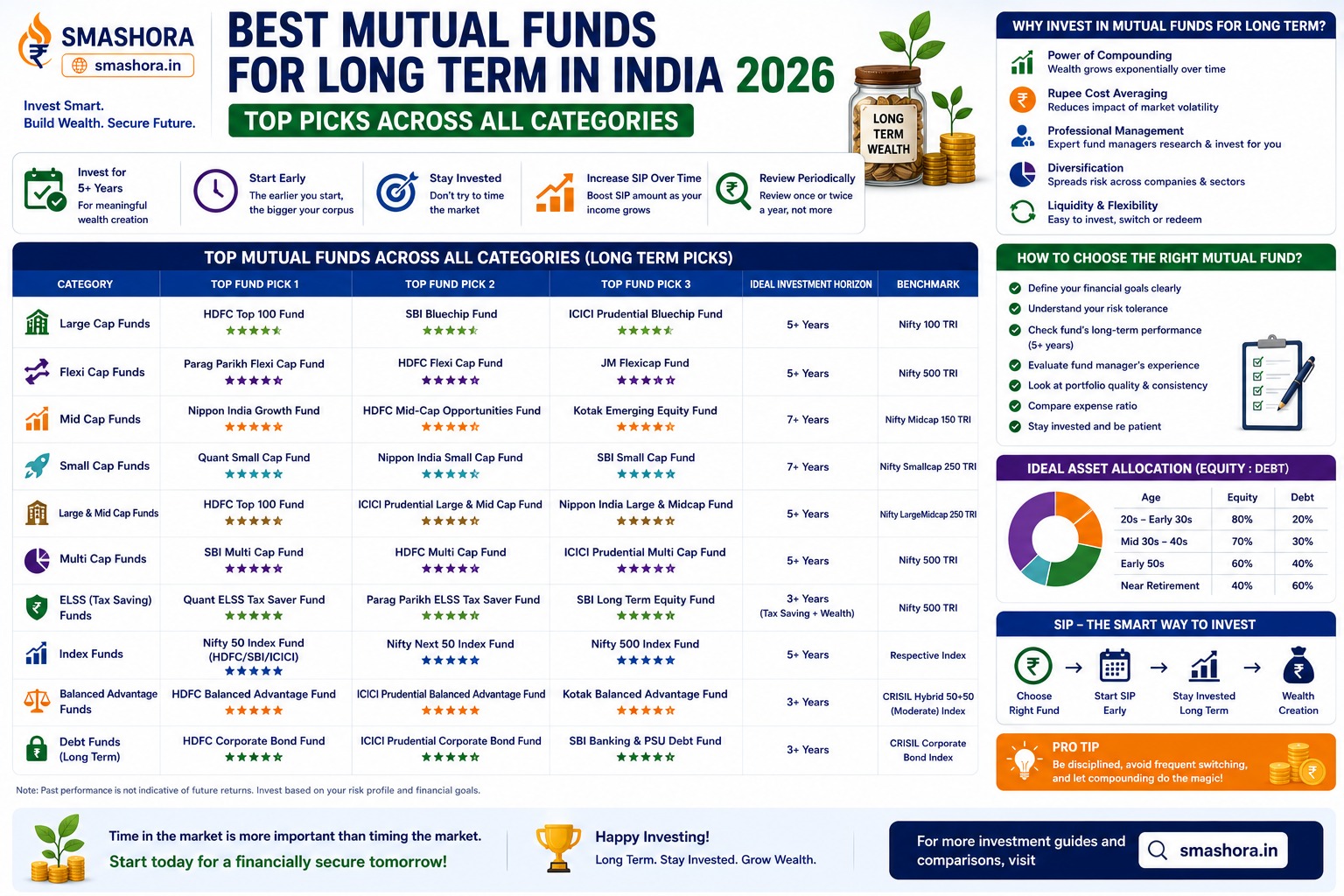
For the majority of individual investors, index funds are the single best category among the best mutual funds for long term in India 2026. These passively managed funds simply track the Nifty 50, Sensex, or other indices — owning all the stocks in the index in proportion to their weight — at extremely low cost. No stock picking, no active management fees, and performance that matches the index.
The data consistently shows that most actively managed large-cap funds fail to beat their benchmark index over 10-year rolling periods. An index fund at 0.10% to 0.20% expense ratio that delivers exactly the index return often outperforms most actively managed funds in the same category once fees are accounted for.
| Fund Name | Index Tracked | Expense Ratio | 5-Year Return | Min SIP |
|---|---|---|---|---|
| UTI Nifty 50 Index Fund | Nifty 50 | 0.18% | Approximately 16% CAGR | ₹500 |
| HDFC Nifty 50 Index Fund | Nifty 50 | 0.20% | Approximately 16% CAGR | ₹500 |
| Motilal Oswal Nifty Next 50 Index Fund | Nifty Next 50 | 0.27% | Approximately 14% to 18% CAGR | ₹500 |
| Nippon India Nifty 50 BeES (ETF) | Nifty 50 | 0.04% | Approximately 16% CAGR | 1 unit (approx ₹250) |
| Mirae Asset Nifty Midcap 150 Index Fund | Nifty Midcap 150 | 0.21% | Approximately 20% to 22% CAGR | ₹500 |
Best for: Anyone starting out, investors who want the lowest-cost long-term equity exposure, and as a core holding (50% to 60% of equity allocation) for all investor types.
Flexi Cap Funds — Best Actively Managed Long-Term Category
Flexi cap funds are among the best mutual funds for long term in India 2026 for investors who want active management. The fund manager has complete freedom to invest across large cap, mid cap, and small cap stocks in any proportion — shifting the allocation based on market conditions. This flexibility allows skilled managers to reduce small and mid cap exposure when valuations are stretched and increase it during market corrections.
| Fund Name | 3-Year CAGR | 5-Year CAGR | Key Strength |
|---|---|---|---|
| Parag Parikh Flexi Cap Fund | 15.15% | 14.87% | Consistent risk-adjusted returns, international diversification (holds global stocks), very low portfolio turnover |
| HDFC Flexi Cap Fund | 21% to 22% | 18% to 19% | Strong large and mid cap blend, experienced fund management team |
| Motilal Oswal Flexi Cap Fund | 17% to 19% | 15% to 17% | High conviction concentrated portfolio, growth-style investing |
| Canara Robeco Flexi Cap Fund | 14% to 16% | 14% to 15% | Consistent category outperformer, moderate volatility, well-diversified |
Standout pick: Parag Parikh Flexi Cap Fund is unique among the best mutual funds for long term in India 2026 because it holds a portion of its portfolio in international stocks — companies like Alphabet, Meta, Microsoft, and Amazon. This gives Indian investors genuine global diversification through a simple domestic mutual fund, something most other Indian funds do not offer.
Mid Cap Funds — Best for Aggressive Long-Term Growth
Mid cap funds invest in companies ranked 101st to 250th by market capitalisation on Indian exchanges. These are established businesses that have grown past the small-cap stage but still have significant growth runway ahead — offering higher growth potential than large caps with lower volatility than small caps. For investors with a 7 to 10 year investment horizon, mid cap funds are consistently among the best mutual funds for long term in India 2026 on a returns basis.
| Fund Name | 3-Year CAGR | 5-Year CAGR | Key Strength |
|---|---|---|---|
| Nippon India Growth Fund | 22% to 24% | 20% to 22% | Consistent long-term outperformer in mid cap category, well-established track record |
| Motilal Oswal Mid Cap Fund | 28% to 30% | 22% to 24% | Recent strong performance, concentrated high-conviction portfolio |
| HDFC Mid Cap Opportunities Fund | 21% to 23% | 19% to 21% | Largest mid cap fund by AUM, strong multi-cycle track record |
| Edelweiss Mid Cap Fund | 23% to 25% | 21% to 23% | Consistent category top-quartile ranking over 5 to 10 year periods |
Important note on mid cap allocation: Mid cap funds should form 20% to 30% of your total equity portfolio — not the entire allocation. They are volatile in the short term and can fall 40% to 50% during market corrections before recovering. They are for money you genuinely will not need for at least 5 to 7 years.
Small Cap Funds — Highest Long-Term Returns, Highest Volatility
Small cap funds invest in companies ranked below 250th by market cap — smaller, faster-growing businesses with higher growth potential and significantly higher risk. Over 10-year periods, small cap funds have delivered the highest returns of any equity mutual fund category in India — but they also experience the sharpest drawdowns during market corrections.
| Fund Name | 3-Year CAGR | 5-Year CAGR | AUM |
|---|---|---|---|
| Nippon India Small Cap Fund | 17.94% | 19.95% | Largest small cap fund by AUM in India |
| HDFC Small Cap Fund | 18% to 20% | 18% to 19% | Large, well-established fund with strong long-term track record |
| Bandhan Small Cap Fund | 28.08% | 20.7% | Strong recent performance, concentrated portfolio |
| Axis Small Cap Fund | 16% to 18% | 17% to 19% | Quality-focused stock selection, lower volatility vs category |
Critical warning for small cap: Never invest more than 10% to 15% of your total equity portfolio in small cap funds. Small caps can fall 50% to 60% in a market downturn and may take 3 to 5 years to recover. They are genuinely only for money with a 10-plus year horizon and investors who can psychologically stomach severe short-term losses without selling.
Large Cap Funds — Stable Core Holding
Large cap funds invest in the top 100 Indian companies by market capitalisation. They are the most stable equity category but also the one where actively managed funds most often fail to beat the Nifty 50 index after fees. If you are investing in large caps, a Nifty 50 index fund at 0.18% to 0.20% expense ratio is typically a better choice than an actively managed large cap fund at 0.80% to 1.50%.
If you prefer active management, these large cap funds have shown consistent long-term outperformance:
- Mirae Asset Large Cap Fund — consistent top-quartile performer with disciplined valuation approach
- Canara Robeco Bluechip Equity Fund — lower volatility than category average, consistent returns
- ICICI Prudential Bluechip Fund — large cap stalwart with 15-plus year track record
Hybrid and Multi-Asset Funds — For Conservative Long-Term Investors
Hybrid funds invest across both equity and debt, providing built-in diversification. They are less volatile than pure equity funds and are among the best mutual funds for long term in India 2026 for investors who are closer to retirement (10 to 15 years out) or who find pure equity fund volatility psychologically difficult to manage.
| Fund Type | Equity Allocation | Expected Return | Best For |
|---|---|---|---|
| Aggressive Hybrid (Balanced Advantage) | 65% to 80% | 12% to 15% CAGR | First-time equity investors, moderate risk appetite |
| Conservative Hybrid | 10% to 25% | 7% to 10% CAGR | Investors nearing retirement, capital preservation focus |
| Balanced Advantage (Dynamic Asset Allocation) | 30% to 80% (dynamic) | 10% to 13% CAGR | Investors who want automatic equity-debt rebalancing |
| Multi-Asset Fund (equity plus debt plus gold) | Varies, typically 50% to 65% | 10% to 13% CAGR | One-fund all-weather portfolio for passive investors |
Building a Portfolio With the Best Mutual Funds for Long Term in India 2026
Understanding which individual funds perform best is only part of the picture. The other part is how to combine them into a portfolio that matches your specific situation. Here is a practical allocation framework:
For Young Investors (Age 22 to 35) — Aggressive Growth Portfolio
| Category | Allocation | Suggested Fund |
|---|---|---|
| Index Fund (Nifty 50) | 40% | UTI Nifty 50 Index Fund or HDFC Nifty 50 Index Fund |
| Flexi Cap Fund | 25% | Parag Parikh Flexi Cap Fund |
| Mid Cap Fund | 25% | HDFC Mid Cap Opportunities Fund or Nippon India Growth Fund |
| Small Cap Fund | 10% | Nippon India Small Cap Fund |
For Mid-Career Investors (Age 35 to 50) — Balanced Growth Portfolio
| Category | Allocation | Suggested Fund |
|---|---|---|
| Index Fund (Nifty 50) | 45% | UTI Nifty 50 Index Fund |
| Flexi Cap Fund | 30% | Parag Parikh Flexi Cap Fund |
| Mid Cap Fund | 15% | HDFC Mid Cap Opportunities Fund |
| Hybrid or Debt Fund | 10% | ICICI Prudential Balanced Advantage Fund |
For Conservative Investors and Pre-Retirement (Age 50 Plus)
| Category | Allocation | Suggested Fund |
|---|---|---|
| Index Fund (Nifty 50) | 35% | UTI Nifty 50 Index Fund |
| Flexi Cap or Large Cap Fund | 25% | Canara Robeco Flexi Cap Fund |
| Balanced Advantage Fund | 25% | HDFC Balanced Advantage Fund |
| Short Duration Debt Fund | 15% | ICICI Prudential Short Term Fund |
Mutual Fund Taxation in India 2026 — What You Must Know
Understanding taxation is an essential part of selecting the best mutual funds for long term in India 2026, since the after-tax return is what you actually keep:
| Fund Type | Holding Period for LTCG | STCG Tax Rate | LTCG Tax Rate |
|---|---|---|---|
| Equity Mutual Funds (65% plus equity) | 12 months | 20% (STCG under Section 111A) | 12.5% on gains above ₹1.25 lakh per year |
| Debt Mutual Funds | Any period | Income slab rate | Income slab rate (no LTCG benefit) |
| Hybrid Funds (equity 65% plus) | 12 months | 20% | 12.5% above ₹1.25 lakh |
| Index Funds and ETFs (equity-based) | 12 months | 20% | 12.5% above ₹1.25 lakh |
The ₹1.25 lakh annual LTCG exemption on equity mutual funds is a meaningful benefit for systematic investors — a person with ₹10 lakh invested in equity funds generating 12.5% annual returns and redeeming ₹1.25 lakh in LTCG per year pays zero tax on those gains under the current rules. Strategic partial redemptions to stay within the annual exemption threshold each year can significantly reduce the overall tax burden over a long investment journey.
Direct vs Regular Mutual Fund Plans — Always Choose Direct
Every mutual fund in India has two versions — a direct plan and a regular plan. The regular plan pays a commission to the distributor or financial advisor who sold it. The direct plan has no such commission and therefore a lower expense ratio — typically 0.50% to 1.00% lower per year than the regular plan.
On a ₹5 lakh lump sum investment over 20 years at 12% gross returns, the difference between a direct plan at 0.50% expense ratio and a regular plan at 1.50% expense ratio is approximately ₹10 to ₹15 lakh in final corpus — purely from the fee difference. Always invest in direct plans for all the best mutual funds for long term in India 2026.
Where to buy direct plans: directly on the AMC’s website, or through platforms like Groww, Zerodha Coin, MFCentral, or Paytm Money — all of which offer direct plans at no additional cost. Our guide on the best demat account in India 2026 covers the brokers that offer direct plan investing alongside stock investing in one unified platform. More Info at amfiindia.com
Common Mistakes When Choosing Mutual Funds for Long Term in India
Chasing Last Year’s Best Performer
The fund that topped the returns chart last year is often not even in the top quartile the following year. Sector and thematic funds that appear in top performers are particularly prone to this — a pharma fund or IT fund that was No. 1 in one year often lags the next when the sector rotates. Always evaluate on 5-year and 10-year rolling returns, not last year’s headline number.
Owning Too Many Funds
Many Indian investors own 15 to 25 mutual funds thinking more funds means more diversification. It does not. Owning 5 different large cap funds gives you essentially the same portfolio 5 times over — the top 10 holdings of most large cap funds are very similar. A 3 to 5 fund portfolio across different categories (index fund, flexi cap, mid cap, and optionally one small cap or hybrid) provides all the diversification needed for most long-term investors.
Investing in Regular Plans Instead of Direct Plans
Many investors buy mutual funds through distributors or bank relationship managers who recommend regular plans — earning commissions on every recommendation. The performance difference between direct and regular plans of the same fund compounds into lakhs of rupees over 15 to 20 years. Always invest in direct plans.
Stopping SIPs During Market Downturns
Market corrections are precisely when SIPs in the best mutual funds for long term in India 2026 are most valuable — your monthly investment buys more units at lower prices, lowering your average cost. Investors who stopped SIPs during the 2020 pandemic crash, the 2022 correction, or any other downturn forfeited the lowest-cost units of their holding period. Never stop a SIP due to short-term market movements.
For a complete guide to SIP investing including step-up SIP strategies and the best SIP amounts by goal, read our detailed article on the best SIP to start in India 2026. And to understand where mutual funds fit within a broader investment comparison including PPF, FDs, and gold, our article on PPF vs FD vs mutual fund in India 2026 covers the complete picture. For complete beginners who want to understand the stock market before exploring mutual funds, our guide on how to invest in stock market for beginners in India provides the foundational knowledge.
Conclusion — Start With Index Funds, Add Category Diversity Over Time
The best mutual funds for long term in India 2026 for a first-time investor are Nifty 50 index funds — UTI Nifty 50 Index Fund and HDFC Nifty 50 Index Fund are both excellent choices at 0.18% to 0.20% expense ratio. Start there. Once you are comfortable with market fluctuations and have been invested for at least one full market cycle, add a flexi cap fund like Parag Parikh Flexi Cap for active management diversification, and a mid cap fund like HDFC Mid Cap Opportunities or Nippon India Growth Fund for higher growth exposure.
Keep the portfolio to 3 to 5 funds maximum. Invest in direct plans only. Evaluate fund performance on 5-year and 10-year data, not last year’s ranking. Never stop your SIPs during market downturns — they are the best months to be buying. Review your portfolio allocation once a year, not every month. These simple principles, applied consistently for 15 to 20 years, have made ordinary Indian salaried employees into genuine long-term wealth creators through mutual funds.
At Smashora, our mission is to help every Indian make every rupee count. If this guide on the best mutual funds for long term in India 2026 helped you plan or improve your mutual fund portfolio, leave a comment below and let us know which fund you are starting with — or share it with a friend who keeps asking which mutual fund to invest in.
Frequently Asked Questions
Which is the best mutual fund for long term investment in India in 2026?
For most long-term investors in India 2026, the best starting point is a Nifty 50 index fund — UTI Nifty 50 Index Fund or HDFC Nifty 50 Index Fund at 0.18% to 0.20% expense ratio. These track India’s 50 largest companies at near-zero cost and have delivered approximately 16% CAGR over 5 years. For investors who also want active management, Parag Parikh Flexi Cap Fund with its 14.87% five-year CAGR and international diversification is consistently among the best long-term performers. A combination of a Nifty 50 index fund (core holding) plus Parag Parikh Flexi Cap is an excellent two-fund portfolio for most investors.
How long should I stay invested in mutual funds in India?
For equity mutual funds, a minimum investment horizon of 5 years is essential — though 7 to 10 years or longer is ideal for capturing the full benefit of compounding. In any 5-year rolling period in Nifty 50 history, the returns have been positive — meaning if you stay invested for at least 5 years, you have historically never lost money in Indian large cap equity funds. For mid cap and small cap funds, 7 to 10 years is the recommended minimum, as these categories experience more severe drawdowns that require longer recovery periods.
Should I invest in a direct plan or regular plan mutual fund in India?
Always invest in direct plans. Regular plans pay a commission to the distributor or bank that sold the fund, resulting in an expense ratio that is typically 0.50% to 1.00% higher per year than the equivalent direct plan. On a 20-year investment of ₹5 lakh at 12% gross return, this fee difference compounds into a corpus difference of ₹10 to ₹15 lakh or more. Direct plans are available at zero additional cost through platforms like Groww, Zerodha Coin, Paytm Money, and the AMC’s own website.
How many mutual funds should I have in my portfolio?
For most individual investors, 3 to 5 funds is optimal. A portfolio of one large cap index fund, one flexi cap fund, and one mid cap fund provides comprehensive exposure to the Indian equity market across market capitalisation segments without unnecessary overlap. Owning more than 5 to 6 equity mutual funds typically means duplicating exposure — most Indian equity fund portfolios share the same top 10 to 15 large cap holdings — without meaningfully increasing diversification. Simplicity in portfolio construction also makes it easier to review and rebalance annually.
What is the minimum amount to start investing in mutual funds in India in 2026?
You can start investing in the best mutual funds for long term in India 2026 with as little as ₹100 to ₹500 per month via SIP, depending on the fund and platform. Most Nifty 50 index funds and flexi cap funds have a minimum SIP of ₹500 per month on platforms like Groww and Zerodha Coin. For lump sum investments, the minimum is typically ₹500 to ₹1,000. There is no maximum — you can invest any amount. The key is not to wait until you have a large amount to invest. Starting with ₹500 per month today and increasing by 10% per year builds significant wealth over 15 to 20 years through compounding.
Are mutual funds safe in India in 2026?
Indian mutual funds are regulated by SEBI (Securities and Exchange Board of India) and all AMCs must follow strict disclosure, valuation, and governance rules. Your mutual fund units are held in your name directly with the AMC — not with the platform or distributor — making them safe from platform default. However, market-linked mutual funds (equity, mid cap, small cap) do carry market risk — their NAV fluctuates daily and can fall significantly during market downturns. The risk is not of losing your money permanently but of short-term value fluctuations. For long-term investors who stay invested across market cycles, this risk has historically been well rewarded with strong positive returns over 5 to 10 year periods.