Contents
- 1 How Gold Loans Work in India — The Basics
- 2 Best Gold Loan Interest Rates in India 2026 — Bank Comparison
- 3 Best Gold Loan Interest Rates in India 2026 — NBFC Comparison
- 4 Banks vs NBFCs — Which Should You Choose for the Best Gold Loan Interest Rates in India 2026?
- 5 Gold Loan Per Gram Rate — What You Can Actually Borrow in 2026
- 6 Hidden Charges to Watch For With Gold Loans
- 7 Types of Gold Loan Repayment Schemes in India 2026
- 8 Gold Loan for Agriculture — Special Lower Rates
- 9 Gold Loan vs Personal Loan — Which Should You Choose?
- 10 How to Get the Best Gold Loan Interest Rate in India 2026 — Step by Step
- 11 Risks of Gold Loans You Must Understand
- 12 Conclusion — Compare the Best Gold Loan Interest Rates in India 2026 Before Pledging
- 13 Frequently Asked Questions
- 13.1 Which bank offers the best gold loan interest rate in India in 2026?
- 13.2 How much loan can I get against 10 grams of gold in India in 2026?
- 13.3 Is a gold loan better than a personal loan in India?
- 13.4 What happens if I cannot repay my gold loan in India?
- 13.5 Do I need a good CIBIL score to get a gold loan in India?
- 13.6 What is the maximum tenure for a gold loan in India in 2026?
With gold prices in India crossing ₹13,400 per gram and touching historic highs in 2026, finding the best gold loan interest rates in India 2026 has never mattered more. The same jewellery sitting in your bank locker that was worth ₹8 lakh three years ago is now worth ₹13 lakh to ₹14 lakh — and that appreciation means you can borrow significantly more against it today than ever before. Gold loan rates in India in 2026 range from as low as 8.05% per year at public sector banks to over 24% at some NBFCs for the same pledged gold — a gap that can mean paying ₹40,000 to ₹1.5 lakh more in interest on a ₹5 lakh loan over a year, simply by choosing the wrong lender.
Gold loans occupy a unique place in Indian household finance. Unlike personal loans which require income proof, employment verification, and a strong CIBIL score, a gold loan is secured entirely against the collateral itself — your gold ornaments or coins. This means even someone with no credit history or a poor CIBIL score can access funds quickly, often within 30 to 90 minutes at NBFC branches. The trade-off is that the interest rate you actually pay varies dramatically depending on whether you prioritise speed (NBFCs) or cost (banks) — and most borrowers do not realise just how large that gap can be.
This complete guide on the best gold loan interest rates in India 2026 covers current rates from all major banks and NBFCs, how Loan-to-Value (LTV) rules work, the per gram rate you can actually expect, hidden charges to watch for, and exactly how to choose between speed and cost based on your specific situation.
How Gold Loans Work in India — The Basics
A gold loan is a secured loan where you pledge gold jewellery, coins, or bars to a bank or NBFC in exchange for cash. The lender holds your gold as collateral until you repay the loan plus interest, after which your gold is returned in full. Because the loan is fully secured by collateral, lenders take on significantly less risk than with unsecured personal loans — which is reflected in generally lower interest rates at banks compared to personal loans.
- Loan to Value (LTV): RBI regulations cap the maximum LTV at 75% to 85% of the gold’s market value, depending on the lender category and loan purpose. This means if your gold is valued at ₹10 lakh, you can typically borrow up to ₹7.5 lakh to ₹8.5 lakh against it.
- Tenure: Gold loans typically range from 6 months to 36 months, though some lenders offer shorter bullet repayment schemes of just a few months.
- Disbursal speed: NBFCs can disburse funds in 20 to 90 minutes after gold appraisal. Banks typically take longer due to additional documentation and verification steps.
- No credit score requirement: Most gold loan lenders do not check CIBIL score since the loan is fully secured — making this one of the only major loan products genuinely accessible to people with poor or no credit history.
Best Gold Loan Interest Rates in India 2026 — Bank Comparison
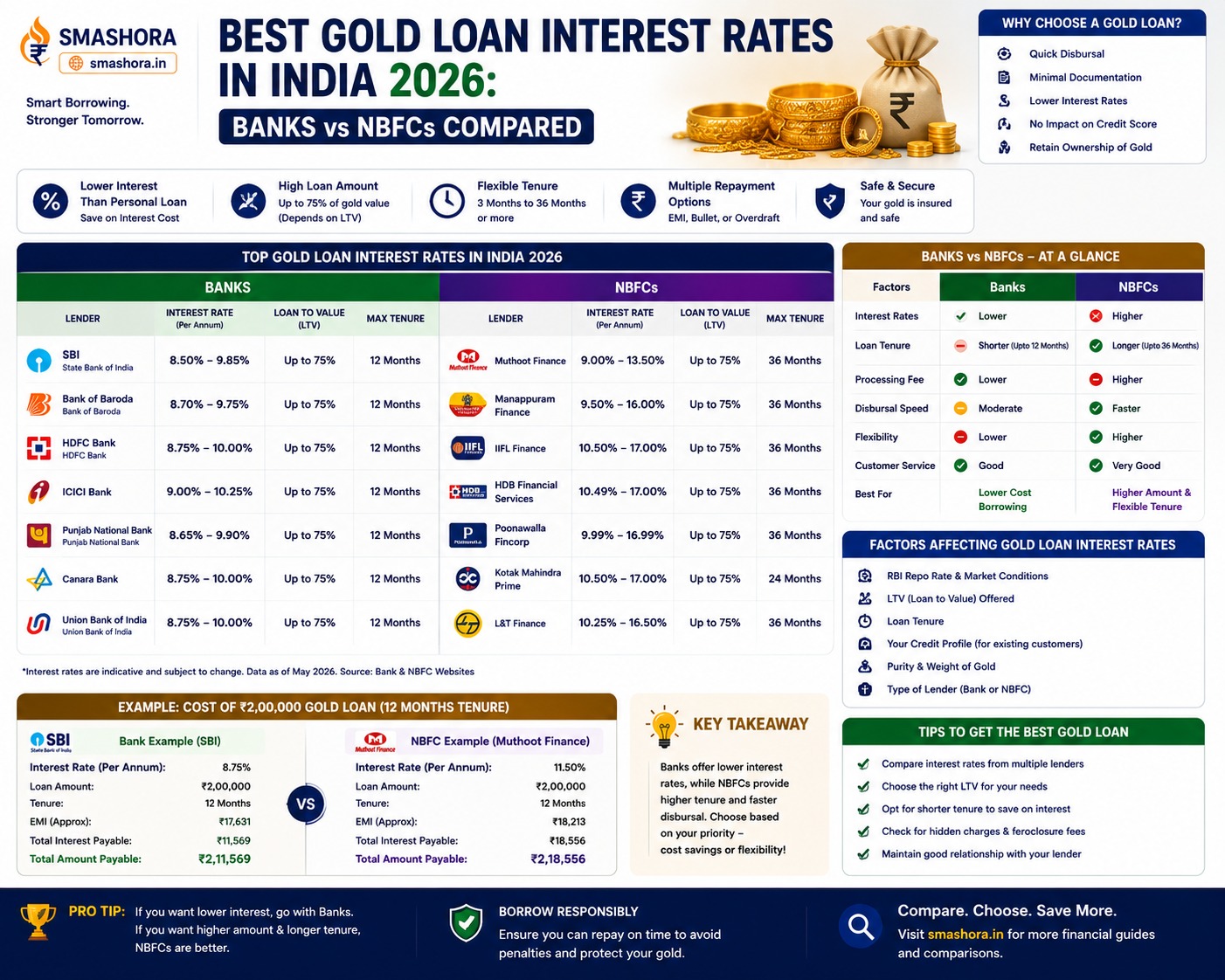
Here are the current best gold loan interest rates in India 2026 from major public sector and private banks:
| Bank | Interest Rate Range | Maximum Loan Amount | Processing Fee |
|---|---|---|---|
| State Bank of India | 8.25% to 8.75% per year | Up to ₹50 lakh | Nil for loans up to ₹3 lakh, low otherwise |
| Punjab National Bank | 8.25% to 8.75% per year | Up to ₹50 lakh | Low, often waived in offers |
| Canara Bank | 8.75% to 9.30% per year | Up to ₹35 lakh | 0.50% |
| HDFC Bank | 8.75% to 9.30% per year | Up to ₹2 crore | 1.00% to 1.50% |
| ICICI Bank | 8.75% to 9.30% per year | Up to ₹1.5 crore | 1.00% |
| Bank of Baroda | 8.50% to 9.00% per year | Up to ₹50 lakh | Low |
For official RBI guidelines on gold loan LTV norms and secured lending regulations, refer to the Reserve Bank of India website.
Best Gold Loan Interest Rates in India 2026 — NBFC Comparison
NBFCs dominate India’s gold loan market due to their speed and convenience, but this comes at a meaningfully higher interest cost compared to banks:
| NBFC | Interest Rate Range | Maximum Loan Amount | Disbursal Speed |
|---|---|---|---|
| Muthoot Finance | 12% to 27% per year | Up to ₹5 crore (no fixed cap in many cases) | 10 to 20 minutes |
| Manappuram Finance | 24% per year (base rate) to 27% | Up to ₹1.5 crore plus | 15 to 30 minutes |
| IIFL Finance | 12% to 24% per year | Up to ₹1 crore plus | 20 to 30 minutes |
| Bajaj Finance | 10% to 22% per year | Up to ₹2 crore | 30 to 45 minutes |
| Rupeek (fintech, doorstep) | Bank-linked rates (via partner banks) | Varies by partner bank | Same day doorstep service |
The wide rate range at NBFCs — sometimes 12% to 27% for the same lender — reflects the specific scheme chosen, loan amount, tenure, and repayment structure. Always ask for the exact rate applicable to your specific loan amount and scheme before committing, since the lowest advertised rate is often reserved for specific high-value or short-tenure schemes only.
Banks vs NBFCs — Which Should You Choose for the Best Gold Loan Interest Rates in India 2026?
| Feature | Banks (SBI, PNB, HDFC, ICICI) | NBFCs (Muthoot, Manappuram, IIFL) |
|---|---|---|
| Interest Rate | 8.05% to 9.30% — significantly lower | 10% to 27% — significantly higher |
| Disbursal Time | 45 to 90 minutes, sometimes longer | 10 to 30 minutes — much faster |
| Documentation | Slightly more thorough | Minimal — gold appraisal is the main step |
| Branch Network | Wide but fewer dedicated gold loan counters | Very wide, many branches purpose-built for gold loans |
| Best For | Borrowers who can wait slightly longer for the lowest cost | Urgent cash needs, tier-2 and tier-3 city borrowers, those without other documentation |
| Maximum LTV | 75% to 80% typically | 75% to 85% — some NBFCs offer the higher end |
The practical recommendation: if your need is not extremely urgent and you can visit a bank branch within a day or two, SBI, PNB, or Bank of Baroda will save you significantly more in interest over the loan tenure compared to any NBFC. If you need cash within the hour for a genuine emergency, NBFCs deliver speed that banks simply cannot match — but be prepared to pay 3% to 18% more in annual interest for that convenience.
Gold Loan Per Gram Rate — What You Can Actually Borrow in 2026
With gold prices crossing ₹13,400 per gram in 2026, understanding the per gram loan value helps you estimate how much you can borrow before visiting any lender:
| Gold Purity | Approximate Market Value Per Gram | Loan Value at 75% LTV | Loan Value at 85% LTV |
|---|---|---|---|
| 24 Karat (99.9% pure) | ₹13,400 | ₹10,050 | ₹11,390 |
| 22 Karat (91.6% pure, typical jewellery) | ₹12,280 | ₹9,210 | ₹10,438 |
| 18 Karat (75% pure) | ₹10,050 | ₹7,538 | ₹8,543 |
Most household gold jewellery is 22 karat, meaning for every 10 grams of jewellery you pledge, you can expect to borrow approximately ₹92,000 to ₹1,04,000 depending on the lender’s LTV ratio. Lenders deduct the weight of stones, beads, and other non-gold materials in jewellery before calculating the loan value, so the actual amount may be somewhat lower than a pure gold calculation suggests.
Hidden Charges to Watch For With Gold Loans
Beyond the headline interest rate, several charges affect the true cost of even the best gold loan interest rates in India 2026:
- Processing fee: Typically 0.25% to 1.5% of the loan amount, charged upfront. Banks often waive this during festive promotions, while NBFCs are less likely to waive it.
- Valuation or appraisal charges: Some lenders charge a fee for appraising your gold’s purity and weight, typically ₹100 to ₹500 per loan, though many waive this for larger loan amounts.
- Storage charges: Some lenders charge an annual locker or storage fee for safekeeping your pledged gold — verify if this is included in your scheme or charged separately.
- Foreclosure or prepayment charges: Many gold loans, particularly at NBFCs, charge 1% to 2% if you close the loan before the agreed tenure. Banks are more likely to offer zero foreclosure charges on floating rate gold loans.
- Auction risk on default: If you fail to repay, the lender has the legal right to auction your pledged gold after a notice period (typically 7 to 15 days past due) to recover the loan amount. This is the single most important risk to understand before pledging valuable or sentimental jewellery.
Types of Gold Loan Repayment Schemes in India 2026
| Scheme Type | How It Works | Best For |
|---|---|---|
| EMI Scheme | Regular monthly EMI covering both principal and interest, like a standard loan | Borrowers who want predictable, disciplined monthly repayment |
| Bullet Repayment | Pay only interest monthly or quarterly; full principal repaid at the end of tenure | Borrowers expecting a lump sum (bonus, business payment) at a future date |
| Overdraft Facility | A credit line against pledged gold; pay interest only on the amount actually utilised | Borrowers with fluctuating cash needs who do not want to draw the full sanctioned amount immediately |
| Partial Payment Scheme | Interest deducted upfront from the disbursed amount; remaining balance paid at maturity | Borrowers who want lower effective cash outflow during the tenure |
Gold Loan for Agriculture — Special Lower Rates
Farmers pledging gold specifically for agricultural purposes can access some of the best gold loan interest rates in India 2026 — as low as 7% per year at several public sector banks, significantly lower than standard gold loan rates. This concessional rate is part of priority sector lending norms designed to support agricultural cash flow needs. Eligible borrowers must demonstrate the loan is being used for crop production, farm equipment, or related agricultural expenses, with documentation requirements varying by bank.
Gold Loan vs Personal Loan — Which Should You Choose?
| Feature | Gold Loan | Personal Loan |
|---|---|---|
| Interest Rate | 8.05% to 27% (banks much lower than NBFCs) | 9.99% to 36% per year |
| Collateral Required | Yes — gold jewellery, coins, or bars | No — unsecured |
| CIBIL Score Requirement | Generally not checked | 750 plus for best rates, often rejected below 650 |
| Disbursal Speed | 10 minutes to a few hours | Minutes to 2 days depending on lender and pre-approval |
| Risk if Default | Lender auctions pledged gold | CIBIL score damage, legal recovery proceedings |
| Best For | Those with gold to pledge wanting the lowest secured rate | Those without gold or who prefer not to pledge personal assets |
If you have gold available and a CIBIL score below 700, a gold loan at a bank like SBI or PNB will almost always be significantly cheaper than a personal loan you might struggle to get approved for at a reasonable rate anyway. For borrowers with strong credit profiles who do not want to risk pledging family gold, our comprehensive guide on the best personal loan in India 2026 covers the full unsecured loan landscape. And if your credit profile needs improvement before considering other loan types, read our guide on how to improve your CIBIL score.
How to Get the Best Gold Loan Interest Rate in India 2026 — Step by Step
- Check current gold prices before visiting any lender: Knowing the approximate market rate for your gold’s purity helps you verify the lender’s valuation is fair and not undervalued to reduce your eligible loan amount
- Compare at least one bank and one NBFC: If you have a day or two before you need the funds, get a quote from SBI or PNB first, then compare against a nearby NBFC for speed-versus-cost trade-off
- Ask for the exact applicable rate, not the advertised minimum: The lowest rate advertised is often for a specific scheme, tenure, or loan amount — confirm the rate that applies to your actual loan parameters
- Negotiate the processing fee: Banks frequently waive processing fees during festive periods — ask explicitly before signing
- Choose the right repayment scheme for your cash flow: If you expect a lump sum later, a bullet repayment scheme avoids monthly EMI pressure. If you want disciplined gradual repayment, choose the EMI scheme.
- Verify zero or low foreclosure charges: If you expect to repay early from another income source, prioritise lenders with no prepayment penalty
- Keep the loan tenure as short as practical: Gold loans are best suited for short to medium-term cash needs — the longer you hold the loan, the more total interest accumulates against an asset that does not itself generate income
Risks of Gold Loans You Must Understand
Auction Risk on Default
If you miss repayments beyond the lender’s grace period, your pledged gold can be legally auctioned to recover the outstanding loan amount plus accrued interest. This is the single biggest risk of gold loans — and it is particularly painful when the pledged gold has sentimental or family value. Never pledge gold for a loan amount or tenure that puts realistic repayment in doubt.
Gold Price Volatility During the Loan Tenure
If gold prices fall significantly during your loan tenure, some lenders may ask you to either pledge additional gold or repay part of the loan to maintain the agreed LTV ratio — known as a margin call. This is uncommon during short tenures but worth understanding if you choose a longer-tenure gold loan during a period of high gold price volatility.
Using Gold Loans for Investment or Speculation
Some borrowers take gold loans to fund stock market trading or speculative investments, betting that investment returns will exceed the gold loan interest rate. This is a high-risk strategy — if the investment underperforms, you are left repaying loan interest on a depreciated or lost investment while still owing the principal against your pledged gold. Gold loans are best used for genuine short to medium-term cash needs, not speculative investment funding.
If you are considering a gold loan because of an unexpected expense, it is worth evaluating whether building a dedicated emergency fund could reduce future reliance on borrowing against assets. Our guide on how to build an emergency fund in India covers exactly how to build this buffer. And if you are exploring gold loans because you are also considering gold as an investment vehicle, our complete guide on how to invest in gold in India 2026 covers Gold ETFs, SGBs, and other options that may suit different financial goals.
Conclusion — Compare the Best Gold Loan Interest Rates in India 2026 Before Pledging
The best gold loan interest rates in India 2026 start at 7% for agricultural purposes and 8.05% to 8.75% for general gold loans at public sector banks like SBI and PNB — significantly below the 12% to 27% range charged by NBFCs like Muthoot, Manappuram, and IIFL for the convenience of faster disbursal. With gold prices at record highs above ₹13,400 per gram, the loan amount available against the same jewellery has increased substantially compared to previous years — making this an opportune time to access liquidity if genuinely needed.
The decision ultimately comes down to urgency versus cost. If your need is not extremely time-sensitive, a bank visit for the lowest rate saves meaningfully more money over the loan tenure. If you genuinely need cash within the hour, NBFCs deliver speed that justifies their higher rate for short tenures — but always compare the actual cost in rupees, not just the convenience, before signing.
At Smashora, our mission is to help every Indian make every rupee count. If this guide on the best gold loan interest rates in India 2026 helped you understand your options before pledging your gold, leave a comment below or share it with a family member who is considering a gold loan right now.
Frequently Asked Questions
Which bank offers the best gold loan interest rate in India in 2026?
State Bank of India and Punjab National Bank offer among the best gold loan interest rates in India 2026, starting from 8.25% per year, with SBI also offering zero processing fee on loans up to ₹3 lakh. Bank of Baroda offers competitive rates starting from 8.50%. Among private banks, HDFC Bank and ICICI Bank start around 8.75% to 9.30%. For agricultural gold loans specifically, several public sector banks offer concessional rates as low as 7% per year as part of priority sector lending norms.
How much loan can I get against 10 grams of gold in India in 2026?
With gold prices around ₹13,400 per gram for 24 karat gold, 10 grams of pure gold is valued at approximately ₹1,34,000. For typical 22 karat household jewellery valued at approximately ₹12,280 per gram, 10 grams would be worth approximately ₹1,22,800. At an LTV ratio of 75%, you could borrow approximately ₹92,100 against 10 grams of 22 karat jewellery. At an LTV of 85% offered by some NBFCs, this could go up to approximately ₹1,04,380. The exact amount depends on the lender’s specific valuation methodology and deductions for stones or impurities in the jewellery.
Is a gold loan better than a personal loan in India?
For borrowers who have gold available to pledge and want the lowest possible interest rate, a gold loan from a bank like SBI or PNB at 8.05% to 8.75% is significantly cheaper than a personal loan, which typically starts at 9.99% and can go up to 24% to 36% depending on your CIBIL score. Gold loans also do not require a strong CIBIL score since they are fully secured by collateral, making them accessible even to borrowers with poor or no credit history. The trade-off is the risk of losing your pledged gold through auction if you default on repayment — a risk that does not exist with unsecured personal loans.
What happens if I cannot repay my gold loan in India?
If you fail to repay your gold loan within the agreed tenure and any grace period offered by the lender (typically 7 to 15 days past due), the lender has the legal right to auction your pledged gold to recover the outstanding loan amount and accrued interest. Any surplus amount after the auction, beyond what is owed to the lender, must be returned to you as the borrower. To avoid this outcome, communicate proactively with your lender if you anticipate difficulty repaying — many lenders offer tenure extensions or partial payment arrangements rather than proceeding directly to auction.
Do I need a good CIBIL score to get a gold loan in India?
No, most gold loan lenders in India do not check your CIBIL score as a primary eligibility criterion, since the loan is fully secured by the pledged gold collateral rather than your creditworthiness. This makes gold loans one of the most accessible loan products for individuals with poor or limited credit history. The lender’s main verification focus is the purity, weight, and authenticity of the gold being pledged, along with basic identity and address verification (KYC documents).
What is the maximum tenure for a gold loan in India in 2026?
Gold loan tenures in India in 2026 typically range from 6 months to 36 months, depending on the lender and the specific scheme chosen. SBI offers tenures up to 36 months on certain schemes, while many NBFC schemes are structured for shorter 6 to 12 month tenures with bullet repayment options. Longer tenures result in lower monthly EMI but higher total interest paid over the loan period, while shorter tenures minimise total interest cost but require higher periodic payments. Choose the tenure based on your realistic ability to repay rather than simply minimising the monthly EMI amount.