Contents
- 1 PPF vs FD vs Mutual Fund in India 2026 — Quick Overview
- 2 What is PPF and Who Should Use It?
- 3 What is a Fixed Deposit and Who Should Use It?
- 4 What are Mutual Funds and Who Should Use Them?
- 5 PPF vs FD vs Mutual Fund — Returns Comparison Over Time
- 6 Tax Treatment — The Most Overlooked Factor in PPF vs FD vs Mutual Fund in India 2026
- 7 Which One Should You Choose in 2026? A Goal-Based Answer
- 8 The Smart Indian Investor’s Approach in 2026
- 9 Conclusion — PPF vs FD vs Mutual Fund in India 2026 Has No Single Winner
- 10 Frequently Asked Questions
- 10.1 Is PPF better than FD in India in 2026?
- 10.2 Is mutual fund better than PPF for long-term investment in India?
- 10.3 Should I close my PPF account and put money in mutual funds?
- 10.4 What is the effective post-tax return on a 7% FD for different tax slabs?
- 10.5 Can I invest in all three — PPF, FD and mutual funds at the same time?
- 10.6 Is a 5-year tax-saving FD a good alternative to PPF?
The debate around PPF vs FD vs mutual fund in India 2026 is one of the most common and most confused conversations in personal finance. Every Indian investor at some point faces the same question — should I put my money in a PPF account, lock it in a fixed deposit, or invest through a mutual fund SIP? The answer is not as simple as picking one winner, because each of these three options serves a very different financial purpose.
I have seen this confusion play out in real life more times than I can count. A colleague once asked me whether he should close his PPF account because a colleague had told him mutual funds always outperform PPF. Another friend had all her savings sitting in a 6% FD for five years, earning returns that barely kept up with inflation, because she had never compared her options. In both cases, the problem was not bad intentions — it was a lack of a clear side-by-side comparison.
This guide on PPF vs FD vs mutual fund in India 2026 gives you exactly that. A no-nonsense comparison across every parameter that matters — returns, tax treatment, liquidity, risk, minimum investment, and the kind of financial goal each option is best suited for. By the end of this article you will know exactly where each of these three fits in a well-structured financial plan and which one is the right choice for your specific situation right now.
PPF vs FD vs Mutual Fund in India 2026 — Quick Overview
Before going deep into each option, here is a quick snapshot of what PPF vs FD vs mutual fund in India 2026 looks like at a glance:
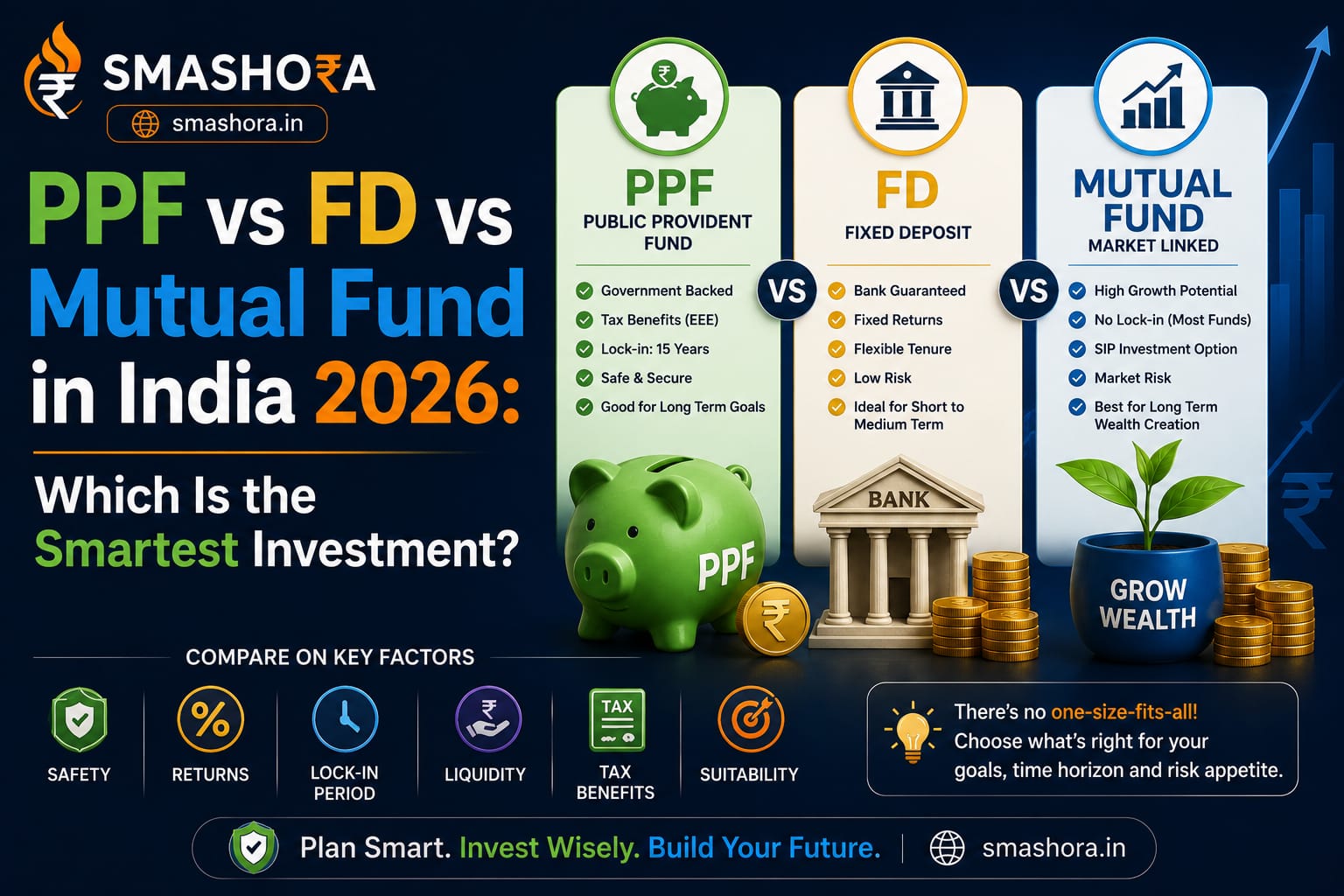
| Feature | PPF | Bank FD | Mutual Fund (Equity) |
|---|---|---|---|
| Current Returns | 7.1% per year (tax free) | 6.5% to 7.5% per year (taxable) | 10% to 15% per year (historical, not guaranteed) |
| Returns Type | Guaranteed by government | Guaranteed by bank | Market-linked, not guaranteed |
| Lock-in Period | 15 years | 7 days to 10 years | None (except ELSS — 3 years) |
| Tax on Returns | Completely tax free | Fully taxable as income | 10% LTCG above ₹1.25 lakh per year |
| Risk Level | Zero — government backed | Very Low — DICGC insured up to ₹5 lakh | Moderate to High depending on fund type |
| Minimum Investment | ₹500 per year | ₹1,000 typically | ₹100 per month (SIP) |
| Maximum Investment | ₹1.5 lakh per year | No upper limit | No upper limit |
| Liquidity | Very Low — 15 year lock-in | Moderate — penalty on early exit | High — redeem anytime (except ELSS) |
What is PPF and Who Should Use It?
The Public Provident Fund is a government-backed long-term savings scheme that has been one of the most trusted investment options in India for decades. When comparing PPF vs FD vs mutual fund in India 2026, PPF stands out clearly for one thing above all else: its tax treatment is unmatched.
PPF follows the EEE (Exempt-Exempt-Exempt) tax structure. The amount you invest qualifies for Section 80C deduction under the Old Tax Regime. The interest you earn every year is completely tax free. And the maturity amount you receive after 15 years is also fully tax free. No other mainstream investment option in India in 2026 offers this triple tax advantage.
PPF Key Details in 2026
- Interest Rate: 7.1% per year (set by government quarterly, has remained stable)
- Lock-in: 15 years (extendable in 5-year blocks)
- Maximum Annual Investment: ₹1.5 lakh per year
- Partial Withdrawal: Allowed from year 7 onwards
- Loan Against PPF: Available from year 3 to year 6
- Where to Open: SBI, Post Office, HDFC, ICICI, most major banks
- Tax Benefit: Section 80C deduction under Old Regime plus tax-free returns
PPF Is Best For
- Retirement corpus building over 15 to 30 years
- Risk-averse investors who want guaranteed, government-backed returns
- People in the 20% or 30% tax bracket who want tax-free long-term returns
- Anyone who wants a disciplined forced savings vehicle with no market anxiety
PPF Drawbacks to Know
- The 15-year lock-in is extremely rigid — not suitable if you may need the money before that
- Maximum investment is capped at ₹1.5 lakh per year — not scalable for high earners
- Returns are modest compared to equity mutual funds over long periods
- Not available under the New Tax Regime for 80C deductions
What is a Fixed Deposit and Who Should Use It?
A bank fixed deposit is the most familiar investment option for most Indians — you deposit a lump sum with a bank for a fixed period and earn a guaranteed interest rate. In the PPF vs FD vs mutual fund in India 2026 comparison, FDs score highest on simplicity and short-term guaranteed returns.
FD Interest Rates in India 2026
| Bank | FD Rate (1 to 3 years) | Senior Citizen Rate |
|---|---|---|
| SBI | 6.8% to 7.0% | 7.3% to 7.5% |
| HDFC Bank | 7.0% to 7.25% | 7.5% to 7.75% |
| ICICI Bank | 6.9% to 7.1% | 7.4% to 7.6% |
| Axis Bank | 7.0% to 7.2% | 7.5% to 7.7% |
| Small Finance Banks | 7.5% to 9.0% | 8.0% to 9.5% |
FD Is Best For
- Short to medium-term goals — 1 to 5 years
- Emergency fund parking (especially sweep-in FDs)
- Retired individuals and senior citizens who need predictable income
- Conservative investors who cannot tolerate any market fluctuation
- Capital that must be guaranteed — home down payment savings, upcoming education fees
FD Drawbacks to Know
- Interest is fully taxable as income — a 7% FD earns only 4.9% effective post-tax returns for someone in the 30% tax slab
- Returns barely beat inflation over long periods — 6% to 7.5% gross vs 5% to 6% inflation means almost zero real growth
- Premature withdrawal attracts a penalty of 0.5% to 1% on the interest rate
- TDS of 10% is deducted at source if annual FD interest exceeds ₹40,000 (₹50,000 for senior citizens)
What are Mutual Funds and Who Should Use Them?
In the PPF vs FD vs mutual fund in India 2026 debate, mutual funds offer the highest growth potential of the three — but with market-linked risk that the other two do not carry. A mutual fund pools money from thousands of investors and invests it in stocks, bonds, or other securities managed by a professional fund manager.
Equity mutual funds — which invest primarily in stocks — have historically delivered 10% to 15% annualised returns over 7 to 10 year periods in India. That is significantly higher than PPF at 7.1% or FDs at 6.5% to 7.5%, but those returns are not guaranteed and they come with short-term volatility that can be unsettling for new investors.
Types of Mutual Funds Relevant to This Comparison
| Fund Type | Risk | Expected Returns | Best Investment Horizon |
|---|---|---|---|
| Large Cap Equity Fund | Moderate | 10% to 12% per year | 5 years and above |
| Flexi Cap Fund | Moderate to High | 11% to 14% per year | 7 years and above |
| ELSS (Tax Saver Fund) | Moderate to High | 11% to 14% per year | 3 years minimum, 7 years ideal |
| Liquid Fund | Very Low | 6% to 7.5% per year | 1 day to 3 months |
| Debt Short Duration Fund | Low | 6.5% to 8% per year | 1 to 3 years |
Mutual Funds Are Best For
- Long-term wealth creation — retirement, child education, financial freedom goals 7 to 20 years away
- Investors who can handle short-term market ups and downs without panicking
- Tax-efficient investment — LTCG of 10% only above ₹1.25 lakh per year, compared to fully taxable FD returns
- Scalable investing — no upper limit on how much you can invest, unlike PPF
- Emergency fund parking in liquid funds — better returns than savings accounts with next-day liquidity
Mutual Fund Drawbacks to Know
- Returns are not guaranteed — a bad year in markets can show negative returns in your equity fund
- Requires emotional discipline — many investors sell in panic during market corrections and lock in losses
- Requires understanding of fund types, categories, and selection — more complex than simply opening an FD
- Short-term capital gains tax of 20% applies if equity funds are redeemed within 1 year
PPF vs FD vs Mutual Fund — Returns Comparison Over Time
The most important question in the PPF vs FD vs mutual fund in India 2026 comparison is how much your money actually grows over time in each option. Here is a realistic comparison using ₹1 lakh invested as a lump sum and as ₹5,000 per month SIP over 15 years:
Lump Sum of ₹1 Lakh — Value After 15 Years
| Investment Option | Assumed Rate | Value After 15 Years | Tax on Returns |
|---|---|---|---|
| PPF | 7.1% (tax free) | ₹2.79 lakh | Zero |
| Bank FD (30% tax slab) | 7% gross, 4.9% post tax | ₹2.04 lakh | Taxed as income every year |
| Equity Mutual Fund | 12% per year (historical average) | ₹5.47 lakh | 10% LTCG above ₹1.25 lakh |
Monthly SIP of ₹5,000 — Value After 15 Years
| Investment Option | Monthly Amount | Total Invested | Value After 15 Years |
|---|---|---|---|
| PPF (annual contribution) | ₹5,000 per month | ₹9 lakh | Approximately ₹16.3 lakh (tax free) |
| Recurring Deposit at 7% | ₹5,000 per month | ₹9 lakh | Approximately ₹15.5 lakh (taxable) |
| Equity Mutual Fund SIP at 12% | ₹5,000 per month | ₹9 lakh | Approximately ₹25 lakh |
The numbers make one thing very clear in the PPF vs FD vs mutual fund in India 2026 comparison: over a 15-year period, equity mutual funds create significantly more wealth than PPF or FD. However, that higher return comes with short-term volatility and requires that you stay invested through market downturns without panicking. For our guide on the best mutual funds to start with, read our detailed article on the best SIP to start in India 2026.
Tax Treatment — The Most Overlooked Factor in PPF vs FD vs Mutual Fund in India 2026
Tax treatment is where the PPF vs FD vs mutual fund in India 2026 comparison gets most interesting — and most misunderstood. Many Indians compare the gross returns of FD and PPF without accounting for taxes, which gives a completely misleading picture.
How PPF Returns Are Taxed
PPF follows EEE taxation — the investment, the annual interest, and the final maturity amount are all completely exempt from tax. A 7.1% PPF return is a true 7.1% in your pocket regardless of your income tax slab. This makes PPF particularly valuable for individuals in the 20% or 30% tax bracket.
How FD Returns Are Taxed
FD interest is added to your total income and taxed at your applicable income tax slab rate every financial year. For someone in the 30% tax slab, a 7% FD effectively gives only 4.9% post-tax returns. A 7% FD for someone in the 20% slab gives 5.6% post-tax. This completely changes the PPF vs FD vs mutual fund in India 2026 equation for salaried professionals in higher tax brackets.
How Mutual Fund Returns Are Taxed
For equity mutual funds held for more than 1 year, Long Term Capital Gains (LTCG) tax of 10% applies on gains above ₹1.25 lakh per financial year. For investments held less than 1 year, Short Term Capital Gains (STCG) tax of 20% applies. Debt mutual funds are now taxed as per your income tax slab regardless of holding period. Overall, equity mutual funds have a tax advantage over FDs for most long-term investors, though PPF remains the most tax-efficient of the three.
| Option | Tax on Investment | Tax on Returns | Tax on Maturity | Effective for 30% Slab |
|---|---|---|---|---|
| PPF | 80C deduction (Old Regime) | Zero | Zero | Best tax efficiency |
| FD | No deduction (except 5-year tax saver FD) | Taxed as income every year | Not applicable | Lowest effective returns |
| Equity Mutual Fund | No deduction (except ELSS) | 10% LTCG above ₹1.25 lakh | 10% LTCG above ₹1.25 lakh | Better than FD, slightly below PPF |
For a complete guide on how to declare and manage your investment taxes while filing your return, read our step-by-step article on how to file ITR online in India 2026 before the July 31 deadline.
Which One Should You Choose in 2026? A Goal-Based Answer
The honest answer to the PPF vs FD vs mutual fund in India 2026 question is that all three have a place in a well-structured financial plan — just for different purposes and different timelines. Here is a simple goal-based guide:
| Your Goal | Best Option | Why |
|---|---|---|
| Emergency fund (3 to 6 months expenses) | Savings account or liquid mutual fund | Must be instantly accessible — FD and PPF are not ideal |
| Short-term goal — 1 to 3 years (vacation, car down payment) | Bank FD or debt mutual fund | Guaranteed returns, predictable amount, no equity risk |
| Medium-term goal — 3 to 7 years (home down payment, higher education) | Debt mutual fund or hybrid fund | Better post-tax returns than FD with moderate risk |
| Tax saving under Section 80C | PPF or ELSS mutual fund | PPF for safety, ELSS for higher returns with 3-year lock-in |
| Long-term wealth creation — 7 years and above | Equity mutual fund SIP | Highest growth potential, beats inflation significantly |
| Retirement corpus — 15 to 25 years away | Mix of PPF and equity mutual funds | PPF for guaranteed tax-free base, mutual funds for growth |
| Senior citizen looking for monthly income | FD or SCSS (Senior Citizen Savings Scheme) | Guaranteed predictable income with capital safety |
The Smart Indian Investor’s Approach in 2026
Rather than choosing one winner in the PPF vs FD vs mutual fund in India 2026 debate, the smartest approach is to use all three for the purpose each is designed for:
- Keep your emergency fund in a high-interest savings account and liquid mutual fund. Read our complete guide on how to build an emergency fund in India for the right structure.
- Maximise PPF at ₹1.5 lakh per year for guaranteed, completely tax-free long-term savings — especially if you are in the Old Tax Regime.
- Use FD for short-term capital that must be guaranteed — down payments, upcoming large expenses within 1 to 3 years.
- Put your long-term wealth creation money into equity mutual fund SIPs — the only option in this comparison that has historically beaten inflation significantly over 10 to 15 year periods.
- Protect your family with term insurance before worrying about optimising between these three options — financial planning without adequate life cover is building on an unstable foundation. Our guide on the best term insurance plans in India 2026 covers the top options.
Conclusion — PPF vs FD vs Mutual Fund in India 2026 Has No Single Winner
The PPF vs FD vs mutual fund in India 2026 comparison does not have one universal winner because each option excels at a different job. PPF wins on tax efficiency and government-backed safety for long-term savings. FD wins on simplicity, guaranteed returns, and short-term capital preservation. Equity mutual funds win on long-term wealth creation and inflation-beating growth potential.
The financially savvy Indian in 2026 does not choose one and ignore the others. They use PPF for the guaranteed tax-free foundation of their long-term savings, FDs for short-term and medium-term capital that cannot risk any market fluctuation, and equity mutual fund SIPs for the long-term compounding engine that builds real wealth over 10 to 20 years.
At Smashora, we are here to help every Indian make every rupee count. If this PPF vs FD vs mutual fund in India 2026 guide helped you understand where each investment fits, leave a comment below and tell us which option you are currently using — or share this with a friend who is still trying to figure out where to put their money. https://www.amfiindia.com
Frequently Asked Questions
Is PPF better than FD in India in 2026?
For long-term savings of 15 years or more, PPF is clearly better than FD for most Indian taxpayers. The reason is tax treatment. PPF returns at 7.1% are completely tax free, while FD interest at 7% is taxed as income. For someone in the 30% tax slab, a 7% FD earns only 4.9% post-tax — significantly less than PPF’s tax-free 7.1%. For short-term goals of 1 to 3 years, FD wins because PPF has a 15-year lock-in that makes it completely unsuitable for money you may need soon.
Is mutual fund better than PPF for long-term investment in India?
Over 15 to 20 year investment periods, equity mutual funds have historically delivered significantly higher returns than PPF — approximately 11% to 14% per year vs PPF’s 7.1%. However, PPF returns are guaranteed by the government while mutual fund returns are market-linked and not guaranteed. The right answer depends on your risk tolerance. For a zero-risk guaranteed foundation, PPF is unbeatable. For maximum long-term wealth creation with the ability to handle short-term market volatility, equity mutual funds deliver substantially more over 15 to 20 years.
Should I close my PPF account and put money in mutual funds?
No, you should not close a PPF account to invest in mutual funds. PPF and equity mutual funds serve different purposes in a financial plan. PPF provides a guaranteed, completely tax-free, government-backed foundation for your long-term savings that no mutual fund can replicate. Equity mutual funds provide the growth potential that PPF cannot match. The smartest approach is to maximise PPF at ₹1.5 lakh per year for the guaranteed component, and invest additional savings in equity SIPs for growth. Running both in parallel is better than choosing one over the other.
What is the effective post-tax return on a 7% FD for different tax slabs?
The post-tax return on a 7% FD depends entirely on your income tax slab. In the zero tax slab, the effective return is 7%. In the 5% slab, it is 6.65%. In the 20% slab, it is 5.6%. In the 30% slab, it is 4.9%. This is why FDs are significantly less attractive than they appear for working professionals in higher tax brackets — and why PPF at 7.1% tax-free consistently beats FD at 7% gross for anyone in the 20% or 30% tax slab.
Can I invest in all three — PPF, FD and mutual funds at the same time?
Yes, absolutely. In fact, using all three together is the recommended approach for most Indian investors. Put ₹1.5 lakh per year into PPF for tax-free guaranteed long-term savings. Keep 3 to 6 months of essential expenses in FDs or liquid funds as your emergency and short-term capital reserve. And invest monthly in equity mutual fund SIPs for long-term wealth creation. This three-layer approach gives you safety, liquidity, and growth — three things no single investment option can provide on its own.
Is a 5-year tax-saving FD a good alternative to PPF?
A 5-year tax-saving FD qualifies for Section 80C deduction just like PPF, but the similarities end there. FD interest is fully taxable as income every year while PPF interest is completely tax free. FD matures in 5 years while PPF compounds tax-free for 15 years. For a 30% tax bracket investor, the post-tax effective return on a 7.25% tax-saving FD is around 5.075% — compared to PPF’s fully tax-free 7.1%. The only scenario where a tax-saving FD makes sense over PPF is if you specifically cannot commit to the 15-year PPF horizon and need the money back in 5 years.