Contents
- 1 What is a Demat Account and Why Do You Need One?
- 2 Best Demat Account in India 2026 — Top Platforms Compared
- 3 Best Demat Account in India 2026 — Complete Comparison Table
- 4 Hidden Charges to Watch For When Choosing the Best Demat Account in India 2026
- 5 How to Open the Best Demat Account in India 2026 — Step by Step
- 6 Demat Account vs Trading Account — What Is the Difference?
- 7 Choosing the Best Demat Account in India 2026 — Which Is Right for You?
- 8 Is Your Demat Account Safe in India?
- 9 Conclusion — Open the Best Demat Account in India 2026 Today
- 10 Frequently Asked Questions
- 10.1 Which is the best demat account in India in 2026 for beginners?
- 10.2 Is Zerodha or Groww better in 2026?
- 10.3 What documents are needed to open a demat account in India in 2026?
- 10.4 Can I have multiple demat accounts in India?
- 10.5 Is a demat account safe if the broker goes bankrupt?
- 10.6 Do I need a demat account to invest in mutual funds in India?
Finding the best demat account in India 2026 is the first real step every new investor must take before buying a single share, ETF, or bond. A demat account is your digital locker for all financial securities — stocks, mutual fund units, gold ETFs, bonds, and IPO allotments all live here. Without one, you cannot invest in the Indian stock market at all. And with India’s demat account base crossing 45 million active accounts in early 2026, the question is no longer whether to open one — it is which one to open.
The good news is that finding the best demat account in India 2026 has never been simpler or cheaper. Account opening at top discount brokers like Zerodha, Groww, Upstox, and Angel One is completely free, takes 10 to 15 minutes online, and requires nothing more than your PAN card, Aadhaar, and a selfie. The bad news is that the differences between platforms matter significantly — especially for beginners who may not realise they are paying unnecessary fees or missing features that would make investing far simpler.
This complete guide on the best demat account in India 2026 compares all the major platforms across every dimension that matters — brokerage charges, annual maintenance fees, ease of use, available investment options, trading platforms, and which type of investor each broker is best suited for. By the end you will know exactly which account to open based on how you plan to invest.
What is a Demat Account and Why Do You Need One?
A Demat (Dematerialised) account holds your shares and securities in electronic form — exactly like a bank account holds your money. When you buy shares of Reliance, TCS, or HDFC Bank on NSE or BSE, those shares are automatically credited to your demat account. When you sell them, they are debited and the sale proceeds go to your linked bank account.
Every demat account in India is held through one of two government-regulated depositories: NSDL (National Securities Depository Limited) or CDSL (Central Depository Services Limited). Both are equally safe and regulated by SEBI. Your broker is the intermediary — they provide the trading platform and customer service, while NSDL or CDSL is where your securities are actually stored.
You need a demat account to:
- Buy and sell stocks on NSE or BSE
- Hold and trade Gold ETFs (covered in our guide on how to invest in gold in India 2026)
- Apply for IPOs online
- Hold bonds, NCDs, and sovereign gold bonds
- Invest in direct mutual funds via platforms like Zerodha Coin
- Hold ETFs of all types — index funds, sector funds, international funds
Best Demat Account in India 2026 — Top Platforms Compared
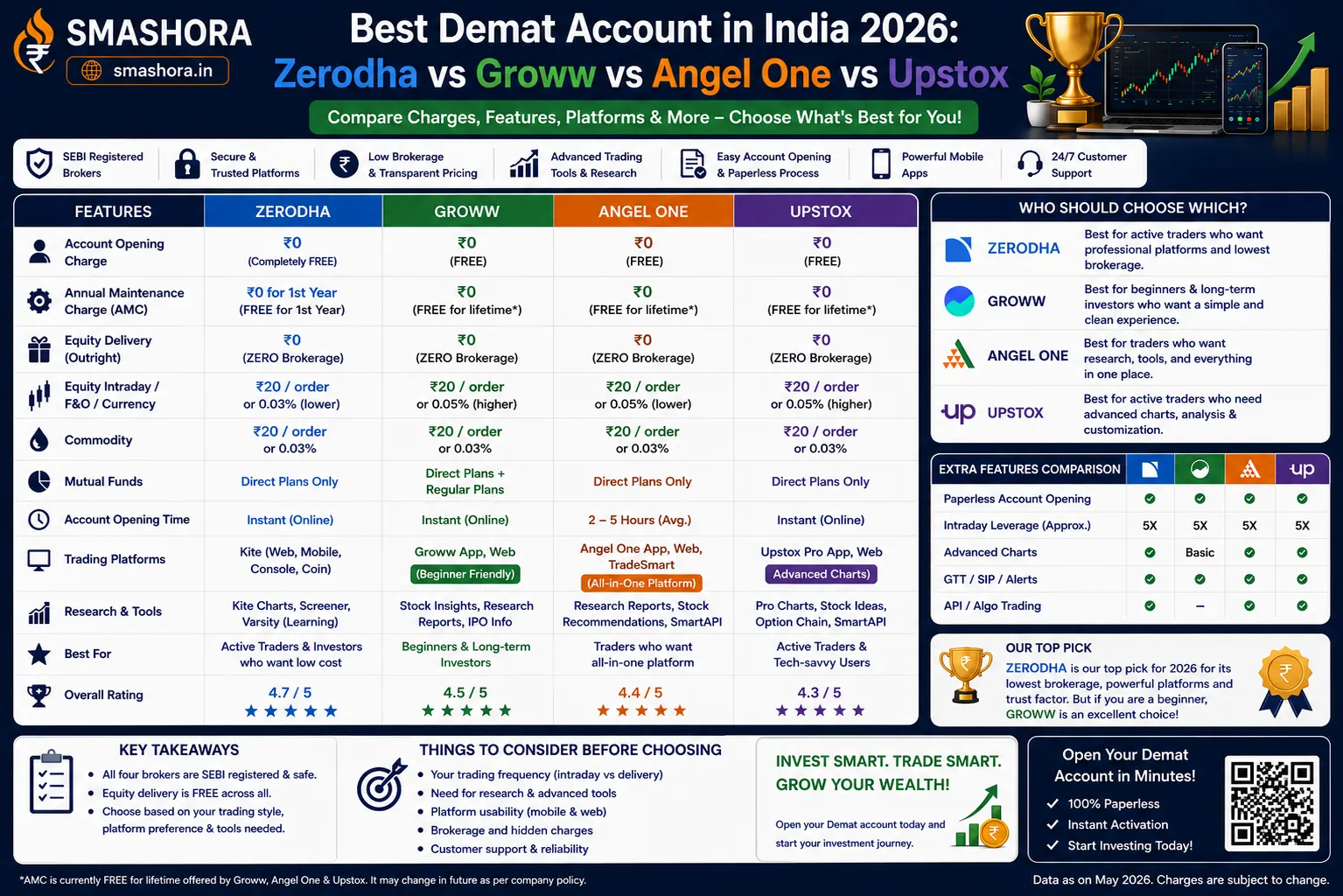
1. Zerodha — Best Overall Demat Account in India 2026
Zerodha is India’s largest stock broker with over 1 crore active clients and is consistently ranked the best demat account in India 2026 for its combination of low cost, powerful trading tools, and investment depth. Founded in 2010, Zerodha pioneered the discount brokerage model in India and remains the gold standard for serious investors and traders.
- Account Opening: Free (completely online via DigiLocker)
- Equity Delivery Brokerage: Zero — no charge on buying and holding stocks for the long term
- Intraday and F&O Brokerage: ₹20 per order or 0.03%, whichever is lower
- Demat AMC: ₹300 per year
- Trading Platform: Kite (web and app) — considered the most powerful and reliable trading platform in India
- Additional Apps: Coin (direct mutual funds), Varsity (free learning), Console (portfolio analytics)
- Depositary: CDSL
- Regulated by: SEBI
Why Zerodha is best overall: Zero brokerage on delivery trading means long-term investors pay absolutely nothing on buy-and-hold stock investments. The Kite platform is fast, stable, and feature-rich with advanced charts and order types. Zerodha Coin gives you access to direct mutual funds at zero commission. For SIP investing via direct plans, no platform does it more cost-efficiently than Zerodha.
Honest consideration: Zerodha does not offer research reports or stock recommendations. If you are a complete beginner who wants guidance on what to buy, Zerodha’s self-directed model can feel overwhelming initially. Their customer support is also primarily ticket-based with no phone support.
Best for: Long-term investors, SIP investors, active traders, and anyone who wants the most powerful and cost-efficient platform available in India in 2026.
2. Groww — Best Demat Account for Beginners in India 2026
Groww is the fastest-growing investment platform in India and the best demat account in India 2026 for first-time investors and beginners. Its mobile app is designed with simplicity as the primary principle — it is the cleanest and easiest-to-navigate investing interface among all major Indian brokers, making the intimidating world of stocks and mutual funds feel genuinely accessible.
- Account Opening: Free (Aadhaar OTP-based, under 10 minutes)
- Equity Delivery Brokerage: Zero
- Intraday Brokerage: ₹20 per order or 0.05%, whichever is lower
- Demat AMC: Free for the first year, then ₹150 per year
- Mutual Fund Investing: Free — no commission on direct fund purchases
- Trading Platform: Groww app (web and mobile) — simple, intuitive, beginner-friendly
- Depositary: CDSL
- Regulated by: SEBI
Why Groww is best for beginners: The app presents complex financial information in a visual, digestible way — stock charts, portfolio performance, fund comparisons are all easy to understand without any prior investing knowledge. Opening an account, making your first SIP, and buying your first stock can all be done in the same session without confusion. For someone reading our guide on the best SIP to start in India 2026 who wants to immediately begin investing, Groww is the most accessible starting point.
Honest consideration: Groww’s trading platform is less powerful than Zerodha Kite for active traders. Advanced charting, order types, and F&O tools are more limited. As your investing sophistication grows, you may find Groww’s simplicity becomes a limitation. Many experienced investors start on Groww and migrate to Zerodha as their needs evolve.
Best for: Complete beginners, young investors starting their first SIP, and anyone who prioritises ease of use over advanced trading features.
3. Angel One — Best Demat Account for Research and Guidance
Angel One (formerly Angel Broking) is the best demat account in India 2026 for investors who want a combination of low brokerage and research support. While Zerodha and Groww are purely self-directed platforms, Angel One provides research reports, stock recommendations, and analyst calls — making it better suited for investors who want some guidance alongside their investing journey.
- Account Opening: Free
- Equity Delivery Brokerage: Zero for delivery trades
- Intraday Brokerage: Up to ₹20 per order
- Demat AMC: ₹240 per year
- Research: Research reports, stock picks, fundamental and technical analysis provided
- Trading Platform: Angel One app and SmartAPI for algorithmic trading
- Depositary: CDSL
- Regulated by: SEBI
Why Angel One stands out: The combination of discount pricing (₹20 flat brokerage) with access to research and advisory support is unique among major brokers. Angel One’s ARQ Prime feature provides algorithm-based investment recommendations based on your investment profile. For beginners who want some hand-holding beyond just a clean interface, Angel One offers more support than Zerodha or Groww.
Honest consideration: Research-based recommendations should always be taken as one input among many — not as definitive buy signals. Angel One’s trading platform is decent but not as powerful as Zerodha Kite for advanced charting.
Best for: Investors who want low-cost trading combined with research reports and stock recommendations. Also suitable for investors interested in algorithmic and SmartAPI trading.
4. Upstox — Best Low-Cost Demat Account for Active Traders
Upstox (backed by Tiger Global and Ratan Tata) is a strong contender for the best demat account in India 2026 among cost-conscious active traders. It offers competitive flat-rate brokerage on intraday and F&O trades and a solid trading platform that sits between Groww’s simplicity and Zerodha’s complexity.
- Account Opening: Free
- Equity Delivery Brokerage: Zero
- Intraday Brokerage: ₹20 per order or 0.1%, whichever is lower
- Demat AMC: ₹150 per year
- Trading Platform: Upstox Pro (web and app)
- Depositary: CDSL
- Regulated by: SEBI
Best for: Budget-conscious traders who want a capable trading platform without paying Zerodha’s higher AMC. Also suitable for investors who want a balance between Groww’s simplicity and Zerodha’s power.
5. ICICI Direct — Best Full-Service Demat Account
ICICI Direct is the most popular full-service broker and the best demat account in India 2026 for investors who want their banking, trading, and demat account integrated into one seamless experience. As part of the ICICI ecosystem, it offers seamless fund transfers between your ICICI savings account and your trading account in real time.
- Account Opening: Free for existing ICICI Bank customers
- Equity Delivery Brokerage: 0.55% per trade — significantly higher than discount brokers
- Intraday Brokerage: 0.275% per trade
- Demat AMC: ₹700 per year
- Research: Full research reports, analyst recommendations, market updates
- Trading Platform: ICICIdirect.com and iMobile app
- Depositary: NSDL
Best for: Existing ICICI Bank customers who want seamless banking-trading integration and are comfortable paying higher brokerage for the full-service experience. Not recommended for cost-conscious investors who trade actively.
Best Demat Account in India 2026 — Complete Comparison Table
| Feature | Zerodha | Groww | Angel One | Upstox | ICICI Direct |
|---|---|---|---|---|---|
| Account Opening | Free | Free | Free | Free | Free (ICICI customers) |
| Delivery Brokerage | Zero | Zero | Zero | Zero | 0.55% |
| Intraday Brokerage | ₹20 or 0.03% | ₹20 or 0.05% | Up to ₹20 | ₹20 or 0.1% | 0.275% |
| Demat AMC | ₹300/year | Free (then ₹150) | ₹240/year | ₹150/year | ₹700/year |
| Ease of Use | Moderate | Very Easy | Easy | Easy | Moderate |
| Research Reports | No | Basic | Yes — full research | Basic | Yes — full research |
| Direct Mutual Funds | Yes (Coin app) | Yes (free) | Yes | Yes | Yes |
| Gold ETF Investing | Yes | Yes | Yes | Yes | Yes |
| IPO Application | Yes | Yes | Yes | Yes | Yes |
| Best For | All investors, traders | Beginners, SIP | Research seekers | Budget traders | ICICI customers |
| Overall Rating | 4.8 out of 5 | 4.5 out of 5 | 4.3 out of 5 | 4.2 out of 5 | 3.8 out of 5 |
Hidden Charges to Watch For When Choosing the Best Demat Account in India 2026
Many investors focus only on brokerage rates and AMC when choosing the best demat account in India 2026, but several other charges can add up significantly over time:
DP Transaction Charges
Every time you sell shares from your demat account, the depository (CDSL or NSDL) charges a Depository Participant (DP) transaction fee. This is separate from brokerage and is typically ₹13.5 to ₹20 per debit transaction regardless of the trade size. For frequent sellers, these charges accumulate over time. Always check the DP charge rate at your chosen broker before opening your best demat account in India 2026.
Pledging Charges
If you want to pledge shares as margin for F&O trading, brokers charge a pledging fee. Zerodha charges ₹30 plus GST per pledge instruction. This matters for active F&O traders but is irrelevant for long-term delivery investors.
SMS and Email Alert Charges
Some brokers charge ₹40 to ₹60 per quarter for SMS trade confirmations. While small, these add up. Zerodha charges ₹45 per quarter for SMS alerts — opt for email-only notifications if you want to avoid this.
Off-Market Transfer Charges
Transferring shares from one demat account to another (off-market transfer) attracts charges of 0.02% to 0.03% of the value at most brokers. This is relevant when consolidating accounts or transferring to a family member’s demat account.
How to Open the Best Demat Account in India 2026 — Step by Step
Opening the best demat account in India 2026 is fully digital and takes under 15 minutes for most applicants:
- Choose your broker: Based on the comparison above, pick the platform that best matches your investing style — Groww for beginners, Zerodha for serious investors and traders, Angel One if you want research support
- Download the app or visit the website: All major brokers offer account opening through their mobile app or website
- Enter basic details: Mobile number, email, PAN card number
- Complete Aadhaar OTP verification: Aadhaar-based eKYC verifies your identity and address instantly without any physical document submission
- Upload PAN card and bank details: Bank account linking is required for fund transfers to and from your trading account
- Complete video KYC: A 2 to 3 minute video call or selfie-based verification required by SEBI regulations
- Sign the account opening form: Digitally via Aadhaar OTP or e-sign
- Account activated: Your demat and trading account details are emailed within 24 to 48 hours
Documents needed: PAN card, Aadhaar card linked to your active mobile number, bank account details (account number and IFSC code), and a selfie or short video for KYC.
Demat Account vs Trading Account — What Is the Difference?
Many first-time investors confuse demat and trading accounts. When you open an account with any broker, you actually get three linked accounts working together:
| Account Type | Purpose | Where It Is Held |
|---|---|---|
| Demat Account | Holds your securities electronically (stocks, ETFs, bonds) | NSDL or CDSL (depository) |
| Trading Account | Used to place buy and sell orders on stock exchanges | Your broker (Zerodha, Groww etc.) |
| Bank Account | Source of funds for buying securities and destination for sale proceeds | Your bank (SBI, HDFC etc.) |
When you open the best demat account in India 2026 with any discount broker, they automatically create both your demat account and your trading account simultaneously. You just link your existing bank account. All three work together seamlessly for every trade.
Choosing the Best Demat Account in India 2026 — Which Is Right for You?
| Your Profile | Best Demat Account Recommendation |
|---|---|
| Complete beginner, first investment | Groww — simplest interface, free mutual fund investing, zero confusion |
| Long-term stock investor, buy and hold | Zerodha — zero delivery brokerage, Kite platform, Coin for direct mutual funds |
| Active intraday or F&O trader | Zerodha — most powerful platform, fastest execution, stable Kite |
| Wants research and stock recommendations | Angel One — research reports, ARQ Prime recommendations, affordable AMC |
| SIP investor wanting direct mutual funds | Groww or Zerodha Coin — both offer zero-commission direct fund SIPs |
| Gold ETF investor | Any of the above — all support Gold ETF investing via demat account |
| ICICI Bank customer wanting integration | ICICI Direct — seamless banking integration despite higher brokerage |
| Budget-conscious active trader | Upstox — low AMC, capable platform, flat ₹20 intraday brokerage |
Once you have your demat account open, your next step is putting it to work. Read our guide on the best SIP to start in India 2026 to begin your first mutual fund investment. And if you want to invest in gold via your demat account, our guide on how to invest in gold in India 2026 covers exactly how Gold ETFs work and which ones to choose.
Is Your Demat Account Safe in India?
Safety is a common concern for new investors choosing the best demat account in India 2026. Here is what protects you:
- SEBI regulation: All brokers and demat accounts are regulated by the Securities and Exchange Board of India. For the latest guidelines and investor protection measures, visit the SEBI official website.
- Depository segregation: Your securities are held directly with CDSL or NSDL — not with the broker. Even if a broker goes bankrupt (like the Karvy case in 2019), your shares held in the depository are safe and can be transferred to another broker.
- Two-factor authentication: All SEBI-regulated brokers in India require two-factor authentication (2FA) for login and trade placement — typically via OTP sent to your registered mobile number.
- CDSL Easiest facility: You can view all your demat holdings directly on the CDSL website independently of your broker — providing an additional layer of verification of your holdings.
- Investor Protection Fund: BSE and NSE maintain Investor Protection Funds that can compensate investors in cases of broker default up to specified limits.
Always choose SEBI-registered brokers and never share your trading PIN or OTP with anyone — including people claiming to be broker representatives. Your CIBIL score is not directly related to your demat account, but maintaining good financial health overall helps your investing journey — read our guide on how to improve your CIBIL score for the complete picture.
Conclusion — Open the Best Demat Account in India 2026 Today
The best demat account in India 2026 for most investors is Zerodha for its zero delivery brokerage, powerful Kite platform, and comprehensive investment options. For complete beginners who prioritise simplicity above everything, Groww is the easiest and most accessible starting point. For investors who want research and guidance alongside low-cost trading, Angel One delivers both at competitive pricing.
Whatever you choose, the most important thing is to open your best demat account in India 2026 today and start investing — even ₹500 per month in an index fund SIP through your demat account compounds meaningfully over 10 to 15 years. The perfect platform matters far less than the habit of investing consistently. Start now, refine later.
At Smashora, our mission is to help every Indian make every rupee count. If this guide on the best demat account in India 2026 helped you decide which platform to open, leave a comment below and let us know which broker you chose — or share it with a friend who has been putting off starting their investment journey.
Frequently Asked Questions
Which is the best demat account in India in 2026 for beginners?
Groww is the best demat account in India 2026 for complete beginners due to its clean, simple app interface, free mutual fund investing with no commission, zero delivery brokerage on stocks, and very fast account opening in under 10 minutes. For beginners who graduate to more serious investing and want advanced charting and trading tools, Zerodha is the natural next step. Many first-time investors start with Groww and open a Zerodha account later for its more powerful Kite platform without closing their Groww account.
Is Zerodha or Groww better in 2026?
Both are excellent but serve different investor profiles. Zerodha is better for serious long-term investors, active traders, and anyone who wants the most powerful and feature-complete platform available in India in 2026. Groww is better for beginners, casual SIP investors, and anyone who prioritises ease of use over advanced features. If you are choosing the best demat account in India 2026 for your very first investment, start with Groww. If you plan to invest in individual stocks actively, trade intraday, or want direct mutual funds with portfolio analytics, choose Zerodha.
What documents are needed to open a demat account in India in 2026?
Opening the best demat account in India 2026 requires: PAN card (mandatory for all market investments), Aadhaar card linked to your active mobile number for OTP-based eKYC, bank account details (account number and IFSC code) for fund transfer linkage, a selfie or short video for SEBI-mandated video KYC, and a digital signature via Aadhaar OTP for the account opening form. No physical documents need to be submitted or couriered. The entire process is completed online in 10 to 15 minutes at all major discount brokers.
Can I have multiple demat accounts in India?
Yes. You can open multiple demat accounts with different brokers using the same PAN card. There is no restriction on the number of demat accounts per person in India. Many experienced investors maintain accounts at multiple brokers — for example, Zerodha for equity trading and Groww for mutual fund SIPs. However, you must pay AMC for each account separately, so keep only accounts you actively use to avoid unnecessary charges accumulating.
Is a demat account safe if the broker goes bankrupt?
Yes, your securities are safe even if your broker fails. Your shares and other securities are held directly with CDSL or NSDL (the depositories) — not with the broker. The broker only has execution access, not custody of your assets. If a broker goes bankrupt, SEBI’s regulations require the transfer of client securities back to clients or to another broker. You can verify your holdings independently on the CDSL or NSDL website at any time. BSE and NSE also maintain Investor Protection Funds for additional security.
Do I need a demat account to invest in mutual funds in India?
Not necessarily. You can invest in mutual funds in India through the Asset Management Company’s own website, the AMFI’s MFCentral platform, or through apps like Paytm Money — all without a demat account. However, if you want to invest in direct mutual fund plans with portfolio analytics, zero commission, and the ability to also invest in stocks and ETFs from one account, a demat account with Zerodha Coin or Groww is more convenient. If your only goal is mutual fund SIPs, you do not strictly need a demat account to get started.