
Contents
- 1 What is a CIBIL Score and Why Does It Matter?
- 2 How to Check Your CIBIL Score for Free in India (2026)
- 3 What Affects Your CIBIL Score? The 5 Key Factors
- 4 How to Improve Your CIBIL Score — 7 Proven Steps
- 4.1 Step 1 — Never Miss an EMI or Credit Card Payment
- 4.2 Step 2 — Keep Credit Card Utilisation Below 30%
- 4.3 Step 3 — Do Not Close Old Credit Cards
- 4.4 Step 4 — Check Your CIBIL Report for Errors and Dispute Them
- 4.5 Step 5 — Avoid Multiple Loan Applications in a Short Period
- 4.6 Step 6 — Build Credit From Scratch With a Secured Credit Card
- 4.7 Step 7 — Maintain a Healthy Mix of Secured and Unsecured Credit
- 5 How Long Does It Take to Improve Your CIBIL Score?
- 6 Common Myths About Improving Your CIBIL Score — Busted
- 7 What CIBIL Score Do You Need for a Home Loan in India?
- 8 Conclusion — Start Today, See Results in 3 Months
- 9 Frequently Asked Questions
- 9.1 How to improve CIBIL score quickly in India?
- 9.2 How to improve CIBIL score from 600 to 750?
- 9.3 Is it safe to check CIBIL score on Paytm or BankBazaar?
- 9.4 Does closing a credit card hurt your CIBIL score?
- 9.5 Can I get a home loan with a CIBIL score of 680?
- 9.6 How often does CIBIL update my score?
If you want to know how to improve your CIBIL score quickly and reliably, you are in the right place. Your CIBIL score is a 3-digit number that decides whether your home loan gets approved, what interest rate you pay on a personal loan, and whether your next credit card application succeeds or fails. Most Indians either do not know their score or have never checked it — and that is costing them lakhs of rupees in higher interest rates.
I have seen this firsthand. A close friend applied for a home loan last year, convinced everything was in order. The bank came back asking questions about a small credit card outstanding from 2021 he had completely forgotten about. That one missed payment had quietly dragged his CIBIL score below 700, and suddenly the interest rate on offer was nearly 1% higher than advertised. On a ₹50 lakh loan over 20 years, that difference adds up to over ₹5 lakh extra in interest.
The good news? Your CIBIL score is not fixed. You can check it for free today, and with the right steps, you can improve your CIBIL score — even if it is currently sitting at 600 or below. This guide covers everything: how to check it, what damages it, and exactly how to push it above 750 in India in 2026.
What is a CIBIL Score and Why Does It Matter?
A CIBIL score is a 3-digit number between 300 and 900 calculated by TransUnion CIBIL — one of India’s four licensed credit bureaus. It is based entirely on your credit history: how you have managed loans, credit cards, and EMI payments over the years.
Banks and NBFCs check your CIBIL score every single time you apply for a loan or credit card. A high score signals that you are a trustworthy borrower. A low score can mean rejection or significantly higher interest rates — which is why learning how to improve your CIBIL score is one of the most valuable financial skills you can develop.
CIBIL Score Ranges — What Does Your Score Mean?
| Score Range | Rating | What It Means for You |
|---|---|---|
| 750 – 900 | Excellent | Best loan rates, fast approvals, premium credit cards |
| 700 – 749 | Good | Most loans approved at decent interest rates |
| 650 – 699 | Fair | Loans possible but at higher interest rates |
| 600 – 649 | Poor | Difficult approvals, high rejection risk |
| 300 – 599 | Very Poor | Loan rejections very likely — urgent action needed |
Most banks in India — SBI, HDFC Bank, ICICI Bank — require a minimum CIBIL score of 750 for home loans at the best rates. If your score is below 700, you are likely paying significantly more than necessary.
How to Check Your CIBIL Score for Free in India (2026)
Before you can improve your CIBIL score, you need to know exactly where you stand. Here are the best free ways to check it right now:
1. CIBIL Official Website — Most Accurate Source
You get one free full credit report per year directly from TransUnion CIBIL’s official website. Visit cibil.com, create an account with your PAN number and mobile number, verify via OTP, and your CIBIL score and full report are displayed instantly.
2. Paytm App — Easiest Option
Open Paytm → go to “Loans & Credit Cards” → tap “Check Credit Score”. Paytm shows your CIBIL score for free and updates it every month. Since Paytm is already installed on most Indian smartphones, this is the quickest way to check your score without opening a new account anywhere.
3. BankBazaar or PaisaBazaar
Both platforms offer instant free CIBIL score checks using your PAN details. They also send monthly score update reminders via email — useful for tracking your improvement progress when you are actively working to improve your CIBIL score.
4. Your Bank’s Mobile App
HDFC Bank, ICICI iMobile, Kotak 811, and Axis Mobile all now have a free credit score section built directly into the app. Check under the “Loans” or “Credit” tab — no separate account needed.
5. Google Pay
Open Google Pay → tap your profile photo → scroll to “Credit Score”. Google Pay shows your Experian credit score for free, which is very close to your CIBIL score and refreshes monthly.
Important: Checking your own score is a “soft inquiry” and does not reduce your CIBIL score — no matter how many times you check it.
What Affects Your CIBIL Score? The 5 Key Factors
To effectively improve your CIBIL score, you must understand what actually goes into calculating it. CIBIL uses five factors — and targeting the right ones makes all the difference:
| Factor | Weightage | What It Covers |
|---|---|---|
| Payment History | ~35% | On-time EMI and credit card bill payments |
| Credit Utilisation | ~30% | How much of your total credit limit you are using |
| Credit Age | ~15% | How long your credit accounts have been active |
| Credit Mix | ~10% | Combination of secured loans and unsecured credit |
| New Credit Enquiries | ~10% | Number of recent loan or credit card applications |
How to Improve Your CIBIL Score — 7 Proven Steps
Here is a practical, step-by-step plan to improve your CIBIL score from wherever it stands today. Real improvement takes 3 to 6 months of consistent action — but every step below has a direct, measurable impact on your score.
Step 1 — Never Miss an EMI or Credit Card Payment
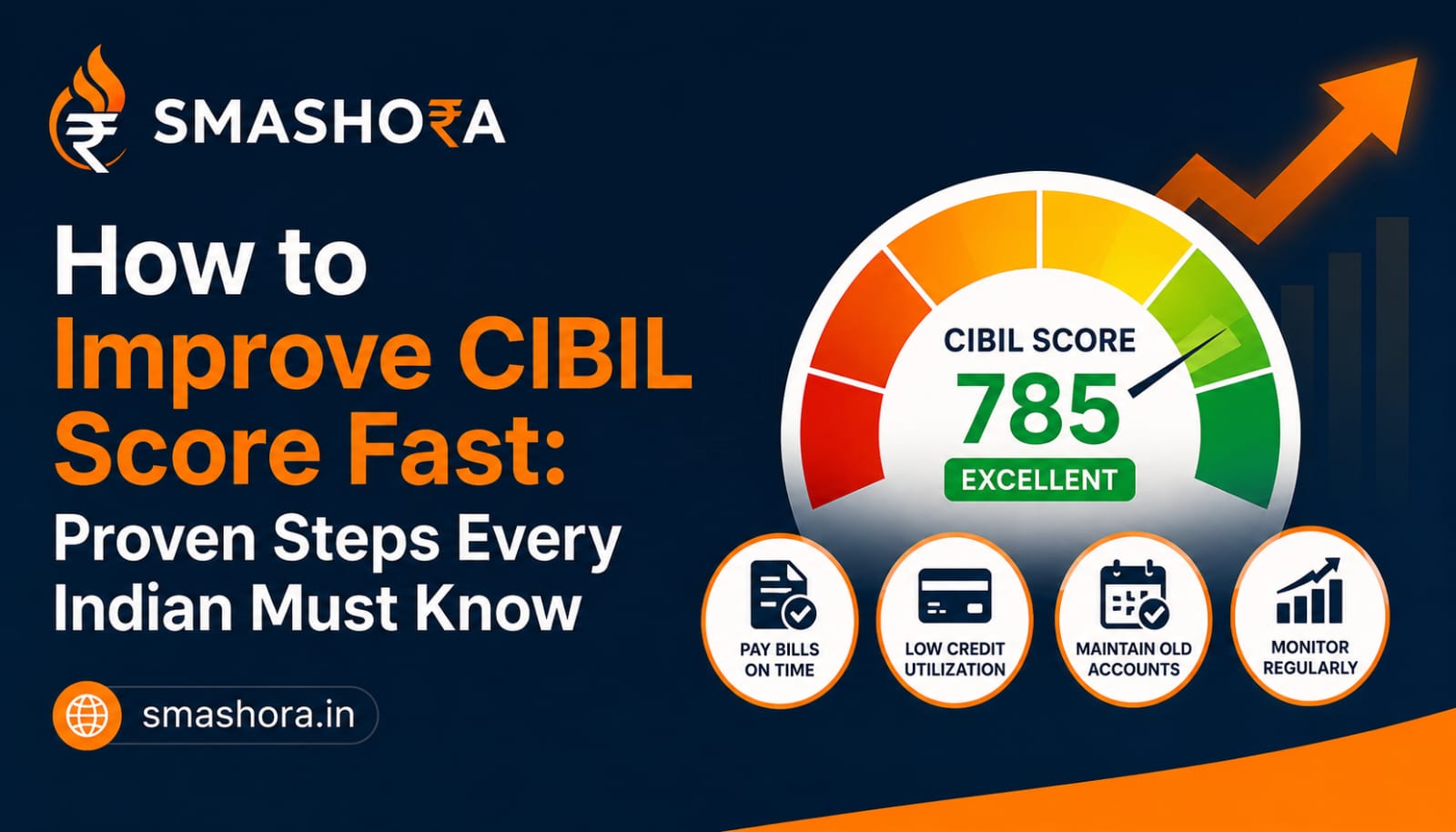
Payment history accounts for roughly 35% of your CIBIL score — the single biggest factor. Even one missed EMI can drop your score by 50 to 100 points overnight. The most powerful thing you can do to improve your CIBIL score is to set up auto-pay for every EMI and credit card minimum due amount right now. Go to HDFC NetBanking, SBI YONO, or ICICI iMobile and enable auto-debit today — this one step alone protects your score permanently going forward.
Step 2 — Keep Credit Card Utilisation Below 30%
Credit utilisation is the percentage of your total credit limit that you are currently using. If your card limit is ₹1,00,000 and you regularly spend ₹70,000 on it, your utilisation is 70% — which signals financial stress to lenders. The golden rule to improve your CIBIL score through utilisation: stay below 30%. On a ₹1,00,000 limit, that means spending no more than ₹30,000 per billing cycle. If you need to spend more, pay mid-cycle before your statement is generated, or request a credit limit increase from your bank.
Step 3 — Do Not Close Old Credit Cards
Closing an old unused credit card feels like good financial hygiene — but it actually hurts your CIBIL score. An old card that has been active for 5–10 years contributes positively to your credit age, which is 15% of your score. Instead of closing old cards, keep them active with one small purchase every 2–3 months and pay it off in full. This keeps the account alive and your credit age intact.
Step 4 — Check Your CIBIL Report for Errors and Dispute Them
This is the most underrated step to improve your CIBIL score fast. Credit report errors are far more common than most Indians realise — a loan you already fully repaid still showing as “outstanding”, a credit card that is not yours appearing on your report, or a wrong PAN match causing someone else’s data to appear on your file.
- Download your full credit report from cibil.com (free once a year)
- Go through every account — check outstanding amounts, payment status, and account type
- If you spot an error, go to the CIBIL website → “Dispute Centre” → raise a dispute
- CIBIL is legally required to investigate and respond within 30 days
Cases where people’s scores jumped by 80–100 points just from correcting a wrongly reported “Settled” account to “Closed” are not rare. Always verify your report before assuming your score is accurate.
Step 5 — Avoid Multiple Loan Applications in a Short Period
Every time you apply for a loan or credit card, the lender performs a “hard inquiry” on your CIBIL report. Each hard inquiry slightly reduces your score. Applying for 3 credit cards and 2 loans in the same month means 5 hard inquiries — which lenders read as a sign of credit desperation and raises a serious red flag.
Apply for new credit only when genuinely needed. If your application was rejected, wait at least 3–6 months before trying again. Use eligibility checkers on BankBazaar or PaisaBazaar first — these use soft inquiries that have zero effect on your CIBIL score.
Step 6 — Build Credit From Scratch With a Secured Credit Card
If your CIBIL report shows “NH” (No History) or “-1”, you have no credit history at all. Interestingly, banks find this harder to handle than a low score. The fastest way to build your score from zero in India is to get a secured credit card — issued against a fixed deposit of as little as ₹10,000–₹20,000 at banks like SBI, Axis Bank, or ICICI Bank. Use it for small monthly purchases, pay the full bill every month, and within 6–12 months you will have a solid CIBIL score above 700.
Step 7 — Maintain a Healthy Mix of Secured and Unsecured Credit
CIBIL rewards borrowers who manage different types of credit responsibly. Having only credit cards, or only a home loan, is not ideal. A mix of secured loans (home loan, car loan, gold loan) and unsecured credit (credit cards, personal loan) signals financial maturity. If you currently only have credit cards, even a small personal loan repaid on time can improve your credit mix score and help boost your overall CIBIL score over time.
How Long Does It Take to Improve Your CIBIL Score?
| Current Score | Target Score | Realistic Timeframe |
|---|---|---|
| 300 – 500 | 650+ | 12 – 24 months |
| 500 – 600 | 700+ | 9 – 12 months |
| 600 – 650 | 750+ | 6 – 9 months |
| 650 – 700 | 750+ | 3 – 6 months |
| 700 – 749 | 780+ | 2 – 4 months |
CIBIL updates your score once a month when your bank submits fresh data. The minimum time between taking action and seeing it reflect in your score is 30–45 days. Stay consistent and patient — the results will show up.
Common Myths About Improving Your CIBIL Score — Busted
Myth 1: Checking Your Score Damages It
False. Checking your own score is a soft inquiry with zero negative impact. Only hard inquiries — when a lender checks your score after you apply for credit — have a minor negative effect.
Myth 2: A High Salary Automatically Means a High CIBIL Score
False. Your income is not factored into the CIBIL score calculation at all. A person earning ₹4 lakh per year who never misses a payment will have a better CIBIL score than someone earning ₹50 lakh who regularly defaults.
Myth 3: Settling a Loan Is the Same as Paying It Off
False. When you “settle” a loan — meaning you pay less than the full amount after negotiating with the lender — CIBIL marks it as “Settled”, not “Closed”. “Settled” is a negative marker that stays on your report for 7 years. Always pay the full outstanding amount if possible. “Closed” is dramatically better than “Settled” on your CIBIL report.
Myth 4: A Joint Loan Does Not Affect Your Individual Score
False. If you are a co-applicant or guarantor on someone else’s loan and they miss payments, it directly and immediately impacts your CIBIL score. Be very careful before agreeing to co-sign any loan.
What CIBIL Score Do You Need for a Home Loan in India?
Major banks in India — SBI, HDFC Bank, ICICI Bank, Axis Bank, Kotak Mahindra Bank — typically require a minimum CIBIL score of 700–750 to approve a home loan. However, the best advertised interest rates are reserved exclusively for borrowers with 750 and above.
To put the numbers in perspective: on a ₹40 lakh home loan over 20 years, the difference between an 8.5% rate (750+ score) and a 9.5% rate (680 score) is approximately ₹5–6 lakh in total extra interest paid. Working to improve your CIBIL score before applying for a home loan is literally worth lakhs of rupees.
For more about how Smashora helps Indians make smarter money decisions, visit our About Us page.
Conclusion — Start Today, See Results in 3 Months
Knowing how to improve your CIBIL score is one of the most valuable financial skills any Indian can develop. The steps are not complicated — pay on time every month, keep credit utilisation below 30%, do not close old cards, check your report for errors, and avoid unnecessary loan applications. None of these cost money. They only require awareness and consistency.
A CIBIL score of 750+ opens real financial doors — lower loan rates, faster approvals, and access to premium credit cards with genuine rewards. Start today by checking your score for free on cibil.com or via Paytm, find out exactly where you stand, and take the first step.
At Smashora, our mission is simple — help every Indian make every rupee count. Found this guide useful? Drop a comment below and share it with someone who needs to start working on their CIBIL score today.
Frequently Asked Questions
How to improve CIBIL score quickly in India?
The fastest ways to improve your CIBIL score in India are: set up auto-pay for all EMIs so you never miss a payment, reduce your credit card utilisation below 30%, and check your CIBIL report for errors and raise disputes immediately. Correcting a reporting error can improve your score within 30–45 days — the fastest possible improvement without waiting months for payment history to build up.
How to improve CIBIL score from 600 to 750?
Moving from 600 to 750 typically takes 6–9 months of consistent effort. Start by clearing any overdue amounts immediately, then set up auto-pay on all future payments. Keep credit card utilisation below 30%, do not apply for any new loans during this period, and check your CIBIL report for errors. If you find any wrongly reported accounts, dispute them on cibil.com — a single correction can jump your score by 50–100 points instantly.
Is it safe to check CIBIL score on Paytm or BankBazaar?
Yes, completely safe. Paytm, BankBazaar, and PaisaBazaar are authorised credit bureau partners. They use your PAN number to fetch your official score via secure API. Always use the official app downloaded from Google Play Store or Apple App Store — not third-party lookalike websites.
Does closing a credit card hurt your CIBIL score?
Yes, it can hurt your score — especially if it is an older card. Closing a card reduces your total available credit limit (increasing utilisation) and shortens your average credit age. If the card has no annual fee, keep it open with minimal usage rather than closing it.
Can I get a home loan with a CIBIL score of 680?
It is possible but not ideal. Some banks may approve a home loan at 680, but at a higher interest rate — typically 0.5% to 1% above the best advertised rate. On a ₹40 lakh loan over 20 years, that extra rate means paying ₹3–6 lakh more in interest. It is almost always worth spending 3–6 months improving your CIBIL score to 750+ before applying for a home loan.
How often does CIBIL update my score?
CIBIL updates your score once a month, typically after your lenders submit fresh payment data. So if you pay off a large outstanding amount today, it will show up in your CIBIL score in approximately 30–45 days. This is why consistency every month matters more than one big action.