Contents
- 1 What is Sukanya Samriddhi Yojana and Why Was It Started?
- 2 Sukanya Samriddhi Yojana 2026 — Current Interest Rate
- 3 Sukanya Samriddhi Yojana 2026 — Key Features at a Glance
- 4 Sukanya Samriddhi Yojana 2026 Maturity Calculator — How Much Will Your Daughter Get?
- 5 Sukanya Samriddhi Yojana 2026 — Tax Benefits
- 6 Sukanya Samriddhi Yojana 2026 — Eligibility Rules
- 7 How to Open a Sukanya Samriddhi Yojana Account in 2026
- 8 Sukanya Samriddhi Yojana 2026 — Withdrawal Rules
- 9 Sukanya Samriddhi Yojana 2026 vs PPF — Which is Better for a Girl Child?
- 10 Common Mistakes to Avoid With Sukanya Samriddhi Yojana 2026
- 11 Sukanya Samriddhi Yojana 2026 vs Child ULIPs and Child Insurance Plans
- 12 Conclusion — Open Your Daughter’s Sukanya Samriddhi Yojana Account Today
- 13 Frequently Asked Questions
- 13.1 What is the Sukanya Samriddhi Yojana interest rate in 2026?
- 13.2 How much will I get if I invest ₹1.5 lakh per year in SSY?
- 13.3 Can I open a Sukanya Samriddhi Yojana account online in India in 2026?
- 13.4 What happens to the SSY account if I miss depositing for a year?
- 13.5 Can I withdraw money from SSY before maturity?
- 13.6 Can grandparents open a Sukanya Samriddhi Yojana account for their granddaughter?
If you have a daughter below the age of 10 and have not yet opened a Sukanya Samriddhi Yojana 2026 account, this guide is the most important personal finance article you will read today. Sukanya Samriddhi Yojana — commonly known as SSY — is a government-backed savings scheme that offers 8.2% interest per year compounded annually, complete EEE (Exempt-Exempt-Exempt) tax treatment, and is backed by the full sovereign guarantee of the Government of India. No other savings instrument in India in 2026 combines this level of safety, this return rate, and this tax efficiency in a single product.
The mathematics are extraordinary when you see them clearly. A parent who invests ₹1.5 lakh per year — the maximum allowed — in Sukanya Samriddhi Yojana 2026 for 15 consecutive years will accumulate approximately ₹63 to ₹65 lakh at the end of the 21-year maturity period. The total amount invested was ₹22.5 lakh. The corpus is 2.8 times the investment. And the entire ₹63 to ₹65 lakh — including all the interest earned — is completely tax-free. Not partially tax-free. Fully. No income tax, no capital gains tax, nothing.
Even starting with ₹10,000 per year — less than ₹900 per month — a parent who opens an SSY account today and invests consistently will hand their daughter a completely tax-free lump sum that can fund her higher education, support her at the time of marriage, or give her a powerful head start in life. This complete guide on Sukanya Samriddhi Yojana 2026 covers everything you need to know — current interest rate, eligibility, maturity calculations, withdrawal rules, tax benefits, and exactly how to open the account today.
What is Sukanya Samriddhi Yojana and Why Was It Started?
Sukanya Samriddhi Yojana 2026 is a small savings scheme launched in January 2015 by the Government of India as part of the Beti Bachao Beti Padhao campaign. Its primary purpose is to encourage parents to save specifically and dedicatedly for a girl child’s higher education and marriage by offering the highest interest rate among all government savings schemes with the most generous tax treatment available.
The SSY was created to address a specific problem: despite the ambitions and dreams parents have for their daughters, many families either do not save specifically for girl children’s future expenses or rely on gold jewellery purchases that carry high making charges and poor investment efficiency. Sukanya Samriddhi Yojana 2026 provides a structured, government-guaranteed, high-return alternative that is simple to open and easy to maintain.
Sukanya Samriddhi Yojana 2026 — Current Interest Rate
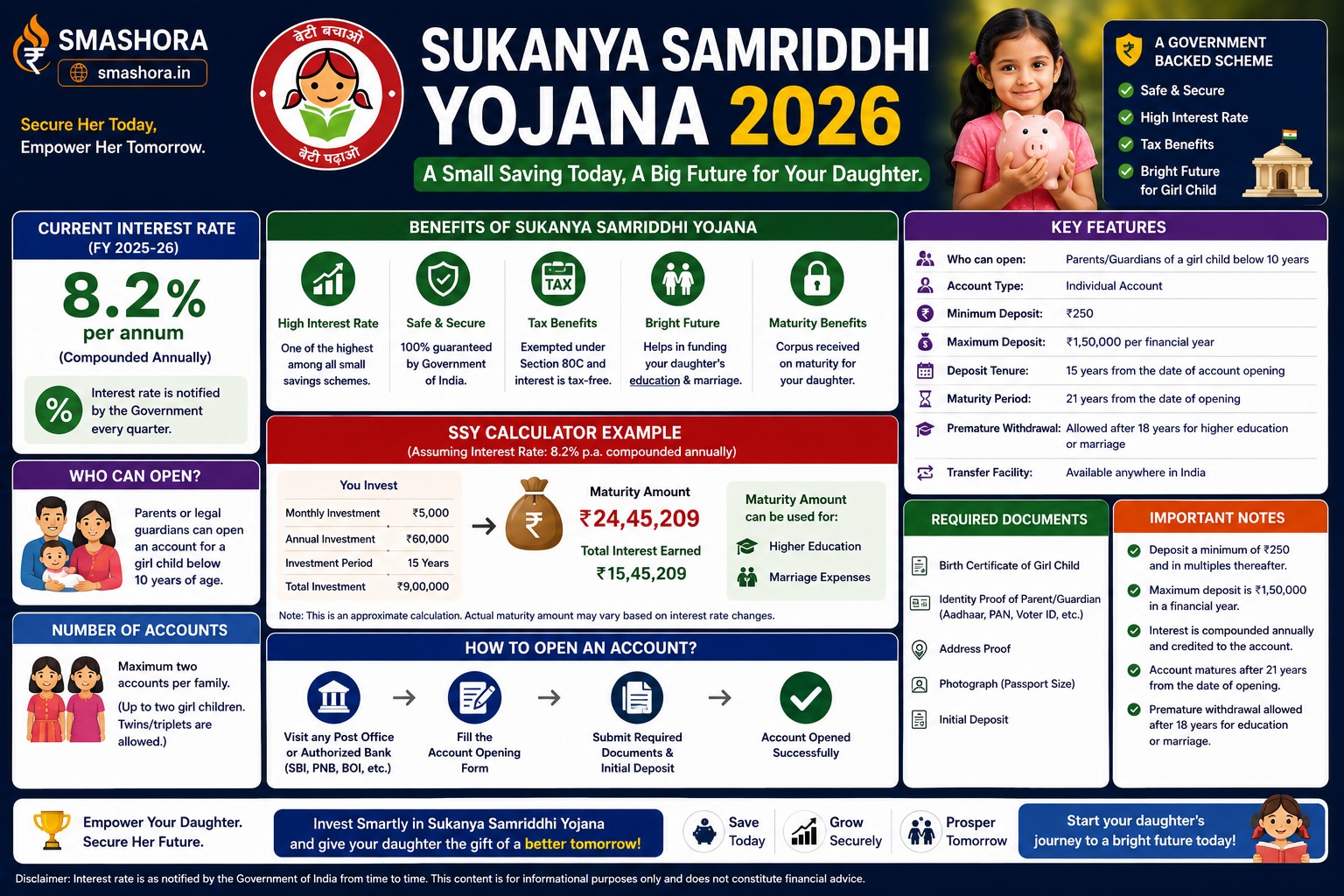
The Sukanya Samriddhi Yojana interest rate for Q1 FY 2026-27 (April to June 2026) is 8.2% per annum, compounded annually. This rate is reviewed quarterly by the Finance Ministry and has remained at 8.2% for several consecutive quarters, making it a stable and reliable return.
At 8.2% compounded annually, Sukanya Samriddhi Yojana 2026 offers the highest interest rate of any government-backed scheme with EEE tax treatment — higher than PPF at 7.1% and significantly higher than any bank FD with comparable safety.
Historical SSY Interest Rates
| Period | SSY Interest Rate |
|---|---|
| April 2026 to June 2026 (Q1 FY 2026-27) | 8.2% per annum |
| January 2024 to March 2026 | 8.2% per annum |
| October 2023 to December 2023 | 8.0% per annum |
| July 2023 to September 2023 | 8.0% per annum |
| April 2020 to March 2023 | 7.6% per annum |
Sukanya Samriddhi Yojana 2026 — Key Features at a Glance
| Feature | Details |
|---|---|
| Current Interest Rate | 8.2% per annum (compounded annually) |
| Minimum Annual Deposit | ₹250 per year |
| Maximum Annual Deposit | ₹1.5 lakh per year |
| Deposit Period | 15 years from date of account opening |
| Maturity Period | 21 years from date of account opening |
| Eligible Age of Girl Child | Below 10 years at time of account opening |
| Maximum Accounts Per Family | 2 accounts (one per girl child, maximum 2 girls) — exception for twins or triplets |
| Tax Treatment | EEE — Investment qualifies for 80C, interest is tax-free, maturity amount is tax-free |
| Government Guarantee | Full sovereign guarantee by Government of India |
| Where to Open | Any post office, SBI, HDFC, ICICI, Axis, Kotak, and all major scheduled banks |
Sukanya Samriddhi Yojana 2026 Maturity Calculator — How Much Will Your Daughter Get?
The maturity amount under Sukanya Samriddhi Yojana 2026 depends on how much you invest annually and at what age you open the account. Here are the calculated maturity amounts at the current 8.2% rate for different annual investment levels:
Maturity Amount at Different Annual Investment Levels
| Annual Investment | Monthly Equivalent | Total Invested (15 years) | Maturity Amount (21 years at 8.2%) | Net Gain |
|---|---|---|---|---|
| ₹12,000 per year | ₹1,000 per month | ₹1.80 lakh | Approximately ₹5.10 lakh | ₹3.30 lakh |
| ₹24,000 per year | ₹2,000 per month | ₹3.60 lakh | Approximately ₹10.20 lakh | ₹6.60 lakh |
| ₹60,000 per year | ₹5,000 per month | ₹9 lakh | Approximately ₹25.50 lakh | ₹16.50 lakh |
| ₹1,00,000 per year | ₹8,333 per month | ₹15 lakh | Approximately ₹42.50 lakh | ₹27.50 lakh |
| ₹1,50,000 per year (maximum) | ₹12,500 per month | ₹22.50 lakh | Approximately ₹63 to ₹65 lakh | ₹40.50 to ₹42.50 lakh |
Important: Under SSY, you only invest for 15 years after opening the account. For the remaining 6 years (from year 15 to year 21), the account continues to earn 8.2% interest on the accumulated balance even without any new deposits. This compounding on the accumulated corpus during years 16 to 21 is what generates the dramatic growth seen in the table above.
Age at Opening vs Final Maturity Age
| Age at Account Opening | Account Matures When Daughter is | Deposit Must Be Made Until |
|---|---|---|
| At birth (0 years) | 21 years | Until she is 15 years old |
| 1 year | 22 years | Until she is 16 years old |
| 3 years | 24 years | Until she is 18 years old |
| 5 years | 26 years | Until she is 20 years old |
| 9 years (latest you can open) | 30 years | Until she is 24 years old |
Opening the SSY account as early as possible — ideally at birth or within the first year — gives the maximum compounding benefit. Every year of delay reduces the maturity corpus significantly because the 6-year silent compounding phase after deposits end is applied to a smaller base.
Sukanya Samriddhi Yojana 2026 — Tax Benefits
Sukanya Samriddhi Yojana 2026 follows the most tax-efficient EEE structure available in India:
- E — Investment is Exempt: Annual SSY deposits qualify for Section 80C deduction up to ₹1.5 lakh under the Old Tax Regime. This saves ₹7,800 to ₹46,800 per year depending on your tax slab.
- E — Interest is Exempt: All interest earned on the SSY balance every year is completely free from income tax. Unlike FD interest which is taxed as income annually, SSY interest grows tax-free year after year.
- E — Maturity Amount is Exempt: The entire maturity amount — principal plus 21 years of accumulated interest — is completely tax-free when withdrawn at maturity. On a corpus of ₹63 lakh, there is zero income tax or capital gains tax payable.
For a 30% tax bracket parent investing the full ₹1.5 lakh per year in SSY, the tax saved on the investment alone is ₹46,800 per year — which effectively means the government is subsidising ₹46,800 of your daughter’s future education corpus every year. Over 15 years of investing, the total direct tax saving is approximately ₹7 lakh, making the true effective return of SSY significantly higher than the stated 8.2%.
For guidance on claiming SSY contributions under Section 80C when filing your income tax return, read our step-by-step guide on how to save tax under Section 80C in India 2026. And for filing the actual ITR, our article on how to file ITR online in India 2026 covers the complete process before the July 31 deadline.
Sukanya Samriddhi Yojana 2026 — Eligibility Rules
- Who can open: Only resident Indian parents or legal guardians of a girl child. Grandparents cannot open SSY accounts unless they have court-appointed legal guardianship of the girl.
- Age of girl child: The girl must be below 10 years of age at the time of account opening. There is no upper limit on the age of the parent.
- Residency: Both the parent and the girl child must be Indian residents. NRIs cannot open SSY accounts. If a girl child already holding an SSY account becomes an NRI (for example, after marriage to an NRI), the account must be permanently closed.
- Number of accounts: A maximum of 2 SSY accounts per family — one per girl child, with a maximum of 2 girl children. Exception: if the second birth results in twins or triplets (all girls), a third account is allowed.
- One account per girl: Only one SSY account can be opened per girl child — it cannot be opened at multiple banks simultaneously.
How to Open a Sukanya Samriddhi Yojana Account in 2026
Opening a Sukanya Samriddhi Yojana 2026 account is straightforward and can be done at any post office or major bank branch:
Documents Required
- Girl child’s birth certificate
- Parent or guardian’s identity proof — Aadhaar card or PAN card
- Parent or guardian’s address proof — Aadhaar card or utility bill
- A photograph of the parent or guardian
- If twins or triplets, a medical certificate confirming multiple birth
- Completed SSY account opening form (Form-1), available at any post office or bank branch
Where to Open
Sukanya Samriddhi Yojana 2026 accounts can be opened at:
- Any post office across India — visit indiapost.gov.in for the nearest post office
- State Bank of India (SBI) — any branch
- HDFC Bank, ICICI Bank, Axis Bank, Kotak Mahindra Bank, PNB, Bank of Baroda, Canara Bank, and most other major scheduled banks
For the official list of authorised banks and current form downloads, visit the National Savings Institute of India website.
Step-by-Step Account Opening Process
- Visit your nearest post office or any of the authorised bank branches listed above
- Collect and fill Form-1 (SSY account opening form) — available at the branch or downloadable from nsiindia.gov.in
- Submit the form with all required documents — birth certificate, parent identity and address proof, photographs
- Make the first deposit — minimum ₹250, maximum ₹1.5 lakh. Payment accepted by cash, cheque, or demand draft.
- Receive your SSY passbook immediately — it shows the account number, opening date, and initial deposit
- For subsequent years, deposit at any post office or through the bank’s net banking or branch. Some banks allow SSY deposits via their mobile banking app.
Sukanya Samriddhi Yojana 2026 — Withdrawal Rules
Understanding the withdrawal rules is critical for planning how to use Sukanya Samriddhi Yojana 2026 effectively:
Partial Withdrawal — For Education (When Daughter Turns 18)
Up to 50% of the SSY balance as of the end of the previous financial year can be withdrawn once the girl child turns 18 — specifically for education expenses. Documents required: proof of admission or fee receipt from the educational institution. This partial withdrawal does not close the account and the remaining balance continues to earn interest until maturity.
Full Premature Closure Rules
The SSY account can be closed before the 21-year maturity only in the following specific circumstances:
- Death of the girl child — full balance with interest paid to parent or guardian
- Marriage of the girl child after she turns 18 — full balance with interest paid as dowry-free financial support
- Account holder (parent or guardian) suffering from life-threatening illness — full balance with interest paid
- Change in residency status to NRI — account must be closed
Premature closure for reasons other than the above attracts a penalty — the interest earned is revised to post office savings account rate (4%) rather than the SSY rate for the period concerned.
Normal Maturity — 21 Years
At 21 years from the date of account opening, the entire balance including all accumulated interest is paid to the girl child. The withdrawal requires submitting Form-4 (withdrawal form) along with the SSY passbook and the account holder’s (girl’s) identity proof to the branch where the account is held.
Sukanya Samriddhi Yojana 2026 vs PPF — Which is Better for a Girl Child?
Both SSY and PPF are EEE government schemes with sovereign guarantees — but they differ in key ways:
| Feature | SSY 2026 | PPF 2026 |
|---|---|---|
| Interest Rate | 8.2% per annum | 7.1% per annum |
| Who Can Open | Only for girl child below age 10 | Any individual above 18 (guardian for minor) |
| Maximum Investment | ₹1.5 lakh per year | ₹1.5 lakh per year |
| Tenure | 21 years | 15 years (extendable) |
| Deposit Period | 15 years | 15 years |
| Partial Withdrawal | 50% at age 18 for education | From year 7 onwards (up to 50%) |
| Tax Treatment | EEE | EEE |
| Return on ₹1.5L per year for 21 years | ₹63 to ₹65 lakh | Approximately ₹40 to ₹44 lakh |
For parents with a daughter below age 10, SSY is clearly better than PPF for that daughter’s dedicated savings — higher rate, same tax treatment, specifically designed for this purpose. Open an SSY account for your daughter AND maintain a separate PPF account in your own name for your personal long-term savings. Both serve different purposes and both should ideally be running simultaneously. For a complete comparison of PPF with other instruments, read our guide on NPS vs PPF in India 2026.
Common Mistakes to Avoid With Sukanya Samriddhi Yojana 2026
Missing the Annual Minimum Deposit
Every year during the 15-year deposit period, you must deposit at least ₹250 in the SSY account. If you miss a year, the account becomes a default account and attracts a penalty of ₹50 per year plus the minimum deposit to regularise it. Always set a calendar reminder or an annual standing instruction to deposit before March 31 of each financial year.
Opening the Account Too Late
Many parents think they can open the SSY account when their daughter is 8 or 9 years old. While technically allowed, every year of delay reduces the final corpus significantly. A ₹1.5 lakh annual investment in SSY opened at birth matures to approximately ₹63 to ₹65 lakh. The same investment started at age 5 matures to approximately ₹47 to ₹50 lakh. Starting 5 years later costs ₹15 to ₹18 lakh in corpus — just from delay.
Confusing SSY With Other Girl Child Schemes
Several state governments run their own girl child welfare schemes with similar names (Kanya Sumangala Yojana, Ladli scheme, etc.). These are different from Sukanya Samriddhi Yojana 2026 which is a central government scheme available across all of India. Always ensure you are opening at a post office or authorised bank under the central government’s SSY scheme, not a state scheme with different terms.
Not Nominating a Successor
When opening the SSY account, always designate a nominee. If something happens to both parents, the nominee ensures the account and its accumulated balance can be properly managed for the girl child’s future.
Sukanya Samriddhi Yojana 2026 vs Child ULIPs and Child Insurance Plans
Many parents are sold child ULIPs and child insurance plans by agents as alternatives to Sukanya Samriddhi Yojana 2026. A direct comparison makes the choice clear:
| Feature | SSY 2026 | Child ULIP or Insurance Plan |
|---|---|---|
| Returns | 8.2% guaranteed by government | 4% to 6% effective (after charges) |
| Risk | Zero — sovereign guarantee | Market risk for ULIP, low but uncertain for insurance plan |
| Charges | Zero | Mortality charges, fund management charges, premium allocation charges |
| Tax Treatment | EEE — fully tax-free | Partially tax-free (conditions apply) |
| Transparency | Complete — government scheme with published rates | Complex — multiple charges reduce effective return |
| Agent Commission | None | High — motivates mis-selling |
The honest comparison shows that Sukanya Samriddhi Yojana 2026 beats child insurance plans and ULIPs on almost every parameter that matters to a parent building their daughter’s financial future. If life insurance protection for the parent is needed, buy a separate term insurance plan at a fraction of the cost. Read our guide on the best term insurance plans in India 2026 for the most cost-effective protection options. For the full landscape of government savings schemes available alongside SSY, our article on the best government savings schemes in India 2026 covers all options.
Conclusion — Open Your Daughter’s Sukanya Samriddhi Yojana Account Today
Sukanya Samriddhi Yojana 2026 is one of the most powerful financial gifts a parent can give a daughter. At 8.2% guaranteed by the Government of India with complete EEE tax treatment, it outperforms every other safe investment available to Indian parents for this specific purpose. A ₹1,000 monthly deposit over 15 years grows to over ₹5 lakh by maturity — completely tax-free. The maximum investment of ₹1.5 lakh per year grows to ₹63 to ₹65 lakh over 21 years — again, completely tax-free.
The account takes 30 minutes to open at any post office with your daughter’s birth certificate, your Aadhaar card, and a minimum deposit of ₹250. There is no simpler, safer, or more rewarding way to start building your daughter’s financial future in India in 2026. If your daughter is below age 10, open her Sukanya Samriddhi Yojana 2026 account today — not next month, not when you have more money. Today, with whatever you can start with.
At Smashora, our mission is to help every Indian make every rupee count — including the rupees you invest in your daughter’s future. If this guide on Sukanya Samriddhi Yojana 2026 helped you understand this powerful scheme, leave a comment below or share it with every parent you know who has a daughter below the age of 10.
Frequently Asked Questions
What is the Sukanya Samriddhi Yojana interest rate in 2026?
The Sukanya Samriddhi Yojana interest rate for Q1 FY 2026-27 (April to June 2026) is 8.2% per annum, compounded annually. This rate is the highest among all government small savings schemes in India with EEE tax treatment and is reviewed by the Finance Ministry every quarter. The 8.2% rate has been maintained for several consecutive quarters, reflecting the government’s commitment to this scheme.
How much will I get if I invest ₹1.5 lakh per year in SSY?
If you invest the maximum ₹1.5 lakh per year consistently for 15 years in Sukanya Samriddhi Yojana 2026 at the current 8.2% rate, the maturity corpus at the end of 21 years from account opening will be approximately ₹63 to ₹65 lakh. Your total investment over 15 years is ₹22.5 lakh. The entire ₹63 to ₹65 lakh maturity amount — including all interest earned — is completely tax-free under the EEE framework. Even smaller investments show powerful growth: ₹5,000 per month (₹60,000 per year) grows to approximately ₹25.50 lakh over 21 years, completely tax-free.
Can I open a Sukanya Samriddhi Yojana account online in India in 2026?
Currently, SSY accounts must be opened in person at a post office branch or authorised bank branch — full online account opening is not available for new SSY accounts. However, once the account is opened, deposits can be made online through the bank’s net banking or mobile banking portal at banks like SBI, HDFC, ICICI, and Axis. India Post has also enabled online SSY deposits through the India Post Payments Bank mobile app for existing account holders. For new account opening, carry your daughter’s birth certificate, your Aadhaar card, your address proof, and a minimum deposit of ₹250 to any post office or authorised bank branch.
What happens to the SSY account if I miss depositing for a year?
If you miss making the mandatory minimum deposit of ₹250 in any financial year during the 15-year deposit period, your SSY account becomes a default account. To regularise a default SSY account, you must pay a penalty of ₹50 per defaulted year plus the minimum deposit of ₹250 for each missed year. The account continues to earn SSY interest on the existing balance even during default years — only the lack of new deposits is penalised. To avoid defaults, set a standing instruction or calendar reminder to deposit before March 31 every year.
Can I withdraw money from SSY before maturity?
Partial withdrawal of up to 50% of the SSY balance is allowed once the girl child turns 18, specifically for higher education expenses — admission fees, tuition, hostel charges. Full premature closure is allowed only in specific circumstances: death of the girl child, marriage of the girl child after age 18, life-threatening illness of the parent, or change in residency to NRI status. For all other premature closures, the interest earned is reduced to post office savings account rate (4%) as a penalty. The scheme is designed to encourage holding until maturity for maximum benefit.
Can grandparents open a Sukanya Samriddhi Yojana account for their granddaughter?
No. Only natural parents or court-appointed legal guardians can open an SSY account. Grandparents who are not the legal guardians of the girl child cannot open an SSY account in the girl’s name. However, grandparents who have been formally appointed as legal guardians through a court order can open and operate an SSY account. If grandparents want to financially contribute to a granddaughter’s future, the best approach is to gift money to the girl’s parents specifically for SSY deposits in the account already held by the parents.