Contents
- 1 Why Government Savings Schemes Still Matter in India in 2026
- 2 Current Interest Rates for All Government Savings Schemes — April to June 2026
- 3 Best Government Savings Schemes in India 2026 — Detailed Reviews
- 3.1 1. Public Provident Fund (PPF) — Best Long-Term Tax-Free Savings Scheme
- 3.2 2. Sukanya Samriddhi Yojana (SSY) — Best Government Scheme for Girl Child Education and Marriage
- 3.3 3. Senior Citizen Savings Scheme (SCSS) — Best Government Scheme for Retired Indians
- 3.4 4. National Savings Certificate (NSC) — Best 5-Year Government Scheme with 80C Benefit
- 3.5 5. Kisan Vikas Patra (KVP) — Best for Doubling Your Money
- 3.6 6. Post Office Monthly Income Scheme (POMIS) — Best for Regular Monthly Income
- 4 Best Government Savings Schemes in India 2026 — Comparison by Goal
- 5 Tax Benefits Comparison Across the Best Government Savings Schemes in India 2026
- 6 How to Open Government Savings Schemes Online in India in 2026
- 7 Government Schemes vs Mutual Funds — Which Is Better in 2026?
- 8 Conclusion — Use the Best Government Savings Schemes in India 2026 as Your Safe Foundation
- 9 Frequently Asked Questions
- 9.1 Which is the best government savings scheme in India in 2026?
- 9.2 What is the current PPF interest rate for 2026?
- 9.3 What is the current Sukanya Samriddhi Yojana interest rate for 2026?
- 9.4 Can I open a PPF account online in India in 2026?
- 9.5 Is the money in government savings schemes safe in India?
- 9.6 Can I invest in both PPF and SSY at the same time?
If you are looking for the best government savings schemes in India 2026, you are in the right place at the right time. The Government of India has kept interest rates on all small savings schemes unchanged for the April to June 2026 quarter — with Sukanya Samriddhi Yojana and Senior Citizen Savings Scheme leading at 8.2% per year and PPF continuing to offer a fully tax-free 7.1% per year. These government-backed schemes offer something no bank FD or mutual fund can match: a sovereign guarantee on both your principal and your returns.
I have seen the power of government savings schemes work quietly but effectively in real families. My own parents had a PPF account opened in 2001 that matured in 2016. By the time it matured, a total investment of ₹9 lakh over 15 years had grown to over ₹25 lakh — completely tax free, without a single market-linked risk. That is the power of compounding with government-backed safety. In 2026, with the best government savings schemes in India 2026 now available digitally through India Post and major banks, accessing these schemes has never been easier for every Indian family.
This guide covers all the major government savings schemes available in India right now — their current interest rates, investment limits, tax benefits, lock-in periods, and which type of investor each scheme is best suited for. By the end, you will know exactly which of the best government savings schemes in India 2026 belongs in your financial plan.
Why Government Savings Schemes Still Matter in India in 2026
With mutual funds and equity investments gaining popularity, some investors wonder if government savings schemes are still relevant. The best government savings schemes in India 2026 remain essential for three reasons that no market-linked product can replicate:
- Sovereign guarantee: Your principal and returns are backed by the Government of India — the only investment in the country with a true zero-default risk.
- Tax efficiency: Schemes like PPF and SSY follow the EEE (Exempt-Exempt-Exempt) framework — your investment, interest earned, and maturity amount are all completely tax free. No equity or debt fund can match this for long-term savings.
- Interest rate stability: Government scheme rates are revised quarterly but have remained largely stable for several years. The predictability helps with long-term financial planning in a way that market-linked returns cannot.
Current Interest Rates for All Government Savings Schemes — April to June 2026
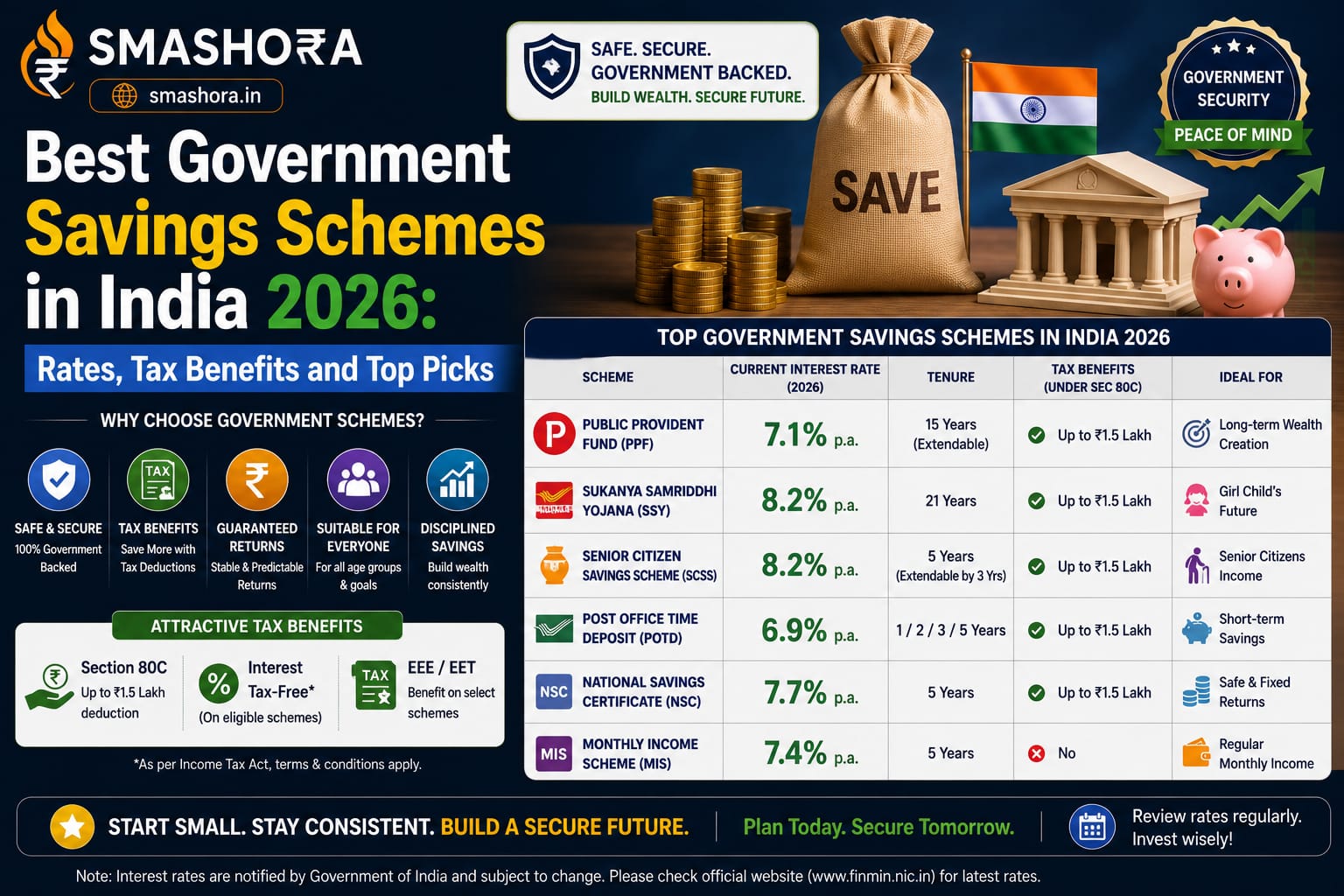
The Finance Ministry has kept all small savings scheme rates unchanged for the April to June 2026 quarter. Here are the latest rates for the best government savings schemes in India 2026:
| Scheme | Interest Rate (Q1 FY 2026-27) | Tenure | Tax on Returns | 80C Benefit |
|---|---|---|---|---|
| Sukanya Samriddhi Yojana (SSY) | 8.2% per year | 21 years | Tax free (EEE) | Yes |
| Senior Citizen Savings Scheme (SCSS) | 8.2% per year | 5 years | Taxable as income | Yes |
| National Savings Certificate (NSC) | 7.7% per year | 5 years | Taxable at maturity | Yes |
| Public Provident Fund (PPF) | 7.1% per year | 15 years | Tax free (EEE) | Yes |
| Kisan Vikas Patra (KVP) | 7.5% per year | 115 months | Taxable as income | No |
| Post Office Monthly Income Scheme (POMIS) | 7.4% per year | 5 years | Taxable as income | No |
| Post Office Time Deposit (3 years) | 7.1% per year | 3 years | Taxable as income | Yes (5-year only) |
| Post Office Recurring Deposit | 6.7% per year | 5 years | Taxable as income | No |
| Post Office Savings Account | 4.0% per year | No tenure | Taxable (₹3,500 exempt) | No |
Best Government Savings Schemes in India 2026 — Detailed Reviews
1. Public Provident Fund (PPF) — Best Long-Term Tax-Free Savings Scheme
The Public Provident Fund is the gold standard among the best government savings schemes in India 2026 for long-term wealth creation. No other government scheme — and arguably no other investment product in India — combines government safety with complete EEE tax treatment the way PPF does.
PPF follows the Exempt-Exempt-Exempt tax framework. The amount you invest (up to ₹1.5 lakh per year) qualifies for Section 80C deduction under the Old Tax Regime. The interest you earn every year is completely tax free. And the maturity amount you receive after 15 years is also fully tax free. For someone in the 30% tax bracket, the effective post-tax return on PPF at 7.1% is equivalent to earning approximately 10.1% on a fully taxable instrument.
- Interest Rate: 7.1% per year (compounded annually)
- Minimum Investment: ₹500 per year
- Maximum Investment: ₹1.5 lakh per year
- Tenure: 15 years (extendable in 5-year blocks)
- Partial Withdrawal: Allowed from year 7 onwards
- Loan Against PPF: Available from year 3 to year 6
- Where to Open: SBI, post office, HDFC Bank, ICICI Bank, Axis Bank, and most scheduled banks
- Tax: EEE — investment, interest, and maturity all exempt
Best for: Working professionals who want a guaranteed, completely tax-free long-term savings instrument for retirement or long-term goals. The 15-year lock-in makes it a powerful forced savings tool that keeps the corpus intact for the long term.
Key consideration: The maximum investment of ₹1.5 lakh per year limits how much you can put here. For higher investable amounts, use PPF for the guaranteed tax-free base and complement it with equity mutual fund SIPs for growth. Read our comparison of PPF vs FD vs mutual fund in India 2026 for a detailed head-to-head analysis.
2. Sukanya Samriddhi Yojana (SSY) — Best Government Scheme for Girl Child Education and Marriage
Sukanya Samriddhi Yojana is currently offering the highest interest rate of 8.2% per year among the best government savings schemes in India 2026 — and it does so with the same EEE tax treatment as PPF. It was launched as part of the Beti Bachao Beti Padhao initiative and is exclusively available for parents of girl children below the age of 10.
- Interest Rate: 8.2% per year (compounded annually) — highest among EEE schemes
- Minimum Investment: ₹250 per year
- Maximum Investment: ₹1.5 lakh per year
- Account can be opened for: Girl children below 10 years of age
- Tenure: 21 years from date of account opening (or until the girl marries after age 18)
- Partial Withdrawal: 50% of balance allowed when the girl turns 18, for education expenses
- Where to Open: Post office, SBI, and other scheduled banks
- Tax: EEE — same as PPF, fully tax free at every stage
Best for: Any parent with a girl child below age 10 who wants to build a dedicated, completely tax-free corpus for her higher education or marriage. At 8.2% compounded annually with EEE treatment, SSY is arguably the single best guaranteed investment available in India in 2026 for this specific purpose.
Example: Investing ₹1.5 lakh per year in SSY for 15 years at 8.2% results in an approximate maturity corpus of ₹65 to ₹70 lakh after 21 years — completely tax free. This level of return from a government-guaranteed instrument is exceptional.
3. Senior Citizen Savings Scheme (SCSS) — Best Government Scheme for Retired Indians
The Senior Citizen Savings Scheme is consistently among the best government savings schemes in India 2026 for retired individuals above age 60. At 8.2% per year with quarterly interest payouts, SCSS offers one of the highest guaranteed income rates available to retirees — backed by the full faith and credit of the Government of India.
- Interest Rate: 8.2% per year (paid quarterly)
- Minimum Investment: ₹1,000
- Maximum Investment: ₹30 lakh per individual (₹60 lakh for a couple)
- Tenure: 5 years (extendable by 3 years)
- Eligibility: Indian citizens above 60 years, or above 55 years if retired under VRS, or defence retirees above 50 years
- Where to Open: Post office, SBI, and authorised banks
- Tax: Investment qualifies for 80C deduction, but quarterly interest is fully taxable as income. TDS applies if annual interest exceeds ₹50,000.
Best for: Retired Indians who need a regular quarterly income at the highest possible guaranteed rate. With a maximum investment of ₹30 lakh, SCSS can generate approximately ₹61,500 in quarterly interest — about ₹20,500 per month — for a senior citizen with the full ₹30 lakh invested.
Key consideration: SCSS interest is fully taxable. For a retired individual with total income below the basic exemption limit, this is not a concern. But for senior citizens with other income sources, the taxability should be factored into the effective return calculation.
4. National Savings Certificate (NSC) — Best 5-Year Government Scheme with 80C Benefit
The National Savings Certificate is one of the most practical among the best government savings schemes in India 2026 for investors who want a 5-year commitment, a Section 80C deduction, and a higher rate than a standard bank FD. NSC is available at all post offices and many banks.
- Interest Rate: 7.7% per year (compounded annually, paid at maturity)
- Minimum Investment: ₹1,000 (no maximum limit)
- Tenure: 5 years
- Where to Buy: Post offices and select banks
- Tax: Investment qualifies for 80C. Interest is compounded and reinvested each year — the reinvested interest also qualifies for 80C deduction in years 1 to 4. Interest is taxable in the year of maturity (year 5).
Best for: Conservative investors who want a higher rate than bank FDs with the added benefit of Section 80C deduction and a 5-year lock-in shorter than PPF. The auto-reinvestment of interest and its eligibility for 80C in years 1 to 4 is a unique tax advantage that effectively increases the return for 80C claimants.
5. Kisan Vikas Patra (KVP) — Best for Doubling Your Money
Kisan Vikas Patra is one of the simplest among the best government savings schemes in India 2026. At 7.5% per year, KVP doubles your invested amount in 115 months — approximately 9 years and 7 months. No interest payout during the tenure — you simply invest and receive double the amount at maturity.
- Interest Rate: 7.5% per year (compounded annually)
- Minimum Investment: ₹1,000 (no maximum limit)
- Maturity Period: 115 months (approximately 9.6 years)
- Where to Buy: Post offices and select banks
- Tax: No 80C benefit. Maturity amount is taxable as income in the year of receipt.
- KYC: Required — PAN mandatory for investments above ₹50,000
Best for: Investors who want a simple, tangible, government-guaranteed instrument with a clear doubling timeline. KVP is popular among small business owners and self-employed individuals who want a safe parking place for surplus cash with a clear return horizon.
6. Post Office Monthly Income Scheme (POMIS) — Best for Regular Monthly Income
The Post Office Monthly Income Scheme is the right choice among the best government savings schemes in India 2026 for investors who need a fixed monthly income rather than a lump sum at maturity. At 7.4% per year paid monthly, POMIS gives you guaranteed income every month for 5 years.
- Interest Rate: 7.4% per year (paid monthly)
- Minimum Investment: ₹1,000
- Maximum Investment: ₹9 lakh (single account), ₹15 lakh (joint account)
- Tenure: 5 years
- Monthly Income Example: ₹9 lakh invested generates approximately ₹5,550 per month
- Where to Open: Post offices across India
- Tax: No 80C benefit. Monthly interest is fully taxable as income.
Best for: Retirees or individuals who need predictable monthly income — homemakers, parents supporting a child’s education, or anyone who has received a lump sum and wants to convert it into a monthly income stream with zero risk.
Best Government Savings Schemes in India 2026 — Comparison by Goal
Here is a quick reference guide to match the best government savings schemes in India 2026 to your specific financial goal:
| Your Financial Goal | Best Government Scheme | Why |
|---|---|---|
| Long-term tax-free retirement savings | PPF | EEE tax, government backed, 15-year compounding |
| Girl child education and marriage fund | Sukanya Samriddhi Yojana | Highest EEE rate at 8.2%, purpose-built for girl child |
| Retirement income for senior citizens | SCSS | 8.2% quarterly payouts, sovereign backed, up to ₹30 lakh |
| 5-year tax saving with higher rate than FD | NSC | 7.7%, 80C benefit, no TDS on interest during tenure |
| Simply doubling money over 9 to 10 years | Kisan Vikas Patra | Simple doubling at 7.5%, no maximum limit |
| Fixed monthly income from lump sum | Post Office MIS | 7.4% monthly payout, up to ₹9 lakh single account |
| Flexible recurring savings with safety | Post Office RD | 6.7%, monthly contributions from ₹100, government backed |
Tax Benefits Comparison Across the Best Government Savings Schemes in India 2026
| Scheme | 80C Deduction on Investment | Tax on Interest | Tax on Maturity | Overall Tax Efficiency |
|---|---|---|---|---|
| PPF | Yes (up to ₹1.5 lakh) | Tax free | Tax free | Excellent — EEE |
| SSY | Yes (up to ₹1.5 lakh) | Tax free | Tax free | Excellent — EEE |
| SCSS | Yes (up to ₹1.5 lakh) | Taxable quarterly | Not applicable | Good — investment exempt, interest taxable |
| NSC | Yes (up to ₹1.5 lakh) | Reinvested interest qualifies for 80C in years 1 to 4 | Taxable in year 5 | Good — complex but effective for 80C claimants |
| KVP | No | Not paid during tenure | Fully taxable | Low — no tax advantage |
| Post Office MIS | No | Fully taxable monthly | Not applicable | Low — no tax advantage |
For a step-by-step guide on claiming 80C deductions from PPF, NSC, and SSY contributions when filing your income tax return, read our article on how to file ITR online in India 2026.
How to Open Government Savings Schemes Online in India in 2026
Opening accounts for the best government savings schemes in India 2026 has become significantly more convenient with digital channels:
PPF Account
You can open a PPF account entirely online through the internet banking portal of SBI, HDFC Bank, ICICI Bank, Axis Bank, or Kotak Bank if you already have a savings account with them. Go to the deposits or investments section, select PPF, complete the e-nomination, and your account is active within minutes.
SSY Account
Sukanya Samriddhi Yojana accounts can be opened at the nearest post office or at select bank branches. Most major banks now offer SSY account opening through their internet banking portals for existing customers. Documents needed include the girl child’s birth certificate, parent’s identity proof, and address proof.
SCSS Account
Senior Citizen Savings Scheme accounts can be opened at post offices and major bank branches. Some banks offer SCSS account opening through internet banking for senior citizen customers. You will need age proof confirming eligibility (above 60 years) along with standard KYC documents.
NSC and KVP
Both NSC and KVP can be purchased at any post office across India. You can also buy them through the India Post Payments Bank app or at select bank branches. Physical certificates are issued for both, which can also be used as collateral for bank loans.
Government Schemes vs Mutual Funds — Which Is Better in 2026?
The best government savings schemes in India 2026 and equity mutual funds are not competitors — they serve different financial goals and both belong in a well-structured financial plan:
| Feature | Government Savings Schemes | Equity Mutual Funds |
|---|---|---|
| Returns | 7.1% to 8.2% (guaranteed) | 10% to 15% (historical, not guaranteed) |
| Risk | Zero — sovereign guarantee | Market risk — can fall in short term |
| Tax on Returns | EEE for PPF and SSY, taxable for others | 10% LTCG above ₹1.25 lakh per year |
| Liquidity | Low to very low — lock-in periods apply | High — redeem anytime (except ELSS) |
| Inflation Beating | Marginally — at 6% to 7% inflation | Significantly over long periods |
| Best Used For | Guaranteed foundation of long-term savings | Growth engine for wealth creation |
The smart Indian investor in 2026 uses government schemes for the guaranteed, tax-efficient foundation and equity mutual fund SIPs for the growth layer. Maximise PPF at ₹1.5 lakh per year, open an SSY account if you have a daughter below 10, and invest additional savings in equity SIPs. Our guide on the best SIP to start in India 2026 will help you build that growth layer alongside your government scheme investments.
Conclusion — Use the Best Government Savings Schemes in India 2026 as Your Safe Foundation
The best government savings schemes in India 2026 offer something that no equity fund, corporate FD, or bank deposit can match — a sovereign guarantee on your money. PPF at 7.1% tax-free is the strongest long-term savings vehicle for salaried Indians. SSY at 8.2% tax-free is unmatched for parents with daughters below age 10. SCSS at 8.2% quarterly payouts is the best regular income option for retirees. NSC at 7.7% with 80C benefits fills the 5-year medium-term savings need effectively.
Use the best government savings schemes in India 2026 as the guaranteed foundation of your financial plan — the layer that will always be there regardless of what happens in the markets. Build your equity investments and wealth creation on top of this foundation for the best of both worlds: safety and growth.
At Smashora, our goal is to help every Indian make every rupee count. If this guide on the best government savings schemes in India 2026 helped you understand your options, leave a comment below and let us know which scheme you are starting with — or share it with a family member who is still keeping all their savings in a low-interest savings account.
Frequently Asked Questions
Which is the best government savings scheme in India in 2026?
The best government savings scheme in India 2026 depends on your goal. For long-term tax-free savings, PPF at 7.1% with EEE tax treatment is unmatched. For parents of girl children, SSY at 8.2% with EEE treatment is the best guaranteed investment in India right now. For retired senior citizens needing regular income, SCSS at 8.2% quarterly payouts is the strongest option. For a 5-year tax-saving fixed deposit alternative, NSC at 7.7% with 80C benefits is excellent.
What is the current PPF interest rate for 2026?
The PPF interest rate for the April to June 2026 quarter is 7.1% per year, compounded annually. The Finance Ministry kept this rate unchanged from the previous quarter. PPF rates are reviewed every quarter and announced in the last week of the preceding quarter. Despite being lower than SSY and SCSS in terms of rate, PPF’s 15-year compounding tenure and EEE tax treatment make it one of the most powerful long-term savings instruments available to Indians.
What is the current Sukanya Samriddhi Yojana interest rate for 2026?
The SSY interest rate for the April to June 2026 quarter is 8.2% per year, compounded annually — the highest rate among all government savings schemes with EEE tax treatment. This means your SSY investment, the interest it earns every year, and the final maturity amount are all completely exempt from income tax. The combination of 8.2% compounding with zero tax makes SSY the single best guaranteed investment for parents of girl children in India in 2026.
Can I open a PPF account online in India in 2026?
Yes. PPF accounts can be opened entirely online through the internet banking or mobile banking portals of SBI, HDFC Bank, ICICI Bank, Axis Bank, and Kotak Mahindra Bank. You need an existing savings account with the bank, a PAN card linked to your account, and Aadhaar-based eKYC. The account is activated within minutes and you can start investing immediately by transferring from your savings account. You can also open a PPF account at any post office if you prefer the physical route.
Is the money in government savings schemes safe in India?
Yes, the money in all government savings schemes in India — PPF, SSY, SCSS, NSC, KVP, POMIS, and Post Office RD — is backed by the full faith and sovereign guarantee of the Government of India. This is the highest level of safety available for any investment in India. Unlike bank FDs that are protected only up to ₹5 lakh by DICGC insurance, there is no upper limit on the sovereign guarantee for government savings schemes. Your principal and the promised returns are completely safe regardless of the investment amount.
Can I invest in both PPF and SSY at the same time?
Yes, absolutely. A parent can have their own PPF account and also open one SSY account per girl child. Both PPF and SSY have a maximum annual investment limit of ₹1.5 lakh each — so a parent with a daughter below age 10 can invest ₹1.5 lakh in their PPF account and an additional ₹1.5 lakh in the SSY account, for a total of ₹3 lakh per year in EEE tax-free government-backed investments. Both qualify for Section 80C deduction separately within the ₹1.5 lakh overall 80C limit per account holder, making this combination one of the most tax-efficient savings strategies available to Indian families in 2026.