Contents
- 1 Why Health Insurance Is Non-Negotiable in India in 2026
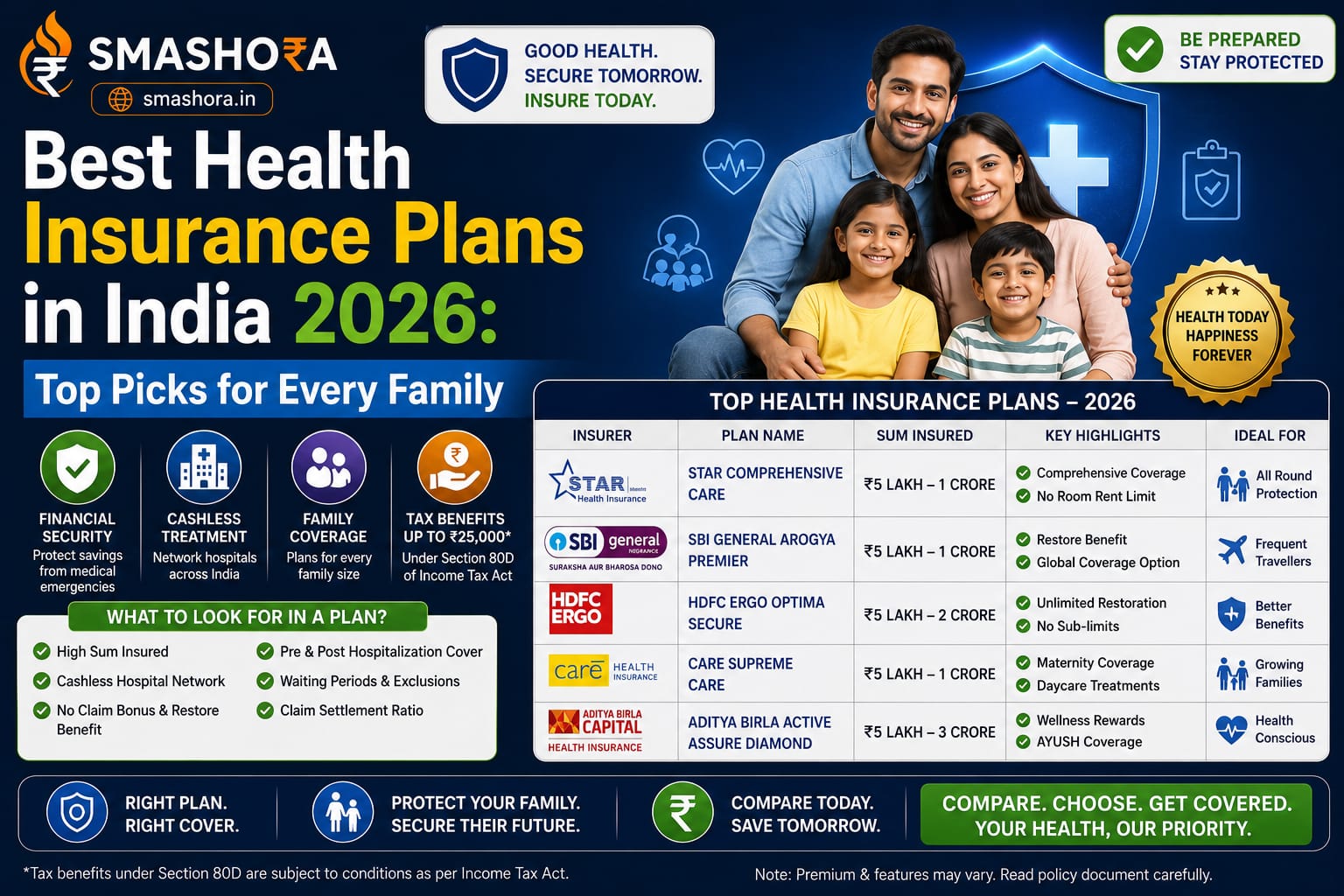
- 2 Best Health Insurance Plans in India 2026 — Top Picks
- 2.1 1. HDFC ERGO Optima Secure Plus — Best Overall Health Insurance Plan
- 2.2 2. Niva Bupa ReAssure 2.0 Platinum Plus — Best for Unlimited Restoration
- 2.3 3. Care Supreme — Best for Comprehensive Coverage at Mid-Range Premium
- 2.4 4. Aditya Birla Activ One Max — Best for Health Rewards and Annual Bonus
- 2.5 5. Bajaj Allianz Health Guard Family Floater — Best for Affordable Family Cover
- 2.6 6. Star Health Comprehensive Plan — Best Standalone Insurer for Individuals
- 3 Best Health Insurance Plans in India 2026 — Comparison Table
- 4 How Much Health Insurance Cover Do You Actually Need in India in 2026?
- 5 Key Features to Compare in the Best Health Insurance Plans in India 2026
- 6 Individual Policy vs Family Floater — Which Is Better?
- 7 Common Mistakes to Avoid When Buying Health Insurance in India
- 8 Tax Benefits of Health Insurance in India 2026
- 9 Conclusion — Get the Best Health Insurance Plans in India 2026 Before You Need It
- 10 Frequently Asked Questions
- 10.1 Which is the best health insurance plan in India in 2026?
- 10.2 How much health insurance cover do I need in India in 2026?
- 10.3 What is room rent capping and why does it matter?
- 10.4 Is it better to buy health insurance online or through an agent in India?
- 10.5 Can I port my existing health insurance to a better plan in India?
- 10.6 Should I buy a separate health policy for my senior citizen parents?
Finding the best health insurance plans in India 2026 has never been more urgent — or more confusing. Medical inflation in India is running at 14% per year, hospital bills for a simple surgery that cost ₹1.5 lakh in 2020 now routinely cross ₹3 lakh, and a serious illness like cancer or a cardiac event can generate bills of ₹15 lakh to ₹40 lakh in just a few weeks of treatment. Without the right health cover, a single medical emergency can wipe out years of savings in one go.
I have watched this happen to people who thought they were covered. A neighbour had a corporate health insurance policy through his employer worth ₹3 lakh. When he was diagnosed with a heart condition requiring bypass surgery in 2024, the bill at a reputable hospital in Hyderabad came to ₹7.2 lakh. The ₹3 lakh employer policy covered less than half. The remaining ₹4.2 lakh came from his fixed deposit — the one he had been building for his daughter’s education. A personal health insurance plan with ₹15 lakh cover would have cost him less than ₹1,200 per month and covered the entire bill.
In 2026, identifying the best health insurance plans in India 2026 requires comparing more than just the premium. Claim settlement ratio, hospital network, room rent capping, restoration benefits, waiting periods, and co-payment clauses all matter significantly. This complete guide covers the top health insurance plans in India right now, what makes each one stand out, how to choose the right cover amount, and what to watch out for when buying a policy.
Why Health Insurance Is Non-Negotiable in India in 2026
The best health insurance plans in India 2026 are not a luxury — they are a financial necessity for every working Indian household. Here is why:
- Medical inflation at 14% per year: Healthcare costs in India are rising nearly three times faster than general inflation. A ₹10 lakh cover bought in 2020 is effectively worth far less in 2026 in terms of actual coverage.
- Inadequate corporate cover: Most employer-provided group health insurance covers only ₹2 lakh to ₹5 lakh — completely inadequate for serious illnesses or major surgeries in 2026. It also ends the moment you leave the job.
- Rising lifestyle disease burden: Diabetes, hypertension, heart disease, and cancer are now common among Indians in their 30s and 40s. The earlier you buy health insurance, the lower your premium and the shorter your waiting period for pre-existing conditions.
- IRDAI data shows claims surge: Health insurers settled claims worth approximately ₹94,248 crore during FY 2024-25 — a massive figure that reflects how heavily Indians are using their health policies. The number of claims filed continues to grow year on year.
- Tax benefit: Health insurance premiums qualify for deduction under Section 80D of the Income Tax Act — up to ₹25,000 per year for self and family, and an additional ₹25,000 to ₹50,000 for parents depending on their age.
Best Health Insurance Plans in India 2026 — Top Picks
Here are the best health insurance plans in India 2026, reviewed across the criteria that matter most at the time of a claim:
1. HDFC ERGO Optima Secure Plus — Best Overall Health Insurance Plan
HDFC ERGO Optima Secure Plus consistently earns its position among the best health insurance plans in India 2026 for its combination of strong insurer fundamentals, a massive hospital network, and a genuinely feature-rich policy. HDFC ERGO is a joint venture between HDFC and ERGO International and has built one of the most trusted reputations in Indian health insurance.
- Claim Settlement Ratio: 99.5% (FY 2024-25)
- Network Hospitals: 16,000 plus cashless hospitals across India
- Sum Insured Options: ₹5 lakh to ₹2 crore
- Monthly Premium for ₹10 lakh cover (30-year individual): Approximately ₹750 to ₹900
- Key Features: No room rent capping, restore benefit (sum insured restored if fully used), no co-payment, 100% no claim bonus up to 100% of sum insured, pre and post hospitalisation cover of 60 and 180 days respectively
Best for: Families in metro and tier-1 cities where hospital billing is aggressive and room rent costs alone can exhaust a limited cover quickly. The no room rent capping feature is especially valuable in private hospitals in cities like Mumbai, Delhi, Bengaluru, and Hyderabad.
Honest consideration: Premium is slightly higher than some competitors. However, the claim settlement track record and the absence of room rent limits make it one of the most reliable among the best health insurance plans in India 2026 when it actually comes to getting a claim paid.
2. Niva Bupa ReAssure 2.0 Platinum Plus — Best for Unlimited Restoration
Niva Bupa (formerly Max Bupa) is one of India’s most respected standalone health insurers and its ReAssure 2.0 Platinum Plus variant is a standout among the best health insurance plans in India 2026 for families with multiple members. Its unlimited restoration benefit means the full sum insured is restored after every single claim — not just once per year — making it exceptionally valuable for families where multiple members may need hospitalisation in the same year.
- Claim Settlement Ratio: 91.9% (FY 2024-25)
- Network Hospitals: 10,000 plus cashless hospitals
- Sum Insured Options: ₹5 lakh to ₹1 crore
- Monthly Premium for ₹10 lakh family floater (family of 3, 35-year-old proposer): Approximately ₹1,800 to ₹2,200
- Key Features: Unlimited restoration of sum insured, no room rent capping, long-term premium lock-in option to avoid annual price hikes, live healthy rewards programme
Best for: Families of 3 or 4 members where multiple hospitalisation events in a single year are a realistic possibility. The unlimited restoration means the family is never left with an exhausted cover mid-year regardless of how many claims are filed.
Honest consideration: The CSR at 91.9% is lower than HDFC ERGO. However, Niva Bupa is a standalone health insurer — meaning 100% of its business is health insurance, which generally results in better claims expertise and customer service than general insurers who also sell motor and property insurance.
3. Care Supreme — Best for Comprehensive Coverage at Mid-Range Premium
Care Health Insurance (formerly Religare Health Insurance) has consistently been among the most popular and best health insurance plans in India 2026 for individuals and families looking for solid comprehensive coverage without paying premium-tier prices. Care Supreme is the flagship plan and it delivers strong features at a competitive price point.
- Claim Settlement Ratio: 90.2% (FY 2024-25)
- Network Hospitals: 24,800 plus cashless hospitals — one of the largest networks in India
- Sum Insured Options: ₹5 lakh to ₹6 crore
- Monthly Premium for ₹10 lakh individual cover (30-year): Approximately ₹650 to ₹800
- Key Features: Unlimited restoration of sum insured, no room rent capping, annual health check-up included, unlimited teleconsultation, no co-payment for most variants, 50% no claim bonus per year up to 100%
Best for: Individuals and families who want a large cashless hospital network — especially those in smaller cities and towns where HDFC ERGO’s network may have gaps. With 24,800 plus network hospitals, Care Supreme has one of the widest geographic coverages among the best health insurance plans in India 2026.
Honest consideration: Care Health’s CSR at 90.2% is the lowest on this list. This is still above the 90% threshold recommended as acceptable, but buyers who prioritise claim reliability above all else may prefer HDFC ERGO despite the higher premium.
4. Aditya Birla Activ One Max — Best for Health Rewards and Annual Bonus
Aditya Birla Health Insurance Activ One Max stands apart from other best health insurance plans in India 2026 with one unique feature: it actively rewards you for staying healthy. The HealthReturns programme credits up to 100% of your annual premium back as a reward if you maintain a healthy lifestyle and hit your daily activity goals through the Activ Health app — making it a standout option for health-conscious young professionals.
- Claim Settlement Ratio: 95.8% (FY 2024-25)
- Network Hospitals: 12,000 plus cashless hospitals
- Sum Insured Options: ₹2 lakh to ₹6 crore
- Monthly Premium for ₹10 lakh individual cover (30-year): Approximately ₹850 to ₹1,050
- Key Features: 100% no claim bonus every single year regardless of claims filed, unlimited restoration, HealthReturns programme that credits premium back for staying active, chronic disease management programme
Best for: Young professionals who are health-conscious, use fitness apps and wearables, and want to earn back their premium through healthy habits. The 100% NCB every year is also exceptional — most policies offer NCB only if no claim is filed, but Activ One Max gives it unconditionally.
Honest consideration: The HealthReturns premium cashback requires consistent daily activity tracking through the app and achieving set goals. If you are not comfortable with app-based health tracking or find it difficult to maintain consistently, this unique advantage will not materialise.
5. Bajaj Allianz Health Guard Family Floater — Best for Affordable Family Cover
Bajaj Allianz is one of India’s most established general insurers and its Health Guard Family Floater is one of the best health insurance plans in India 2026 for budget-conscious families who want reliable coverage without paying the highest premiums. With one of the largest hospital networks in the industry at 18,400 plus hospitals, it ensures cashless access even in smaller cities and towns.
- Claim Settlement Ratio: 98.0% (FY 2024-25)
- Network Hospitals: 18,400 plus cashless hospitals across India
- Sum Insured Options: ₹1.5 lakh to ₹1 crore
- Monthly Premium for ₹10 lakh family floater (family of 3): Approximately ₹1,400 to ₹1,800
- Key Features: Cumulative bonus of 10% per claim-free year up to 100%, AYUSH treatment covered, maternity cover available as add-on, daily hospital cash benefit available, no sub-limits on modern treatments
Best for: Families in tier-2 and tier-3 cities who need a wide hospital network at an affordable premium. Bajaj Allianz combines a very high claim settlement ratio of 98% with one of the largest cashless hospital networks in India — a rare combination at this price point.
Honest consideration: The base Health Guard plan has room rent capping in some variants — verify the specific variant you choose does not have room rent limits, as this can significantly reduce your effective coverage in a real claim scenario.
6. Star Health Comprehensive Plan — Best Standalone Insurer for Individuals
Star Health and Allied Insurance is India’s first and largest standalone health insurance company — meaning it only does health insurance and nothing else. This specialisation results in faster and more accurate claim processing, better health-specific product design, and customer service staff who understand medical claims far better than general insurance agents. Star Health Comprehensive is consistently among the best health insurance plans in India 2026 for individuals.
- Claim Settlement Ratio: 99.1% (FY 2024-25)
- Network Hospitals: 14,000 plus cashless hospitals
- Sum Insured Options: ₹5 lakh to ₹1 crore
- Monthly Premium for ₹10 lakh individual cover (30-year): Approximately ₹900 to ₹1,100
- Key Features: No pre-policy medical check-up up to age 45, automatic restoration of 100% sum insured once per year, no co-payment, air ambulance cover included, second medical opinion benefit
Best for: Individuals buying their first personal health policy, especially those who want the claims process handled by specialists rather than a general insurance company. Star Health’s dedicated health insurance focus means their TPA (Third Party Administrator) teams understand medical bills and claim submissions at a granular level.
Best Health Insurance Plans in India 2026 — Comparison Table
| Plan Name | CSR (FY 2024-25) | Network Hospitals | Monthly Premium (approx) | Best For |
|---|---|---|---|---|
| HDFC ERGO Optima Secure Plus | 99.5% | 16,000 plus | ₹750 to ₹900 | Best overall, metro cities |
| Niva Bupa ReAssure 2.0 | 91.9% | 10,000 plus | ₹1,800 to ₹2,200 (family) | Unlimited restoration for families |
| Care Supreme | 90.2% | 24,800 plus | ₹650 to ₹800 | Widest hospital network |
| Aditya Birla Activ One Max | 95.8% | 12,000 plus | ₹850 to ₹1,050 | Health rewards, 100% NCB |
| Bajaj Allianz Health Guard | 98.0% | 18,400 plus | ₹1,400 to ₹1,800 (family) | Affordable family cover |
| Star Health Comprehensive | 99.1% | 14,000 plus | ₹900 to ₹1,100 | Standalone health specialist |
All premium figures are approximate for illustrative purposes. Actual premiums depend on age, city of residence, sum insured, add-ons chosen, and pre-existing health conditions. Always get a personalised quote from the insurer or comparison platform before finalising your policy.
How Much Health Insurance Cover Do You Actually Need in India in 2026?
One of the most common mistakes Indians make when choosing from the best health insurance plans in India 2026 is underestimating the cover amount needed. Here is a practical framework:
For Individuals in Metro Cities
A minimum of ₹15 lakh to ₹25 lakh sum insured is recommended for individuals living in Mumbai, Delhi, Bengaluru, Hyderabad, Chennai, or Pune. Healthcare costs in these cities are significantly higher than tier-2 and tier-3 cities. A single cardiac surgery or cancer treatment course at a reputable private hospital in a metro can cost ₹12 lakh to ₹30 lakh.
For Individuals in Tier-2 and Tier-3 Cities
A sum insured of ₹10 lakh to ₹15 lakh is adequate for most individuals in smaller cities where hospital costs are lower. However, if you are likely to travel to a metro city for serious treatment — which many tier-2 city residents do for specialised procedures — go with ₹15 lakh to be safe.
For Families
A family floater policy should cover the sum of what each member would need individually. For a family of 4 in a metro city, a minimum of ₹25 lakh to ₹50 lakh family floater is recommended. Remember that a family floater’s sum insured is shared — if one member uses ₹15 lakh, only the remaining amount is available for other members that year.
| Profile | Minimum Cover Recommended | Ideal Cover |
|---|---|---|
| Individual, metro city, age 25 to 35 | ₹10 lakh | ₹15 lakh to ₹25 lakh |
| Individual, tier-2 city, age 25 to 35 | ₹5 lakh | ₹10 lakh to ₹15 lakh |
| Family of 3, metro city | ₹15 lakh floater | ₹25 lakh to ₹50 lakh floater |
| Family of 4 with senior parents, metro | ₹25 lakh floater | Separate policy for senior parents |
| Individual, age 45 plus, any city | ₹15 lakh | ₹25 lakh to ₹50 lakh |
Key Features to Compare in the Best Health Insurance Plans in India 2026
Claim Settlement Ratio
The claim settlement ratio tells you what percentage of claims the insurer settled in a given year. For health insurance, look for insurers with a CSR above 90% — with the best health insurance plans in India 2026 offering CSRs of 95% and above. Check the latest CSR data published annually by the Insurance Regulatory and Development Authority of India at irdai.gov.in.
Waiting Periods
Every health insurance policy has waiting periods. The initial waiting period is typically 30 days — no claims are admitted in the first 30 days except for accidents. Pre-existing disease waiting period is usually 2 to 4 years — conditions you had before buying the policy are not covered until this period passes. Specific disease waiting periods of 1 to 2 years apply to conditions like hernia, cataracts, and knee replacement. Buying early means your waiting periods expire while you are young and healthy, so the cover is fully active when you actually need it.
No Claim Bonus
No Claim Bonus (NCB) rewards you for not making a claim by increasing your sum insured by 10% to 50% per year. Over 5 to 10 claim-free years, your effective coverage can double without any increase in premium. This makes the best health insurance plans in India 2026 increasingly valuable over time for policyholders who stay healthy.
Co-Payment
A co-payment clause means you pay a fixed percentage of every claim out of pocket — typically 10% to 20%. This reduces your premium but means you always pay a portion of every hospital bill. For most working-age Indians, avoid co-payment plans entirely — the premium saving is rarely worth the out-of-pocket cost at the time of a claim.
Individual Policy vs Family Floater — Which Is Better?
| Feature | Individual Policy | Family Floater |
|---|---|---|
| Sum Insured | Separate for each member | Shared among all members |
| Premium | Higher total if covering multiple members separately | Lower total premium for family coverage |
| Risk if one member is frequently hospitalised | Others remain fully covered | Cover for others reduces if one member exhausts it |
| Best for families with | Senior members who need their own higher cover | Young healthy families where multiple large claims in a year are unlikely |
| Premium basis | Based on each individual’s age | Based on oldest member’s age |
The general recommendation for most Indian families in 2026 is a family floater for the younger members and a separate individual policy for senior parents above age 60 — since adding senior parents to a family floater dramatically increases the premium for everyone else.
Common Mistakes to Avoid When Buying Health Insurance in India
Relying Only on Employer Group Cover
Corporate group health insurance typically covers only ₹2 lakh to ₹5 lakh — inadequate for serious illnesses in 2026. It also ends the moment you leave the job or are laid off, leaving you without cover at a time when buying a fresh policy may be difficult due to age or newly diagnosed conditions. Always maintain a personal health insurance policy regardless of your employer cover.
Buying the Cheapest Plan Without Reading the Fine Print
Low premium plans almost always come with hidden restrictions — room rent capping, co-payment clauses, sub-limits on specific procedures, or exclusions for specific conditions. Two of the most expensive words in Indian health insurance are “room rent capping” — they can turn a ₹10 lakh policy into an effectively ₹3 lakh policy in a real claim scenario.
Not Disclosing Pre-Existing Conditions
Just as with term insurance, not disclosing a pre-existing condition like diabetes, hypertension, or thyroid disorder during health insurance application gives the insurer grounds to reject your claim. Always disclose your complete medical history truthfully. A slightly higher premium or a longer waiting period is infinitely better than a rejected claim.
Delaying Purchase Until You Are Older or Unwell
Health insurance premiums increase significantly with age. A ₹10 lakh individual policy that costs ₹800 per month at age 30 may cost ₹2,500 per month at age 45 and ₹5,000 or more at age 55. Buying early locks in a lower premium base and starts your waiting period clock earlier so your pre-existing condition exclusions expire while you are still young.
Tax Benefits of Health Insurance in India 2026
Health insurance premiums give you significant tax deductions under Section 80D of the Income Tax Act in the Old Tax Regime:
| Who is Covered | Maximum 80D Deduction |
|---|---|
| Self, spouse, and children | Up to ₹25,000 per year |
| Parents (below 60 years) | Additional ₹25,000 per year |
| Senior citizen parents (60 years and above) | Additional ₹50,000 per year |
| Total maximum deduction (self plus senior parents) | Up to ₹75,000 per year |
For a person in the 30% tax bracket paying ₹25,000 in health insurance premiums for self and family, the actual net cost after Section 80D tax saving is only about ₹17,500 per year. For a complete guide on how to claim 80D and other deductions when filing your taxes, read our step-by-step article on how to file ITR online in India 2026.
Health insurance is the foundation of financial security alongside term insurance and an emergency fund. Once you have your health cover in place, make sure the rest of your financial protection is solid too. Our detailed guide on the best term insurance plans in India 2026 covers the life insurance side of your protection plan. And for building the cash reserve that handles expenses your insurance does not cover, read our guide on how to build an emergency fund in India.
Conclusion — Get the Best Health Insurance Plans in India 2026 Before You Need It
The best health insurance plans in India 2026 are not something you shop for when you are already unwell. Buy before you need it, buy adequate cover, and buy early. For most working Indians in metro cities, HDFC ERGO Optima Secure Plus and Star Health Comprehensive are the most reliable overall options among the best health insurance plans in India 2026. For families who want the widest hospital network at an affordable premium, Care Supreme and Bajaj Allianz Health Guard are exceptional choices. For health-conscious young professionals who want rewards for staying active, Aditya Birla Activ One Max is uniquely rewarding.
Whatever you choose from the best health insurance plans in India 2026, prioritise no room rent capping, a CSR above 90%, a cashless network that includes hospitals in your city, and a sum insured of at least ₹10 lakh for individuals and ₹25 lakh for families. These four criteria alone will eliminate most of the bad policies and narrow you down to genuinely strong options.
At Smashora, our mission is to help every Indian make every rupee count — and no rupee is better spent than one that protects your family from the financial devastation of a medical emergency. If this guide on the best health insurance plans in India 2026 helped you, leave a comment below or share it with a friend or family member who is still relying on employer cover alone.
Frequently Asked Questions
Which is the best health insurance plan in India in 2026?
Among the best health insurance plans in India 2026, HDFC ERGO Optima Secure Plus stands out for its 99.5% claim settlement ratio, 16,000 plus hospital network, no room rent capping, and strong overall features. For families, Bajaj Allianz Health Guard offers an excellent balance of premium affordability and a massive 18,400 plus hospital network with a 98% CSR. For the widest hospital reach, Care Supreme at 24,800 plus hospitals is hard to beat. The right answer depends on your city, family size, and budget.
How much health insurance cover do I need in India in 2026?
For most individuals in metro cities in India in 2026, a minimum of ₹15 lakh to ₹25 lakh in individual health cover is recommended. For tier-2 and tier-3 cities, ₹10 lakh to ₹15 lakh is a reasonable starting point. For families of 3 or 4 in metro areas, a ₹25 lakh to ₹50 lakh family floater is advisable. Medical inflation running at 14% per year means whatever cover felt adequate in 2020 is likely inadequate in 2026 for the same type of treatment.
What is room rent capping and why does it matter?
Room rent capping is a policy clause that limits the daily room rent the insurer will pay to a fixed amount — for example ₹3,000 per day. If you are admitted to a hospital where the standard room costs ₹6,000 per day, the insurer does not just limit your room rent reimbursement — it proportionally reduces your entire claim bill by the same ratio. So if your room cost is twice the capped limit, the insurer may pay only 50% of your entire hospitalisation bill including doctor fees, medicines, and surgery costs. This is why no room rent capping is one of the most important features to look for in the best health insurance plans in India 2026.
Is it better to buy health insurance online or through an agent in India?
Buying health insurance online directly from the insurer’s website or through comparison platforms like Policybazaar or Ditto Insurance is generally better for most buyers in 2026. Online policies from the same insurer are 10% to 30% cheaper than equivalent offline policies because no agent commission is embedded in the premium. The policy terms, coverage, and claim process are identical. For complex situations involving very high cover amounts, multiple pre-existing conditions, or senior citizens above age 70, a knowledgeable health insurance advisor or broker can add genuine value in selecting the right plan and ensuring complete disclosure.
Can I port my existing health insurance to a better plan in India?
Yes. IRDAI regulations allow you to port your health insurance policy from one insurer to another at the time of annual renewal without losing your accumulated no claim bonus or your waiting period credit. This means if you have already completed 2 years of a 4-year pre-existing disease waiting period with your current insurer, the new insurer must credit those 2 years and apply only the remaining 2-year waiting period. Portability makes it practical to switch to better plans among the best health insurance plans in India 2026 without starting your waiting periods from scratch. Initiate portability at least 45 days before your renewal date.
Should I buy a separate health policy for my senior citizen parents?
Yes, in most cases a separate individual health policy for senior parents above age 60 is better than adding them to your family floater. Adding senior parents to a family floater significantly increases the premium for the entire family since the premium is based on the oldest member’s age. A separate senior citizen policy also allows you to choose a plan specifically designed for older individuals with appropriate features like OPD cover, domiciliary treatment, and higher sum insured for age-related conditions. Keep your own family floater lean and add a separate policy for parents above 60.