Contents
- 1 Why UPI Fraud Has Grown So Rapidly in India
- 2 The Single Most Important Rule — UPI PIN Is Only for Sending Money
- 3 How to Protect Yourself from UPI Fraud in India 2026 — The Most Common Scam Patterns
- 4 Emerging UPI Fraud Trends in 2026
- 5 Two Habits That Eliminate the Majority of UPI Fraud Risk
- 6 Complete UPI Safety Checklist for India 2026
- 7 Special Precautions for Senior Citizens and Less Tech-Savvy Family Members
- 8 What to Do Immediately If You Become a Victim of UPI Fraud
- 9 How UPI Fraud Affects Your Broader Financial Health
- 10 Conclusion — Awareness Is Your Strongest Defence
- 11 Frequently Asked Questions
- 11.1 Do I ever need to enter my UPI PIN to receive money?
- 11.2 What should I do immediately if I fall victim to UPI fraud?
- 11.3 How can I tell if a customer care number is fake?
- 11.4 What is a digital arrest scam and how do I protect myself?
- 11.5 Can scammers steal my money just by scanning my QR code?
- 11.6 How does a SIM swap fraud work and what is the warning sign?
Learning how to protect yourself from UPI fraud in India 2026 has become essential for every smartphone user, not just the digitally inexperienced. According to Finance Ministry data, India recorded 10.64 lakh UPI fraud cases in FY 2024-25 alone, involving ₹805 crore — and the Reserve Bank of India’s own Annual Report documented a 34% year-on-year increase in digital payment fraud cases. With India processing over 20 billion UPI transactions every month across more than 400 million active users, the sheer scale of the ecosystem has made it an extremely attractive target for organised fraud networks operating from call centres across the country.
Here is the single most important fact that protects you more than any app setting or bank policy: UPI fraud in 2026 is almost never about technical hacking. Research and bank guidance consistently show that the vast majority of UPI fraud cases are what security experts call “authorised but unintended” transactions — the user is manipulated into entering their own PIN, sharing an OTP, or granting screen-sharing access, which satisfies UPI’s security checks while completely defeating the user’s intent. In other words, UPI itself is technically secure. UPI frauds work by tricking you into authorising the payment yourself.
This complete guide on how to protect yourself from UPI fraud in India 2026 covers every major scam pattern currently active, the specific psychological tactics fraudsters use, the two habits that alone would eliminate the majority of UPI losses in India, and the exact steps to take within minutes if you become a victim.
Why UPI Fraud Has Grown So Rapidly in India
Understanding the scale helps explain why learning how to protect yourself from UPI fraud in India 2026 matters more than ever, and why this should be considered essential reading for every UPI user regardless of how tech-savvy they consider themselves. Approximately 1 in 5 Indian families has experienced some form of UPI fraud, according to recent reporting. The Ministry of Home Affairs has noted that senior citizens alone lost more than ₹20 billion through impersonation and coercion-based scams, with “digital arrest” scams being a primary driver. Scammers have evolved their tactics significantly — in 2026, they are exploiting QR code infrastructure, screen-sharing tools, SIM vulnerabilities, and even legitimate UPI “collect” features with increasingly sophisticated social engineering scripts.
The Single Most Important Rule — UPI PIN Is Only for Sending Money
If you remember nothing else from this guide, remember this: your UPI PIN is required only when you are sending money, never when you are receiving it. A surprisingly large number of Indians still misunderstand this basic mechanic, and scammers exploit that confusion relentlessly. If any message, call, or app screen asks you to enter your UPI PIN in order to “receive” a refund, prize, payment, or salary advance, it is a scam. Full stop. There is no legitimate scenario where receiving money requires you to enter your PIN.
How to Protect Yourself from UPI Fraud in India 2026 — The Most Common Scam Patterns
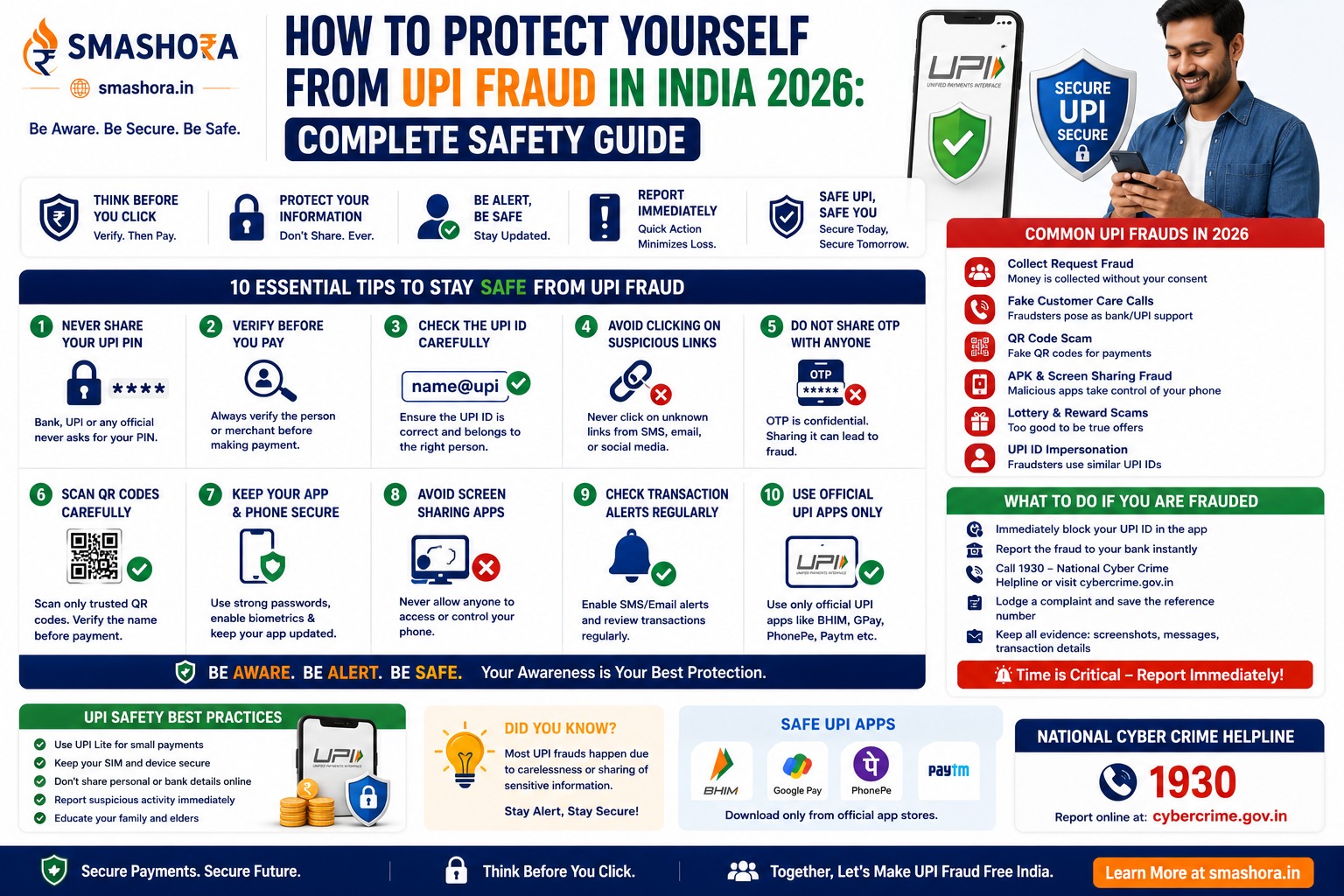
1. The Collect Request Scam
You receive a UPI collect request from an unknown number, often paired with a message like “approve this to receive your prize” or “accept this to get your refund.” The request looks like it is asking you to approve receiving money, but approving it and entering your PIN actually authorises a payment from your account to the scammer. Protection: Never approve a collect request from anyone you do not recognise, and remember that entering your PIN always means money is leaving your account, never arriving.
2. The Fake Customer Care Scam
This is one of the fastest-growing scams in 2026. You search Google for something like “PhonePe customer care number” or “HDFC Bank UPI helpline.” A sponsored result or a high-ranking organic result shows a phone number that looks official. You call it, and a professional-sounding person uses the bank’s name confidently and asks you to “verify” your account by sharing an OTP or your UPI PIN. In Q2 2026 alone, India’s Cyber Crime Coordination Centre (I4C) removed 4,200 fake customer care pages from Google — meaning fraudulent listings often outnumber legitimate ones in certain search results. Protection: Never source a customer care number from a Google search. Always get official numbers from the back of your debit card, by typing your bank’s official website URL directly into your browser, or from the in-app support section of your banking or UPI app. No legitimate customer care representative will ever ask for your UPI PIN or OTP over a call.
3. The QR Code Scam
A fraudster posing as a buyer for something you are selling online, or as a delivery agent, or even a stranger at a temple donation box or parking area, asks you to scan a QR code to “receive” payment. Scanning the code opens your UPI app showing an amount and a PIN entry field — and entering your PIN sends that amount out of your account rather than bringing money in. This scam also occurs physically: fraudsters have been documented swapping out legitimate merchant QR codes at shops with their own, redirecting customer payments to themselves for days before being noticed. Protection: A QR code can only be used to send money, never to receive it. You should never need to scan anything to receive a payment.
4. The Screen-Sharing App Scam
Fraudsters convince victims to install remote screen-sharing apps like AnyDesk or TeamViewer, typically under the pretext of helping resolve a technical issue or process a refund. Once installed, the scammer can see everything on your screen — including OTPs and banking app details — and can guide you through actions that transfer money out of your account while you watch, often without realising what is happening until it is too late. Protection: Never install a screen-sharing app at the request of a stranger or unsolicited caller. No legitimate bank, UPI provider, or government department requires remote access to your phone to resolve any issue.
5. The SIM Swap Fraud
Using personal details gathered from data leaks, breached KYC databases, or social media, fraudsters approach a telecom store with forged documents and convince staff to issue a duplicate SIM card linked to your number. Once active, this duplicate SIM receives your OTPs, and your phone often loses signal entirely just before the attack — by the time the victim notices and reports it, accounts have frequently already been drained, with average losses in documented cases ranging from ₹2 lakh to ₹25 lakh, particularly targeting high-balance accounts. Protection: If your phone suddenly and unexpectedly loses signal, call your telecom operator immediately from another phone to check for a SIM swap. Enable SIM change alerts through TRAI’s official portal. The Department of Telecommunications implemented a 5-day cooling period in 2025, meaning a newly issued SIM cannot be used for mobile banking for 5 days — a meaningful safety buffer if you act quickly.
6. The Digital Arrest Scam
This is among the most psychologically coercive scams active in India in 2026. You receive a call, sometimes a video call, from someone claiming to be a police officer, CBI official, customs officer, or similar authority figure. They tell you that you are under “digital arrest” for an alleged crime like money laundering or parcel-related smuggling, and instruct you to remain on the call continuously, not contact anyone, and transfer money to “resolve” the matter or avoid physical arrest. The fear and urgency are deliberately manufactured to prevent you from pausing to verify the claim with anyone else. Protection: No Indian law enforcement agency conducts arrests, investigations, or fine collection over a phone or video call. If a call creates fear, urgency, or threatens arrest while demanding payment, disconnect immediately and verify independently by calling the relevant department through its official published number.
7. The Wrong Transfer / Refund Pressure Scam
A fraudster claims they mistakenly transferred money into your account and pressures you to urgently send it back to a different account, often creating time pressure and emotional appeals. In reality, no money was actually sent to you, or the “refund” request is structured to extract a real payment from you under the guise of correcting their mistake. Protection: Always verify any claimed incoming transfer directly in your own bank statement or app — not based on a screenshot or claim from the other party — before taking any action.
8. Phishing and Smishing
Fake emails, SMS messages, or WhatsApp links direct you to counterfeit bank or government websites designed to capture your login credentials, OTP, or UPI PIN the moment you enter them. These fake sites are often near-identical visual copies of the real ones. Protection: Never click on unknown links received via SMS, email, or WhatsApp. Always type your bank’s official website address directly into your browser rather than following a link, and check the URL carefully for spelling errors or unusual domain extensions before entering any credentials.
Emerging UPI Fraud Trends in 2026
- Micro-transactions to dodge alerts: Fraudsters increasingly use small transactions below ₹500 specifically to avoid triggering bank fraud-alert thresholds, often as a precursor to a larger attempted transaction once initial small ones succeed undetected
- Mule UPI accounts via gaming apps: Scammers route stolen funds through UPI accounts linked to gaming or betting apps to obscure the money trail
- Deepfake voice phishing: AI-generated voice cloning is increasingly used to impersonate family members or known contacts in distress, asking for urgent money transfers
- RBI biometric requirement: In response to rising fraud, RBI now requires biometric authentication for UPI transactions above ₹10,000, adding a meaningful additional verification layer for higher-value transfers
Two Habits That Eliminate the Majority of UPI Fraud Risk
Among everything covered in this guide on how to protect yourself from UPI fraud in India 2026, two simple rules cover the overwhelming majority of fraud scenarios:
- Never approve a collect request from anyone you do not personally recognise. This single habit defeats the collect request scam, the QR-disguised collect scam, and most variations of the “receive money” deception.
- Never install a screen-sharing app at anyone’s request, ever. This single habit defeats the technical support scam, the fake refund scam, and most remote-access-based account takeovers.
Complete UPI Safety Checklist for India 2026
This checklist condenses everything you need to know about how to protect yourself from UPI fraud in India 2026 into actionable daily habits:
- Never share your OTP, UPI PIN, card CVV, password, or Aadhaar details with anyone, including someone claiming to be from your bank, police, or a government department
- Always verify the recipient’s name and number carefully before approving any UPI payment, since UPI apps display the registered name associated with the account
- Download banking and UPI apps only from the official Google Play Store or Apple App Store, never from links shared in SMS or WhatsApp
- Enable two-factor authentication and biometric login wherever your banking and UPI apps offer it
- Set a daily UPI transaction limit lower than your full account balance, particularly useful for senior citizens or less tech-savvy family members
- Regularly monitor your bank statements and enable SMS and email transaction alerts for every debit and credit
- Keep your mobile phone, UPI app, and operating system updated to the latest version at all times
- Use strong, unique passwords for your banking and UPI-linked accounts, never reused across other websites or apps
- Be extra cautious with any unexpected call, message, or offer that sounds too good to be true or creates urgency and fear
- Enable SIM change alerts through TRAI’s official portal to catch a potential SIM swap attempt early
Special Precautions for Senior Citizens and Less Tech-Savvy Family Members
Senior citizens are disproportionately targeted by digital arrest scams, fake customer care impersonation, and phishing attempts that exploit unfamiliarity with how UPI mechanics actually work. If you have elderly parents or relatives who use UPI, take these specific steps:
- Set a lower daily UPI transaction limit on their account specifically, reducing the maximum possible loss from any single fraudulent transaction
- Explain clearly, in simple terms, that entering a UPI PIN always means sending money, never receiving it — this single concept prevents the majority of scams targeting this age group
- Save your own number and the bank’s official helpline number prominently in their phone so they can call a trusted person before acting on any unexpected request
- Periodically review their transaction history together to catch any unusual activity early
For families managing a parent’s retirement income and investments alongside UPI safety, our guide on best investment options for senior citizens in India 2026 covers the broader financial protection picture for this life stage.
What to Do Immediately If You Become a Victim of UPI Fraud
Acting within minutes, not hours or days, significantly increases your chance of transaction reversal or freezing the fraudster’s account before the money is withdrawn or moved further. Follow these steps in order:
- Contact your bank’s official customer care immediately using the number from the back of your debit card or the bank’s official app — not a number found through a Google search
- Report the fraud on the National Cyber Crime Reporting Portal at cybercrime.gov.in, or call the dedicated cyber crime helpline number 1930 — this is India’s official, government-run reporting channel specifically for financial cybercrime
- File a complaint at your nearest police station if the amount is significant or if the cybercrime portal directs you to do so
- Keep all evidence safe — screenshots of the fraudulent transaction, call records, the scammer’s phone number or UPI ID, and any messages exchanged
- Change your UPI PIN and banking app passwords immediately as a precaution, even if you believe only one specific transaction was compromised
- If you suspect a SIM swap, contact your telecom operator from a different phone immediately to verify and block any unauthorised SIM activation
For official RBI guidance on digital payment security frameworks and your rights as a banking customer in cases of unauthorised electronic transactions, refer to the Reserve Bank of India website, which publishes specific customer liability provisions for cases reported promptly versus those reported with delay.
How UPI Fraud Affects Your Broader Financial Health
Beyond the immediate monetary loss, UPI fraud can disrupt your broader financial planning in ways that take months to fully recover from — a sudden ₹50,000 or ₹2 lakh loss can derail an emergency fund you have spent years building, or force you to liquidate investments at an inopportune time. This is precisely why maintaining a properly structured emergency fund, separate from your day-to-day UPI-linked account, provides a meaningful buffer even in the worst-case scenario. Our detailed guide on how to build an emergency fund in India covers exactly how to structure this safety net. Similarly, a sudden financial shock from fraud is one more reason consistent monthly saving habits matter — our guide on how to save money every month in India 2026 covers building the financial resilience that helps any household absorb an unexpected setback without lasting damage.
Conclusion — Awareness Is Your Strongest Defence
Learning how to protect yourself from UPI fraud in India 2026 ultimately comes down to internalising one core truth: UPI itself is a secure, well-engineered payment system, but fraudsters succeed by manipulating people, not by breaking the technology. Every major scam pattern covered in this guide — collect requests, fake customer care, QR code tricks, screen-sharing apps, SIM swaps, and digital arrest threats — relies on creating urgency, fear, or false trust to get you to authorise a transaction yourself, satisfying every technical security check while completely defeating your actual intent.
Internalise the two non-negotiable habits covered here — never approve an unrecognised collect request, and never install a screen-sharing app at anyone’s request — and you will have eliminated the vast majority of UPI fraud risk facing Indian households today. Share this awareness with your family, especially parents, grandparents, and anyone less familiar with exactly how UPI’s PIN mechanics work, since education is consistently the single most effective fraud prevention tool available.
At Smashora, our mission is to help every Indian make every rupee count — and that starts with protecting the rupees you already have from fraud before focusing on growing them further. If this guide on how to protect yourself from UPI fraud in India 2026 helped you or your family stay safer, leave a comment below or share it with a parent, grandparent, or friend who relies on UPI every day.
Frequently Asked Questions
Do I ever need to enter my UPI PIN to receive money?
No, never. Your UPI PIN is required only when you are sending money or authorising a payment, never when you are receiving funds. If any message, call, app notification, or QR code instructs you to enter your UPI PIN in order to “receive” a refund, prize, payment, or salary, it is a scam, regardless of how official or urgent it appears. This single principle, once understood, prevents the majority of UPI fraud attempts targeting Indian users in 2026.
What should I do immediately if I fall victim to UPI fraud?
Contact your bank’s official customer care immediately using the number printed on the back of your debit card or found in your bank’s official app, not a number from a Google search. Simultaneously, report the fraud on the National Cyber Crime Reporting Portal at cybercrime.gov.in or call the dedicated helpline number 1930. Keep all evidence including screenshots, the fraudster’s number or UPI ID, and transaction details. Acting within minutes rather than hours significantly increases your chances of transaction reversal or freezing the fraudulent account before funds are withdrawn.
How can I tell if a customer care number is fake?
Never source a customer care number through a Google search, since fraudsters have flooded search results with fake listings — in one recent quarter alone, India’s Cyber Crime Coordination Centre removed 4,200 fake customer care pages from Google. Always find official numbers from the back of your debit or credit card, by typing your bank’s official website URL directly into your browser, or through the official in-app support section of your banking or UPI application. No legitimate customer care representative will ever ask you to share your OTP, UPI PIN, or grant remote screen access.
What is a digital arrest scam and how do I protect myself?
A digital arrest scam involves fraudsters posing as police, CBI, customs, or other law enforcement officials over a phone or video call, falsely claiming the victim is under investigation or “digital arrest” for a crime like money laundering, and demanding immediate payment to avoid physical arrest. The scam relies entirely on manufactured fear and urgency to prevent the victim from pausing to verify the claim. No Indian law enforcement agency conducts arrests, investigations, or fine collection over a phone or video call. If you receive such a call, disconnect immediately and independently verify by calling the relevant department through its official, publicly listed number rather than any number provided by the caller.
Can scammers steal my money just by scanning my QR code?
A legitimate QR code that you generate to receive payment cannot be used by a scammer to take money from your account simply by viewing or scanning it on their end — QR codes are used to initiate payments, not extract funds independently. However, scammers exploit a different misunderstanding: they share their own QR code with you and falsely claim that scanning it will transfer money to you. In reality, scanning any QR code and entering your PIN always results in money leaving your account, never arriving. The protection is simple: you never need to scan a QR code to receive a payment, only to send one.
How does a SIM swap fraud work and what is the warning sign?
In a SIM swap fraud, criminals use your personal information, often obtained from data leaks or breached databases, to convince a telecom store to issue a duplicate SIM card linked to your phone number using forged documents. Once the duplicate SIM is activated, it receives your OTPs and banking alerts instead of your genuine phone. The clearest warning sign is your phone suddenly and unexpectedly losing network signal entirely. If this happens, immediately contact your telecom operator from a different phone to check for unauthorised SIM activation. Enabling SIM change alerts through TRAI’s official portal provides an additional early-warning layer, and the Department of Telecommunications’ 5-day cooling period on new SIMs for mobile banking use provides a meaningful buffer if you report the issue quickly.