Contents
- 1 How Loan Against Property Works
- 2 Best Loan Against Property Interest Rates in India 2026 — Bank and HFC Comparison
- 3 Public Sector Banks — Best for the Lowest Base Rate
- 4 Private Banks and HFCs — Best for Speed and Flexibility
- 5 Loan to Value (LTV) Ratio — How Much You Can Actually Borrow
- 6 What Determines Your Loan Against Property Interest Rate
- 7 Loan Against Property vs Home Loan — Key Differences
- 8 Loan Against Property vs Business Loan — Which Is Cheaper?
- 9 Documents Required for Loan Against Property in India 2026
- 10 Processing Fees and Other Charges to Watch For
- 11 How to Get the Best Loan Against Property Interest Rate in India 2026 — Step by Step
- 12 Loan Against Property vs Personal Loan for Large Funding Needs
- 13 Important Considerations Before Taking a Loan Against Property
- 14 Conclusion — Compare the Best Loan Against Property Interest Rates in India 2026 Before You Mortgage
- 15 Frequently Asked Questions
- 15.1 Which bank offers the best loan against property interest rate in India in 2026?
- 15.2 How much loan can I get against my property in India?
- 15.3 Is loan against property cheaper than a personal loan?
- 15.4 What is the difference between loan against property and a home loan?
- 15.5 What documents are required for a loan against property in India?
- 15.6 Can I get a loan against property with a low CIBIL score?
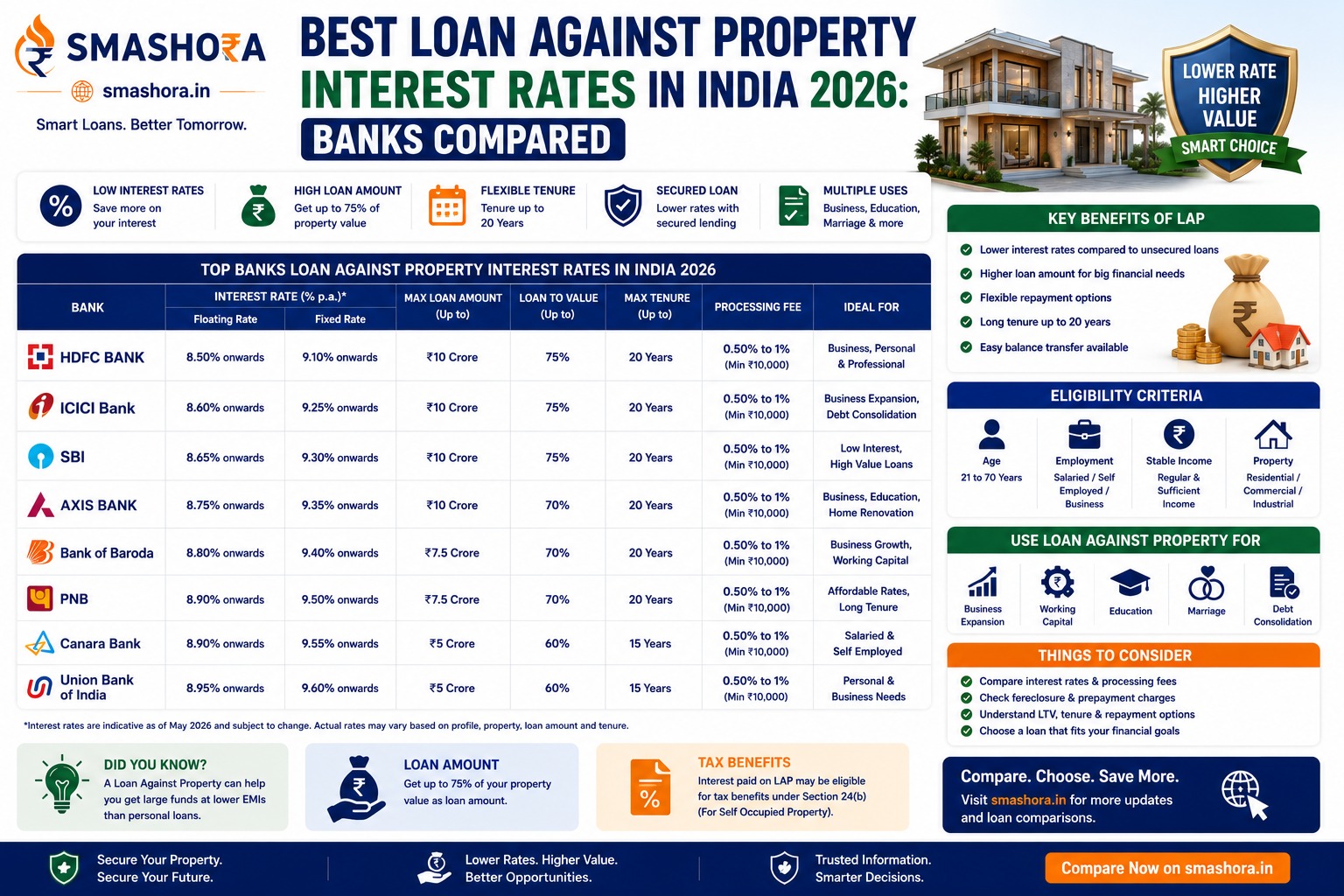
Finding the best loan against property interest rates in India 2026 matters enormously for anyone sitting on a valuable but illiquid asset — your home, office, or commercial space — while needing access to a large amount of capital for business expansion, a child’s education abroad, medical expenses, or consolidating multiple high-interest debts into one manageable loan. Loan against property interest rates in India in 2026 range from as low as 7.5% to 8.75% at public sector banks and select HFCs for well-qualified borrowers, up to 18% at lenders working with weaker credit profiles or more flexible end-use requirements. On a ₹50 lakh loan over 15 years, that gap can mean a difference of well over ₹15 lakh to ₹20 lakh in total interest.
A loan against property (LAP) lets you mortgage a residential or commercial property you already own to raise funds, while continuing to retain full ownership and, in most cases, continued use of the property itself. Because it is secured by real estate, LAP interest rates sit meaningfully below unsecured business loans, which commonly start from 14% to 16% or higher, making LAP one of the most cost-efficient large-ticket borrowing options available to property owners in India.
This complete guide on the best loan against property interest rates in India 2026 covers current rates across leading banks and HFCs, how the Loan to Value (LTV) ratio works, what determines your specific rate, the documentation process, and exactly how to compare offers before mortgaging an asset as significant as your property.
How Loan Against Property Works
A loan against property is a secured loan where you pledge a residential, commercial, or industrial property as collateral in exchange for funds, while continuing to hold legal title and, typically, continued occupancy or rental income from the property throughout the loan tenure. The lender places a charge on the property, meaning if you default on repayment, the lender has the legal right to recover dues by selling the mortgaged property, but day-to-day ownership and use remain with you as long as repayments stay current.
- End-use flexibility: Unlike a home loan which is restricted to property purchase or construction, LAP funds can typically be used for almost any legitimate purpose — business expansion, education, medical emergencies, debt consolidation, or working capital
- Loan amount: Generally based on a percentage of the property’s assessed market value, known as the Loan to Value (LTV) ratio
- Tenure: LAP tenures can extend up to 15 to 25 years depending on the lender, the property type, and the borrower’s age at the time of application
Best Loan Against Property Interest Rates in India 2026 — Bank and HFC Comparison
| Lender Category | Interest Rate Range | Typical LTV | Processing Fee |
|---|---|---|---|
| Public Sector Banks (SBI and similar) | 7.5% to 9% per year onwards | Up to 60% to 70% | 0.50% to 1% |
| Private Banks (HDFC and similar) | 8.5% to 13% per year | Up to 65% to 70% | 0.50% to 1.5% |
| Housing Finance Companies (Bajaj and similar) | 8.45% to 14.5% per year | Up to 65% to 70% | 0.50% to 1.5% |
| NBFCs (weaker credit profiles) | 14% to 18% per year | Up to 50% to 60% | 1% to 2% |
The overall market for the best loan against property interest rates in India 2026 spans roughly 7.5% to 18% per annum, with the precise rate depending heavily on your credit profile, the lender category, and the type and location of the property pledged. Public sector banks consistently offer the lowest base rates but generally require more rigorous documentation, while fintech-backed HFCs often lead on speed and accessibility for borrowers with strong CIBIL scores above 800. LAP rates are typically linked to the Repo Linked Lending Rate (RLLR) as per RBI guidelines, meaning your EMI can move when the central bank changes the repo rate — for official monetary policy updates, refer to the Reserve Bank of India website.
Public Sector Banks — Best for the Lowest Base Rate
Public sector banks, led by SBI, remain a benchmark for the best loan against property interest rates in India 2026 due to their transparent pricing structure with minimal hidden spread adjustments and consistently lower starting rates of 7.5% to 9% per year. The trade-off is a more rigorous documentation and property valuation process, where every legal paper on the property must be in order before the technical valuation even begins.
Best for: Property owners with clean, fully documented title records and the patience for a more thorough verification process in exchange for the lowest possible interest rate.
Private Banks and HFCs — Best for Speed and Flexibility
Private banks like HDFC and fintech-backed housing finance companies like Bajaj offer competitive rates starting from 8.45% to 8.75% for the strongest credit profiles, with the added advantage of faster processing and more flexible eligibility criteria for self-employed and business-owner applicants. For borrowers with a CIBIL score above 800, these lenders frequently match or come close to public sector rates while delivering meaningfully faster turnaround — often sanction within 48 hours and disbursal within 7 to 10 working days at digitally-driven lenders.
Best for: Business owners and self-employed professionals who value speed and a smoother digital application process, and who have a strong enough credit profile to access the better end of the private lender rate range.
Loan to Value (LTV) Ratio — How Much You Can Actually Borrow
The LTV ratio determines what percentage of your property’s assessed market value a lender will offer as a loan. This is one of the most important numbers to understand before applying for the best loan against property interest rates in India 2026, since it directly caps your maximum loan amount regardless of how favourable the interest rate is.
| Property Type | Typical Maximum LTV |
|---|---|
| Residential Property | Up to 70% |
| Commercial Property | Up to 50% to 65% |
This means a residential property valued at ₹1 crore could secure a loan of up to ₹70 lakh at the most generous lenders, while the same value in commercial property might secure only ₹50 lakh to ₹65 lakh, reflecting the relatively higher liquidity and resale predictability of residential real estate compared to commercial assets.
What Determines Your Loan Against Property Interest Rate
- CIBIL score: Applicants with credit scores above 750 consistently secure meaningfully lower interest rates; below this threshold, expect rates toward the higher end of the lender’s published range, or outright rejection at the most competitive public sector banks
- Loan amount and tenure: Larger loan amounts and the specific tenure chosen can both influence the precise rate offered, with longer tenures sometimes carrying a small rate premium to compensate the lender for extended exposure
- Property type and location: Residential properties in well-documented, high-liquidity markets typically secure better rates than commercial or industrial properties, and properties in smaller towns may see more conservative valuations
- Employment type: Salaried applicants with stable income are often viewed favourably, though most lenders also have well-developed LAP products specifically for self-employed and business-owner applicants
- Fixed vs floating rate choice: Floating rates typically start lower but fluctuate with market conditions, while fixed rates remain constant throughout the tenure — some lenders allow switching between the two during the loan tenure, subject to specific terms
If your CIBIL score needs improvement before applying for the best loan against property interest rates in India 2026, read our detailed guide on how to improve your CIBIL score, since this single factor has one of the largest impacts on the rate you are ultimately offered.
Loan Against Property vs Home Loan — Key Differences
| Feature | Loan Against Property | Home Loan |
|---|---|---|
| Purpose | Flexible — business, education, medical, debt consolidation | Restricted to property purchase or construction |
| Interest Rate | Slightly higher — 7.5% to 18% | Generally lower — 7.20% to 9.85% at most lenders |
| LTV Ratio | 50% to 70% of property value | Up to 90% of property value |
| Tax Benefits | Limited, generally only if proceeds are used for business or specific qualifying purposes | Significant — Section 24(b) and 80C benefits available |
LAP rates run slightly higher than home loan rates specifically because the end-use flexibility introduces more uncertainty for the lender compared to a home loan, where the funds are tied directly to the property being financed. For a complete comparison of current home loan rates, our guide on the best home loan interest rates in India 2026 covers the full landscape for property purchase financing specifically.
Loan Against Property vs Business Loan — Which Is Cheaper?
For business owners weighing their funding options, the secured nature of LAP delivers a meaningful cost advantage. Unsecured business loans command interest rates starting from approximately 14% to 16%, compared to LAP rates starting from 7.5% to 9% at the most competitive lenders — a gap that highlights why pledging property collateral, when available, is consistently the more cost-effective route for large-ticket business funding needs. Our comprehensive guide on the best business loan interest rates in India 2026 covers the full range of secured and unsecured business financing options, including government-backed schemes that may suit smaller funding needs without requiring property collateral at all.
Documents Required for Loan Against Property in India 2026
- PAN card and Aadhaar card of all applicants and co-applicants
- Complete property title documents, including the sale deed and any prior mortgage clearance certificates
- Latest property tax receipts
- Income proof — salary slips and Form 16 for salaried applicants, or ITR and audited financials for the last 2 to 3 years for self-employed and business applicants
- Bank statements for the last 6 to 12 months
- Property valuation report, typically arranged by the lender’s empanelled valuer as part of the application process
Processing Fees and Other Charges to Watch For
Beyond the headline interest rate, processing fees typically range from 0.5% to 1.5% of the loan amount and can represent a meaningful cost on large loans — on a ₹1 crore LAP, even a 1% processing fee amounts to ₹1 lakh. Always ask lenders for a fee waiver or discount, particularly during festive promotional periods, since this is frequently negotiable. Other charges to verify before signing include legal and technical valuation fees, stamp duty on the mortgage deed where applicable, and prepayment or foreclosure charges, which vary meaningfully between fixed and floating rate loans and across lenders.
How to Get the Best Loan Against Property Interest Rate in India 2026 — Step by Step
- Check your CIBIL score first: A score above 750 opens access to the lowest end of the rate range across virtually every lender category
- Start with your existing banking relationship: Visit the bank or HFC where you already hold accounts before exploring the wider market, since existing relationship banking can sometimes streamline approval and pricing
- Compare offers from at least one public sector bank and one private lender or HFC: The rate gap between categories can be substantial, and your specific profile may fit one category’s risk appetite better than another
- Confirm the LTV ratio being offered against your property’s assessed value: Do not assume the maximum advertised LTV automatically applies to your specific property and location
- Choose floating rate if you anticipate rates trending downward, and fixed rate if you prioritise certainty in your EMI over the full tenure
- Negotiate the processing fee explicitly, particularly during festive seasons when waivers and discounts are more commonly available
- Ensure your property documentation is complete and in order before applying, since incomplete title records are one of the most common causes of delayed approval at public sector banks specifically
Loan Against Property vs Personal Loan for Large Funding Needs
| Feature | Loan Against Property | Personal Loan |
|---|---|---|
| Interest Rate | 7.5% to 18% (secured) | 9.99% to 36% (unsecured) |
| Loan Amount | Significantly higher, tied to property value | Typically capped at ₹40 lakh to ₹50 lakh |
| Tenure | Up to 15 to 25 years | Typically up to 5 to 8 years |
| Best For | Large funding needs where you own a property to pledge | Smaller, shorter-term needs without collateral |
For genuinely large funding requirements, mortgaging a property almost always works out significantly cheaper over the loan tenure than an equivalent personal loan, given the substantial rate gap between secured and unsecured credit. For smaller or shorter-term needs where pledging property feels disproportionate to the amount required, our guide on the best personal loan in India 2026 covers the full unsecured lending landscape for comparison.
Important Considerations Before Taking a Loan Against Property
Mortgaging your property is a significant financial commitment that deserves careful consideration beyond simply comparing interest rates. Defaulting on a LAP carries the genuine risk of losing the mortgaged property through legal recovery proceedings, making it essential to borrow only an amount with a realistic, sustainable repayment plan, ideally backed by a stable income source or a clear business cash flow projection. Before committing, calculate your total EMI obligations across all existing loans to ensure the new LAP EMI remains comfortably manageable alongside your other financial commitments, and always use a LAP EMI calculator to model the full repayment schedule before signing any agreement.
Conclusion — Compare the Best Loan Against Property Interest Rates in India 2026 Before You Mortgage
The best loan against property interest rates in India 2026 start at approximately 7.5% to 8.75% at public sector banks and select fintech-backed HFCs for borrowers with strong credit profiles and clean property documentation, rising to 13% to 18% for weaker profiles or more flexible NBFC lenders. The combination of a low secured interest rate, long repayment tenure of up to 15 to 25 years, and the flexibility to use funds for almost any legitimate purpose makes LAP one of the most powerful financing tools available to property owners in India, whether for business expansion, education funding, or consolidating costlier debt.
Before mortgaging a property as significant as your home or commercial space, always check your CIBIL score, compare at least one public sector bank against a private lender or HFC, confirm the LTV ratio against your property’s genuine assessed value, and negotiate processing fees explicitly. The difference between the best and worst available rate on a large LAP can easily run into several lakhs of rupees over the loan tenure.
At Smashora, our mission is to help every Indian make every rupee count. If this guide on the best loan against property interest rates in India 2026 helped you evaluate this significant financing decision, leave a comment below or share it with someone currently exploring property-backed funding options.
Frequently Asked Questions
Which bank offers the best loan against property interest rate in India in 2026?
Public sector banks, particularly SBI, consistently offer among the best loan against property interest rates in India 2026, starting from approximately 7.5% to 9% per year, with transparent pricing and minimal hidden spread adjustments. Among private lenders and fintech-backed HFCs, Bajaj and similar institutions offer competitive starting rates of 8.45% to 8.75% for borrowers with CIBIL scores above 800, often with faster processing than traditional public sector documentation timelines. Always compare your specific profile against at least one public sector bank and one private lender before finalising, since the best fit depends heavily on your credit score and how quickly you need funds disbursed.
How much loan can I get against my property in India?
The loan amount is determined by the Loan to Value (LTV) ratio, which typically allows up to 60% to 70% of a residential property’s assessed market value, and a somewhat lower 50% to 65% for commercial properties. For example, a residential property valued at ₹1 crore could secure a loan against property of up to ₹70 lakh at the most generous lenders, while the same value in commercial property might secure ₹50 lakh to ₹65 lakh. The exact LTV offered to you also depends on your credit profile, income, and the lender’s specific policies.
Is loan against property cheaper than a personal loan?
Yes, significantly. Loan against property interest rates in India in 2026 typically range from 7.5% to 18% per year, compared to personal loan rates of 9.99% to 36% per year for the same borrower profile. Since LAP is secured by real estate collateral, lenders take on substantially less risk, which translates directly into lower interest rates and longer available tenures of up to 15 to 25 years, compared to typical personal loan tenures of 5 to 8 years. For large funding needs where you own a property to pledge, LAP is almost always the more cost-effective option over the life of the loan.
What is the difference between loan against property and a home loan?
A home loan is restricted specifically to purchasing or constructing a property and generally offers lower interest rates (typically 7.20% to 9.85%) along with significant tax benefits under Section 24(b) and Section 80C. A loan against property allows you to mortgage a property you already own to raise funds for virtually any purpose — business expansion, education, medical expenses, or debt consolidation — but comes with a slightly higher interest rate range of 7.5% to 18% and generally limited tax benefits unless the funds are used for specific qualifying purposes such as business investment.
What documents are required for a loan against property in India?
Standard documentation includes PAN card and Aadhaar card of all applicants, complete property title documents including the sale deed and any prior mortgage clearance, latest property tax receipts, income proof (salary slips and Form 16 for salaried applicants, or ITR and audited financials for the last 2 to 3 years for self-employed and business applicants), bank statements for the last 6 to 12 months, and a property valuation report typically arranged through the lender’s empanelled valuer. Incomplete or unclear property title documentation is one of the most common causes of delayed approval, particularly at public sector banks with more rigorous verification processes.
Can I get a loan against property with a low CIBIL score?
Yes, though the interest rate offered will be meaningfully higher and the maximum LTV ratio may be more conservative compared to what a strong credit profile would secure. Borrowers with CIBIL scores below 750 may still access loan against property financing, particularly through NBFCs and lenders with more flexible underwriting, but typically at rates toward the higher end of the market range, often 14% to 18% per year, compared to the 7.5% to 9% available to borrowers with scores above 750. Improving your CIBIL score before applying, even by a modest amount, can meaningfully reduce your effective interest rate on a large, long-tenure loan like LAP.