Contents
- 1 What Is a REIT and Why It Matters for Indian Investors in 2026
- 2 Best REITs to Invest in India 2026 — Complete Comparison
- 3 Embassy Office Parks REIT — Best for Stability and Predictable Income
- 4 Mindspace Business Parks REIT — Best for Balanced Growth and Lowest Volatility
- 5 Brookfield India Real Estate Trust — Best for Institutional Management Quality
- 6 Nexus Select Trust — Best for Retail Mall Exposure and Highest Occupancy
- 7 Best REITs to Invest in India 2026 — Yield Comparison and Risk Trade-Off
- 8 How REIT Taxation Works in India 2026
- 9 How to Invest in REITs in India 2026
- 10 Key Risks to Understand Before Investing
- 11 REITs vs Physical Real Estate — A Practical Comparison
- 12 How Much Should You Allocate to REITs in Your Portfolio?
- 13 Conclusion — REITs Are a Genuinely Mature Asset Class for Indian Investors in 2026
- 14 Frequently Asked Questions
- 14.1 Which is the best REIT to invest in India in 2026?
- 14.2 How much money do I need to start investing in REITs in India?
- 14.3 Are REIT dividends taxable in India?
- 14.4 Is investing in REITs safer than buying physical real estate in India?
- 14.5 What is the average dividend yield of REITs in India in 2026?
- 14.6 How many REITs are listed in India in 2026?
Finding the best REITs to invest in India 2026 has opened a door that was firmly closed to ordinary Indian investors until just a few years ago — direct ownership of premium, income-generating commercial real estate, available for the price of a single listed unit rather than the crores typically needed to buy office space or a shopping mall outright. With India’s five listed REITs now carrying a combined AUM of approximately ₹2.4 lakh crore, and SEBI’s reclassification of REITs as equity instruments effective January 1, 2026 expected to boost liquidity and mutual fund participation further, this asset class has genuinely matured into a mainstream portfolio option in 2026.
A Real Estate Investment Trust is a SEBI-regulated entity that owns income-generating real estate assets, pools investor capital to acquire or develop those assets, and is legally required to distribute at least 90% of its net distributable cash flows to unitholders as dividends — this is not optional, it is a binding SEBI mandate. REITs trade on NSE and BSE exactly like stocks, held in your demat account, with a minimum lot size reduced to just 1 unit, meaning you can start investing in commercial real estate income with whatever a single unit costs, often as little as ₹80 to ₹500.
This complete guide on the best REITs to invest in India 2026 covers all five listed options with their current yields, occupancy, and portfolio quality, how REIT taxation actually works, the genuine risks involved, and a practical framework for deciding how much of your portfolio should sit in this asset class.
What Is a REIT and Why It Matters for Indian Investors in 2026
Before comparing the best REITs to invest in India 2026, understanding the structural advantage REITs offer is essential. Traditionally, investing in premium commercial real estate — Grade-A office parks leased to multinational tenants, large retail malls, or institutional-grade business districts — required capital in the crores and was accessible only to large institutions and ultra-wealthy individuals. REITs democratise this by pooling investor capital and listing ownership units on the stock exchange, giving any investor with a demat account access to the same underlying asset class.
- Mandatory income distribution: SEBI requires REITs to distribute at least 90% of net distributable cash flows to unitholders, making them genuinely income-focused instruments rather than purely growth vehicles
- Stock exchange liquidity: Unlike physical real estate, which can take months to sell, REIT units can be bought and sold within seconds during market hours
- Low entry barrier: With minimum lot sizes reduced to 1 unit, REIT investing starts from a few hundred rupees rather than tens of lakhs
- Professional, institutional management: India’s listed REITs are backed by major institutional names including Blackstone and Brookfield, bringing global-standard asset management practices to retail investors
Best REITs to Invest in India 2026 — Complete Comparison
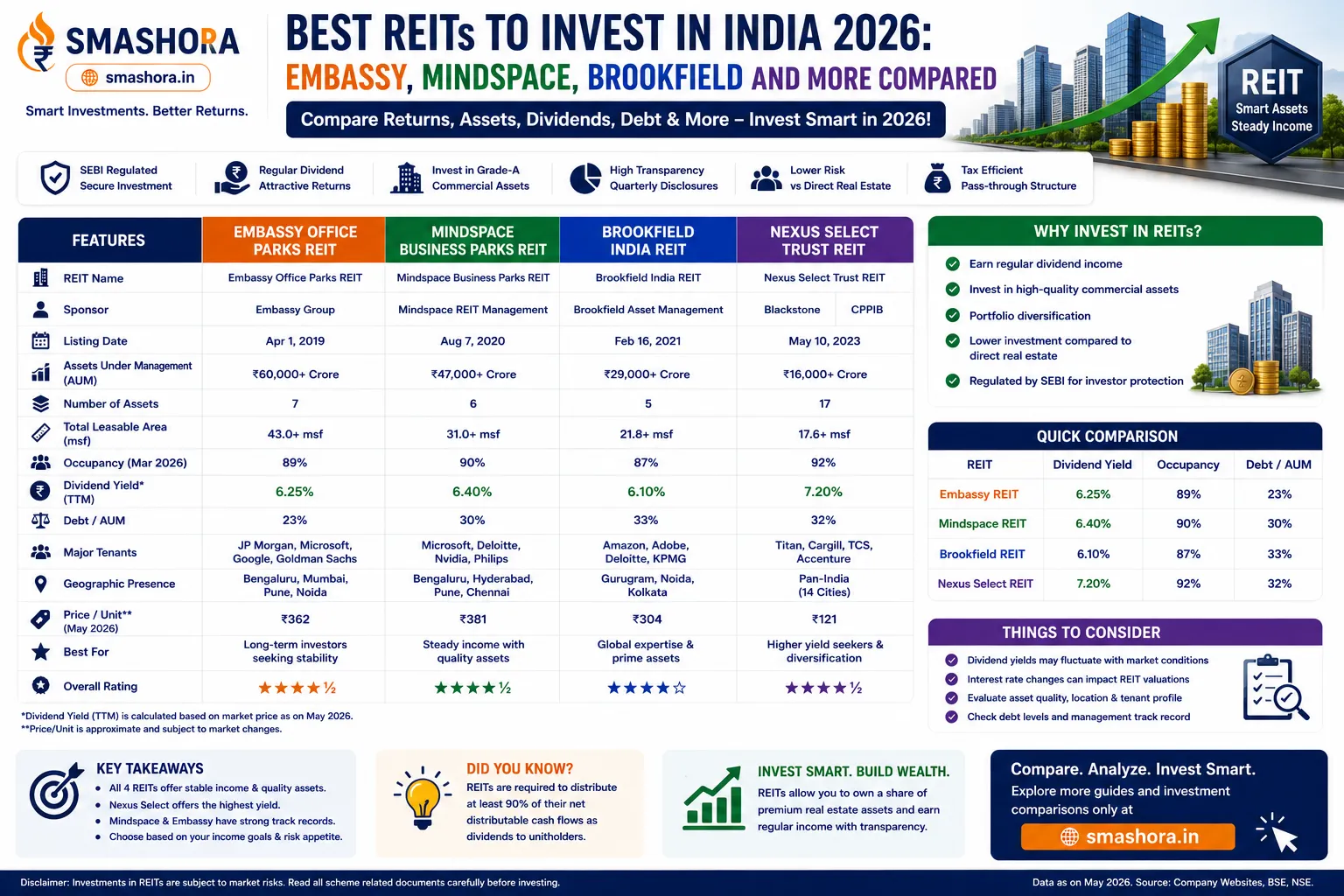
As of 2026, India has five publicly listed REITs: Embassy Office Parks REIT, Mindspace Business Parks REIT, Brookfield India Real Estate Trust, Nexus Select Trust, and the newly added Knowledge Realty Trust.
| REIT | Portfolio Focus | Size | Occupancy | Approximate Dividend Yield |
|---|---|---|---|---|
| Embassy Office Parks REIT | Office parks across Bengaluru, Mumbai, Pune, NCR, Chennai | 51 million sq ft — India’s largest | Approximately 92% | Approximately 5.3% |
| Mindspace Business Parks REIT | Office parks across Hyderabad, Mumbai, Pune, Chennai | 34 million sq ft | Strong, diversified tenant base | Approximately 7% to 8% |
| Brookfield India Real Estate Trust | 100% institutionally managed offices across Mumbai, NCR, Kolkata | 14 million sq ft | Improved from 82% to 92% committed | Approximately 5.1% to 7% |
| Nexus Select Trust | India’s only listed retail mall REIT — 19 malls across 15 cities | 19 premium shopping malls | 97.2% | Approximately 7.5% to 9% |
| Knowledge Realty Trust | Newly listed (2025), diversified commercial portfolio | Growing portfolio | Building track record | Emerging, monitor quarterly disclosures |
Embassy Office Parks REIT — Best for Stability and Predictable Income
Embassy is India’s largest listed REIT and is widely considered among the best REITs to invest in India 2026 for investors who prioritise stability over aggressive yield-chasing. With approximately 92% occupancy and a long weighted average lease expiry (WALE) across its 51 million square foot portfolio spanning five major Indian cities, Embassy has consistently delivered reliable quarterly distributions, including a declared dividend of ₹6.47 per unit for Q3 FY26.
Best for: Conservative income-focused investors who want the safest, most established option with the lowest single-asset concentration risk given its size and geographic diversification.
Mindspace Business Parks REIT — Best for Balanced Growth and Lowest Volatility
Mindspace stands out among the best REITs to invest in India 2026 for its combination of strong capital appreciation and notably lower volatility than its peers, having delivered a CAGR of 8.85% since listing — attributed largely to its geographic and tenant base diversification across Hyderabad, Mumbai, Pune, and Chennai. Morgan Stanley has named Mindspace its top REIT pick for 2026, projecting 20.5% FY27 returns on an overweight rating.
Best for: Growth-oriented investors who want meaningful capital appreciation potential without taking on the volatility typically associated with smaller, less diversified REITs.
Brookfield India Real Estate Trust — Best for Institutional Management Quality
Brookfield is India’s only 100% institutionally managed office REIT, backed by Brookfield Asset Management, one of the world’s largest alternative asset managers. Its occupancy improved meaningfully from 82% to 92% committed by the end of December 2025, and it carries the lowest promoter conflict risk among comparable peers given its fully institutional structure, with a dividend yield around 5.1% to 7%.
Best for: Investors who specifically want global institutional management quality and governance standards applied to their Indian commercial real estate exposure.
Nexus Select Trust — Best for Retail Mall Exposure and Highest Occupancy
Nexus Select Trust is India’s only listed retail-focused REIT, owning 19 premium malls across 15 cities with a remarkable 97.2% occupancy rate and over 130 million annual visitors generating ₹124 billion in tenant sales in FY25. Among the best REITs to invest in India 2026, Nexus offers genuine sector diversification away from pure office space, capturing India’s resilient post-pandemic retail and consumption recovery.
Best for: Investors who want diversification beyond office REITs and exposure to India’s consumption and retail growth story specifically.Best REITs to invest in India 2026
Best REITs to Invest in India 2026 — Yield Comparison and Risk Trade-Off
| Priority | Best Choice | Trade-Off |
|---|---|---|
| Stability and predictable income | Embassy Office Parks REIT | Lower yield relative to smaller, higher-risk peers |
| Capital appreciation with lower volatility | Mindspace Business Parks REIT | Slightly lower current yield than highest-yield options |
| Highest dividend yield | Brookfield or Nexus Select (approximately 7% to 9%) | Smaller size and somewhat more concentrated risk |
| Sector diversification (retail) | Nexus Select Trust | More exposed to consumption and footfall trends than office REITs |
How REIT Taxation Works in India 2026
Understanding taxation is essential before choosing among the best REITs to invest in India 2026, since REIT distributions are structured differently from typical dividend income. Each quarterly distribution can include multiple components — interest income, dividend income, amortisation of debt, and return of capital — each taxed differently:
| Distribution Component | Tax Treatment |
|---|---|
| Interest income component | Taxable at your applicable income slab rate |
| Dividend income component (where REIT’s underlying SPV has not opted for the concessional corporate tax regime) | Tax-free in the hands of the unitholder |
| Return of capital component | Not taxed immediately, but reduces your cost basis, affecting future capital gains calculation |
| Capital gains on sale of REIT units | 12.5% LTCG above ₹1.25 lakh per year if held over 12 months; 20% STCG if held under 12 months |
The exact tax-free proportion of each REIT’s distribution varies by quarter and depends on the specific REIT’s internal restructuring efforts — Mindspace has historically distributed over 90% of returns as tax-free, while Embassy and Brookfield have both undertaken restructuring specifically aimed at increasing the tax-free component of their distributions over time. Always check the latest distribution breakup disclosed by each REIT in its quarterly filings rather than assuming a fixed tax treatment, since this composition genuinely changes period to period.
How to Invest in REITs in India 2026
- Open a demat account: REITs are bought and sold exactly like stocks through your existing demat and trading account — if you do not already have one, our complete guide on the best demat account in India 2026 covers the top brokers and how to open one
- Search for the REIT ticker: Embassy trades as EMBASSY, Mindspace as MINDSPACE, Brookfield as BIRET, and Nexus Select under its respective listed ticker on NSE and BSE
- Place your buy order: Since the minimum lot size is now just 1 unit, you can start with whatever a single unit costs — typically ₹300 to ₹500 for Embassy, Mindspace, and Brookfield, or ₹80 to ₹120 for Nexus Select
- Track quarterly distributions: Most REITs pay distributions quarterly, with Embassy and Mindspace specifically paying 4 times per year — these are credited directly to your linked bank account
- Monitor quarterly occupancy and financial disclosures: REIT performance is driven primarily by occupancy rate multiplied by lease escalation, so reviewing each REIT’s quarterly occupancy trend is the single most useful ongoing monitoring habit
Key Risks to Understand Before Investing
- Interest rate sensitivity: Rising bond yields can make REIT distributions comparatively less attractive and increase REIT borrowing costs — India’s 10-year bond yield rising to a 20-month high of 7.0% by March 2026 illustrates how this risk plays out in real time
- Vacancy and tenant concentration risk: A REIT’s income depends directly on occupancy and tenant lease renewals — always check the leverage ratio (debt-to-equity), with a ratio above 1.5x generally considered higher risk; Embassy, Mindspace, and Brookfield have all maintained ratios in the safer 1.1x to 1.3x range
- Not RERA regulated: REITs fall under SEBI regulation, not RERA, meaning you do not get the same buyer protections as a direct property purchase — though SEBI’s disclosure requirements for quarterly financials, valuation reports, and lease details are themselves quite stringent
- Market price volatility: Despite being backed by physical real estate, REIT unit prices can still fluctuate with broader market sentiment and economic conditions, behaving somewhat like equity in the short term even though the underlying asset is real estate
- Don’t buy solely for yield: Total return, which combines distribution yield with capital appreciation or depreciation, matters more than headline yield alone — always compare a REIT’s total return against alternatives like fixed deposits or bonds before deciding
For official SEBI regulations governing REITs, including the recent reclassification as equity instruments effective January 1, 2026, refer to the Securities and Exchange Board of India website.
REITs vs Physical Real Estate — A Practical Comparison
| Feature | REITs | Physical Real Estate |
|---|---|---|
| Minimum Investment | Price of 1 unit (as low as ₹80 to ₹500) | Typically tens of lakhs and above |
| Liquidity | High — sell within seconds during market hours | Low — can take months to sell |
| Management Burden | None — professionally managed | Significant — tenant issues, maintenance, repairs |
| Diversification | Exposure across multiple properties and cities in one unit | Concentrated in a single property and location |
| Regulatory Protection | SEBI regulated, quarterly disclosures mandated | RERA regulated for new purchases |
A retired investor choosing between a ₹50 lakh flat purchase yielding ₹15,000 to ₹18,000 per month in rental income, with ongoing maintenance headaches, versus deploying the same amount across diversified REITs and receiving approximately ₹35,000 per month in distributions, illustrates the practical income advantage REITs can offer compared to direct rental property ownership — though this comparison should always factor in your specific liquidity needs and risk tolerance.
How Much Should You Allocate to REITs in Your Portfolio?
Most financial advisors suggest REITs are suitable for a 10% to 20% portfolio allocation as a steady-income, moderate-growth component, complementing rather than replacing your core equity mutual fund and government scheme holdings. REITs are best understood as occupying a position between bonds and equities — offering bond-like income predictability through mandated distributions, with equity-like exposure to capital appreciation and market-linked price movements. For a complete understanding of how REITs fit relative to mutual funds and other long-term wealth-building instruments, read our comprehensive guide on the best mutual funds for long term in India 2026, and for first-time investors building foundational market knowledge before adding REITs to their portfolio, our guide on how to invest in stock market for beginners in India covers the essentials.
Conclusion — REITs Are a Genuinely Mature Asset Class for Indian Investors in 2026
The best REITs to invest in India 2026 — Embassy, Mindspace, Brookfield, Nexus Select, and the newly listed Knowledge Realty Trust — collectively give retail investors access to premium, institutionally managed commercial real estate that was simply unavailable to ordinary Indians a decade ago. Embassy offers the safest, most stable choice given its scale and occupancy. Mindspace delivers the strongest balance of growth and low volatility. Brookfield brings global institutional governance standards. Nexus Select provides genuine retail sector diversification with the highest occupancy in the market.
With SEBI’s 2026 reclassification of REITs as equity instruments expected to improve liquidity and broaden mutual fund participation, and capital inflows into Indian real estate up 72% year-on-year in early 2026, this asset class appears positioned for continued institutional and retail attention through the rest of the decade. Always check quarterly occupancy, leverage ratios, and distribution composition before investing, and treat REITs as a 10% to 20% income-and-growth component of a broader, diversified portfolio rather than a standalone strategy.
At Smashora, our mission is to help every Indian make every rupee count. If this guide on the best REITs to invest in India 2026 helped you understand this growing asset class, leave a comment below or share it with someone exploring real estate investment options beyond buying physical property.
Frequently Asked Questions
Which is the best REIT to invest in India in 2026?
The best choice depends on your priority. Embassy Office Parks REIT is the most established and stable option, India’s largest with approximately 92% occupancy, ideal for conservative income-focused investors. Mindspace Business Parks REIT offers the strongest combination of growth and low volatility, having delivered an 8.85% CAGR since listing, and is Morgan Stanley’s top REIT pick for 2026. Brookfield India Real Estate Trust offers global institutional management quality with the lowest promoter conflict risk. Nexus Select Trust provides the highest occupancy at 97.2% and exposure to retail real estate specifically. Many investors choose to diversify across two or three of these rather than concentrating in a single REIT.
How much money do I need to start investing in REITs in India?
Very little. Since the minimum lot size for REITs in India was reduced to 1 unit, you can start investing with whatever a single unit costs — typically ₹300 to ₹500 for Embassy, Mindspace, and Brookfield, or ₹80 to ₹120 for Nexus Select Trust. This makes REITs one of the most accessible ways to gain exposure to premium institutional-grade commercial real estate, compared to direct property purchase which typically requires capital in the tens of lakhs or more.
Are REIT dividends taxable in India?
It depends on the specific component of each distribution. REIT distributions in India can include interest income (taxable at your income slab rate), dividend income (which is tax-free in the hands of unitholders in most current structures), and return of capital (not immediately taxed, but it reduces your cost basis for future capital gains calculation). The exact proportion of each component varies by REIT and by quarter, and is disclosed in each REIT’s quarterly filings. Capital gains from selling REIT units are taxed at 12.5% LTCG above ₹1.25 lakh per year if held over 12 months, or 20% STCG if held under 12 months.
Is investing in REITs safer than buying physical real estate in India?
REITs and physical real estate carry different risk profiles rather than one being universally safer. REITs offer significantly higher liquidity, professional management, diversification across multiple properties and cities, and SEBI-mandated quarterly financial disclosures. However, REITs fall under SEBI regulation rather than RERA, meaning they do not offer the same specific buyer protections as a direct property purchase, and REIT unit prices can be more volatile in the short term than the perceived stability of physical real estate, even though the underlying assets are the same type of commercial property.
What is the average dividend yield of REITs in India in 2026?
Dividend yields across India’s listed REITs in 2026 generally range from approximately 5% to 9%, varying by REIT and fluctuating with unit price movements. Embassy Office Parks REIT yields around 5.3%, Mindspace Business Parks REIT around 7% to 8%, Brookfield India Real Estate Trust around 5.1% to 7%, and Nexus Select Trust around 7.5% to 9%. These yields should always be evaluated alongside total return, which includes capital appreciation or depreciation, rather than considered in isolation, since a higher headline yield does not automatically mean a better overall investment outcome.
How many REITs are listed in India in 2026?
As of 2026, India has five publicly listed REITs: Embassy Office Parks REIT, Mindspace Business Parks REIT, Brookfield India Real Estate Trust, Nexus Select Trust, and the newly added Knowledge Realty Trust, which joined the market in 2025. Together, these five REITs carry a combined assets under management of approximately ₹2.4 lakh crore, and analysts expect further new listings from developers including Prestige, RMZ, CapitaLand, and others as the asset class continues to mature and attract both institutional and retail investor interest.