Contents
- 1 What Is Critical Illness Insurance and How Does It Work
- 2 Standalone Critical Illness Plan vs Rider — Which Should You Choose?
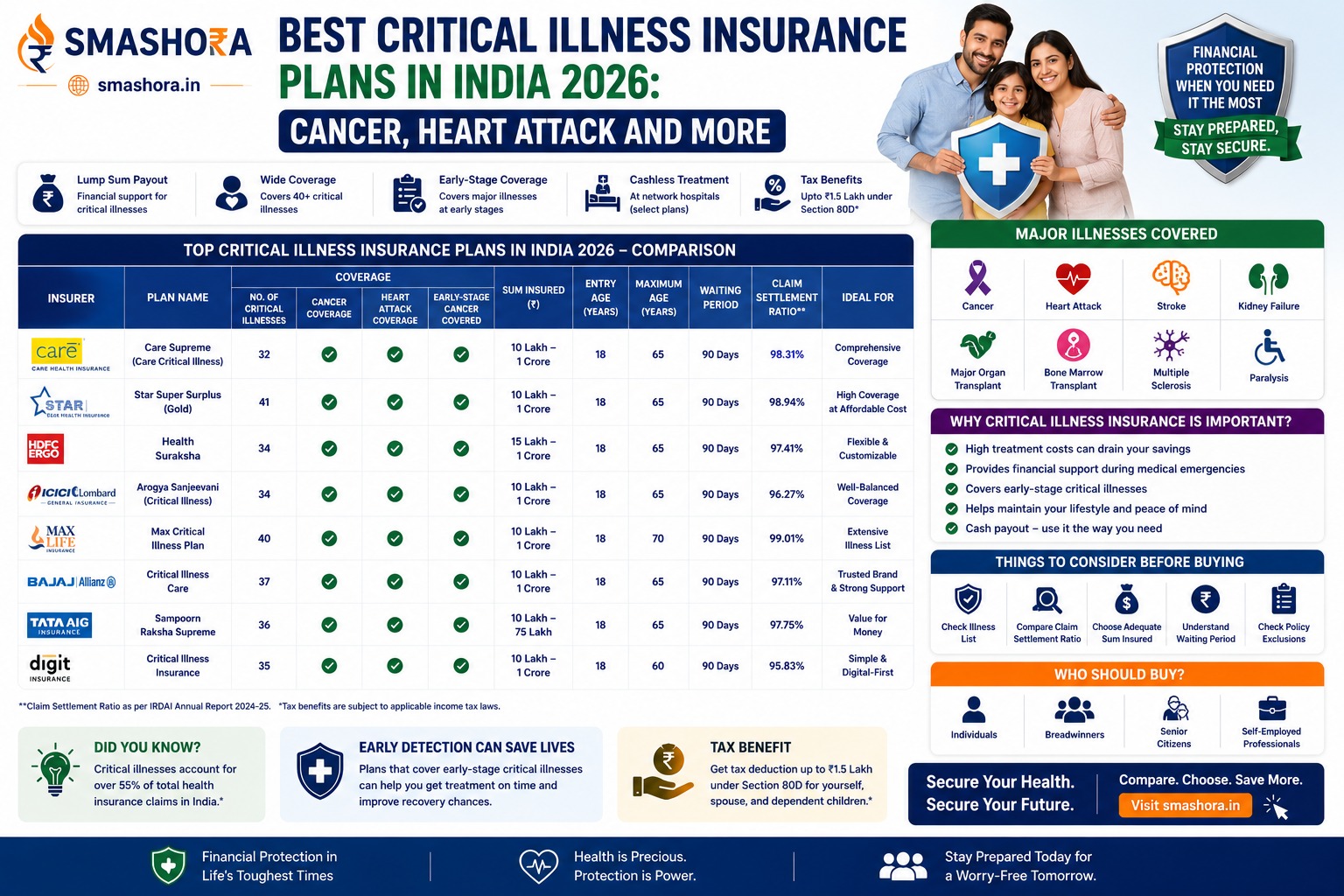
- 3 Best Critical Illness Insurance Plans in India 2026 — Top Insurer Options
- 4 Critical Illnesses Typically Covered in 2026
- 5 Waiting Period and Survival Period — Two Critical Terms to Understand
- 6 How Much Sum Insured Do You Actually Need?
- 7 Critical Illness Insurance vs Regular Health Insurance — Why You Need Both
- 8 Tax Benefits on Critical Illness Insurance Premiums
- 9 Choosing the Best Critical Illness Insurance Plan in India 2026 — A Practical Checklist
- 10 Conclusion — Fill the Gap That Health Insurance Cannot Cover
- 11 Frequently Asked Questions
- 11.1 What is the best critical illness insurance plan in India in 2026?
- 11.2 What is the difference between a critical illness rider and a standalone plan?
- 11.3 What is a survival period in critical illness insurance?
- 11.4 How much sum insured should I choose for critical illness insurance?
- 11.5 Does critical illness insurance cover early-stage cancer?
- 11.6 Are critical illness insurance premiums tax deductible in India?
Choosing the best critical illness insurance plans in India 2026 addresses a gap that standard health insurance simply does not cover — the loss of income and non-hospitalisation costs that follow a serious diagnosis like cancer, heart attack, or stroke. A standard health insurance policy reimburses your hospital bill. It does nothing for the months of reduced earning capacity, the expensive follow-up therapies, the lifestyle modification costs, or the family care expenses that often add up to far more than the hospitalisation itself. Critical illness insurance fills exactly this gap by paying a lump sum the moment a covered diagnosis is confirmed — money you can use however your family genuinely needs it.
Medical inflation in India continues to rise sharply in 2026, and treatments for cancer, cardiac surgeries, and neurological disorders can cost several lakhs while often requiring months of recovery during which the patient is unable to work. During this period, a critical illness payout provides immediate funds that support both medical and non-medical expenses, ensuring your existing savings and investments remain protected rather than being drained to cover the gap between what health insurance pays and what the situation actually demands.
This complete guide on the best critical illness insurance plans in India 2026 covers the difference between standalone plans and riders, the top insurers offering strong coverage, what waiting and survival periods mean for your claim, how much sum insured is genuinely appropriate, and the tax benefits available under Section 80D.
What Is Critical Illness Insurance and How Does It Work
Critical illness insurance pays a lump-sum benefit upon diagnosis of a specified critical illness — typically cancer, heart attack, stroke, kidney failure, paralysis, or major organ transplant — regardless of the actual treatment cost incurred. This is fundamentally different from regular health insurance, which reimburses you based on actual hospital bills submitted.
- Lump-sum payout: Once a covered diagnosis is confirmed and any survival period requirement is met, the insurer pays the full sum insured in one payment, with no requirement to submit hospital bills or prove specific expenses
- One-time benefit (in basic plans): Most standard critical illness riders pay out once and then the cover terminates — you receive no further benefit for any subsequent critical illness diagnosis under that specific rider
- Multipay options: Some standalone plans, like Star Critical Illness Multipay, allow multiple payouts across different illness categories within the same policy, offering more comprehensive long-term protection
- Use the money however needed: Unlike health insurance reimbursement tied to hospital bills, critical illness payouts can cover income replacement, alternative treatment, family support, or simply provide breathing room during recovery
Standalone Critical Illness Plan vs Rider — Which Should You Choose?
One of the first decisions when evaluating the best critical illness insurance plans in India 2026 is whether to buy a standalone policy or add a critical illness rider to your existing term or life insurance plan.
| Feature | Standalone Critical Illness Plan | Critical Illness Rider |
|---|---|---|
| Sum Insured Flexibility | High — typically ₹5 lakh to ₹2 crore, chosen independently | Capped at 25% to 50% of the base policy’s sum assured |
| Cost Structure | Dedicated premium based purely on the cover chosen | Lower incremental cost added to your existing premium |
| Number of Illnesses Covered | Often broader — up to 64 to 100 illnesses in leading plans | Typically narrower — commonly 15 to 34 illnesses |
| Independence from Base Policy | Fully independent — continues regardless of your term policy status | Tied to the base policy — may lapse if the base policy lapses |
| Best For | Those wanting comprehensive, high-value dedicated cover | Those wanting a simple, low-cost add-on to existing life cover |
For most families, a standalone critical illness plan with a sum insured of ₹10 lakh to ₹50 lakh offers significantly more genuine financial protection than a rider capped at 25% to 50% of your term insurance sum assured. If you already hold a term insurance policy and want to understand how a critical illness rider fits alongside it, our comprehensive guide on the best term insurance plans in India 2026 covers how riders typically integrate with base life cover.
Best Critical Illness Insurance Plans in India 2026 — Top Insurer Options
Several insurers stand out among the best critical illness insurance plans in India 2026 for their combination of broad illness coverage, high claim settlement reliability, and flexible sum insured options:
| Plan | Illnesses Covered | Sum Insured Range | Standout Feature |
|---|---|---|---|
| Niva Bupa CritiCare | Up to 20 major illnesses, focused on high-impact conditions | ₹1 lakh to ₹50 lakh | High claim settlement ratio (approximately 99%), trusted brand, easy claims process |
| Tata AIG CritiCare Plus / Criti Medicare | Up to 64 to 100 illnesses | ₹5 lakh to ₹2 crore | One of the broadest illness coverage lists in the market |
| Bajaj Allianz Critical Illness Gold Plus | Major illnesses including cancer, heart attack, stroke, kidney failure | Flexible, multiple tiers | Comparatively shorter survival period requirement |
| ICICI Lombard CritiShield / ICICI Pru Heart and Cancer Protect | Focused heart and cancer coverage plus broader CI options | Flexible | No survival period clause in select plan variants |
| Star Critical Illness Multipay | Multiple illness categories with multipay benefit | Flexible | Allows multiple payouts across different illness categories, not just a single one-time benefit |
| Aditya Birla Activ Secure | Comprehensive coverage list | High sum insured options available | Strong overall balance of coverage breadth and reliability |
| HDFC Life CSC Platinum / ICICI Pru iProtect Smart | 34 to 64 critical illnesses depending on variant | Flexible, often bundled as a life insurance rider option | Strong integration with broader life insurance planning |
Premiums vary meaningfully by age, gender, sum insured, smoking status, and whether you purchase online versus through an agent — online purchases typically offer a 10% to 20% discount over offline channels. Women and non-smokers generally receive lower premiums across nearly all insurers. Always request current quotes directly from the insurer or a licensed comparison platform, since rates and the specific list of covered conditions change periodically with product revisions.
Critical Illnesses Typically Covered in 2026
Coverage breadth is one of the most important differentiators among the best critical illness insurance plans in India 2026, with leading plans now covering anywhere from 15 to over 100 distinct conditions. Common categories include:
- Cancers of varying severity: From early-stage to advanced-stage cancer diagnoses, though coverage scope differs significantly between plans — many basic riders exclude early-stage cancers entirely, which is why dedicated cancer insurance or comprehensive standalone CI plans are often chosen separately
- Cardiovascular illnesses: First heart attack, coronary artery bypass surgery, aorta graft surgery, and related cardiac conditions
- Neurological disorders: Stroke, paralysis, multiple sclerosis, and other major neurological diagnoses
- Organ-related conditions: Kidney failure, major organ transplant, and primary pulmonary arterial hypertension
Always review the specific exclusions in any plan you are considering — for example, tumours caused by HIV infection are commonly excluded, and many standard plans specifically exclude early-stage cancers, making it important to verify exactly what stage of diagnosis triggers your payout before purchasing.
Waiting Period and Survival Period — Two Critical Terms to Understand
Two specific clauses determine whether your critical illness claim is actually payable, and misunderstanding either is one of the most common reasons claims get rejected:
Waiting Period
Most critical illness policies impose a waiting period of 90 to 180 days from the policy start date, during which no claim is admissible regardless of diagnosis. This protects insurers against people purchasing cover only after symptoms have already appeared, but it also means new buyers are not covered for any diagnosis confirmed within this initial window.
Survival Period
This is the clause that most commonly surprises policyholders. Many critical illness riders and plans require the policyholder to survive a set duration — typically 15 to 30 days, though it can range from 7 to 30 days depending on the insurer — counted from the date of diagnosis, in order to receive the payout. If the policyholder passes away before completing this survival period, the critical illness benefit is generally not paid (separate from any base life insurance death benefit, which would still apply if the policy includes one). Some insurers, including select ICICI Lombard plan variants, have removed the survival period clause entirely, which is a meaningful point of comparison when shortlisting plans.
How Much Sum Insured Do You Actually Need?
Given that critical illness treatment costs in India can exceed ₹20 lakh to ₹50 lakh or more for serious conditions, and the payout must also realistically cover months of lost income during recovery, most financial advisors recommend a sum insured of ₹10 lakh to ₹50 lakh or more, generally calculated as 10 to 20 times your annual income for primary breadwinners.
| Annual Income | Recommended Sum Insured (10x to 20x) |
|---|---|
| ₹6 lakh | ₹60 lakh to ₹1.2 crore (practically, ₹10 to ₹25 lakh is a realistic affordable starting point) |
| ₹12 lakh | ₹25 lakh to ₹50 lakh |
| ₹25 lakh and above | ₹50 lakh to ₹1 crore plus |
Rather than treating the 10x to 20x benchmark as rigid, choose the highest sum insured your budget comfortably allows, since premiums for critical illness cover are genuinely affordable, especially when purchased at a younger age before any health complications arise.
Critical Illness Insurance vs Regular Health Insurance — Why You Need Both
| Feature | Regular Health Insurance | Critical Illness Insurance |
|---|---|---|
| Payout Basis | Reimbursement of actual hospital bills (indemnity-based) | Fixed lump sum on diagnosis, regardless of actual expense |
| Covers Income Loss | No | Yes, effectively, since the lump sum can be used for any purpose |
| Covers Non-Hospital Expenses | Limited or none | Yes — family support, travel for treatment, lifestyle adjustment costs |
| Best Used For | Hospitalisation and treatment cost coverage | Income replacement and financial cushion during recovery |
The two products are complementary, not competing — your health insurance policy handles the hospital bill, while your critical illness payout handles everything the hospital bill does not cover, from lost income to ongoing therapy costs that continue long after discharge. For a comprehensive guide on choosing the right base health insurance policy to pair with your critical illness cover, read our detailed article on the best health insurance plans in India 2026.
Tax Benefits on Critical Illness Insurance Premiums
Premiums paid for critical illness insurance, whether as a standalone plan or a health insurance rider, qualify for deduction under Section 80D of the Income Tax Act:
- Up to ₹25,000 per year for self, spouse, and children (below 60 years)
- Up to ₹50,000 per year if the policyholder or insured is a senior citizen
This deduction is part of the same overall 80D limit that applies to your regular health insurance premium, so the combined premium for both health and critical illness cover counts toward the same ceiling. For seniors specifically considering critical illness cover alongside their broader financial planning, our guide on best investment options for senior citizens in India 2026 covers how to balance insurance premiums against income-generating investments at this life stage.
Choosing the Best Critical Illness Insurance Plan in India 2026 — A Practical Checklist
- Check the exact list of covered illnesses: Do not assume “cancer cover” means all stages and all types — verify whether early-stage cancers are included or specifically excluded
- Note the survival period: A plan with no survival period clause, or a shorter one, offers more reliable protection for your family in the worst-case scenario
- Compare claim settlement ratio: Insurers with consistently high CSR (95% and above) for critical illness specifically, not just their overall health insurance book, indicate stronger claims reliability
- Decide between single-pay and multipay structures: If lifetime protection against multiple distinct critical illness diagnoses matters to you, a multipay plan like Star Critical Illness Multipay offers more comprehensive long-term coverage than a standard one-time payout plan
- Buy early: Premiums rise significantly with age, and any health condition diagnosed after a certain age can result in exclusions, loading, or outright rejection — buying in your 30s while healthy locks in both lower cost and broader eligibility
For the latest IRDAI guidelines on critical illness and health insurance product standards, refer to the Insurance Regulatory and Development Authority of India website. A critical illness payout is also most powerful when it supplements, rather than replaces, your existing emergency fund — our guide on how to build an emergency fund in India covers how to structure that liquid safety net alongside your insurance cover.
Conclusion — Fill the Gap That Health Insurance Cannot Cover
The best critical illness insurance plans in India 2026 are not a replacement for your health insurance — they fill a specific and significant gap that hospitalisation-focused coverage simply cannot address: the income loss, family support costs, and extended recovery expenses that follow a serious diagnosis. Among standalone options, Tata AIG’s broad illness list, Niva Bupa CritiCare’s strong claim reliability, and Star Critical Illness Multipay’s repeat-payout structure each address different priorities, while a critical illness rider on an existing term plan offers a lower-cost entry point for those not yet ready for dedicated standalone cover.
Whatever you choose, buy early while healthy, choose a sum insured of at least 10 to 20 times your annual income where your budget allows, and read the survival period and exclusion clauses carefully before signing — these details determine whether a policy that looks comprehensive on paper actually delivers when your family needs it most.
At Smashora, our mission is to help every Indian make every rupee count, including the rupees that protect your family’s financial stability during the hardest moments. If this guide on the best critical illness insurance plans in India 2026 helped you understand your options, leave a comment below or share it with a family member who has not yet considered this layer of financial protection.
Frequently Asked Questions
What is the best critical illness insurance plan in India in 2026?
There is no single universal best plan, since the right choice depends on your priorities. For broad illness coverage, Tata AIG’s CritiCare Plus or Criti Medicare options cover up to 64 to 100 illnesses. For strong claim reliability, Niva Bupa CritiCare offers a claim settlement ratio around 99%. For repeat protection against multiple critical illness diagnoses over time, Star Critical Illness Multipay’s multipay structure stands out. For those who want to avoid the survival period clause entirely, select ICICI Lombard plan variants offer this feature. Always compare current quotes and the specific covered conditions list directly with the insurer before purchasing, since terms are revised periodically.
What is the difference between a critical illness rider and a standalone plan?
A critical illness rider is added to an existing term or life insurance policy and is typically capped at 25% to 50% of the base policy’s sum assured, making it a lower-cost but more limited option. A standalone critical illness plan is purchased independently with its own sum insured, typically ranging from ₹5 lakh to ₹2 crore, and generally covers a broader list of illnesses than a rider. Standalone plans also remain in force independently of any base policy, whereas a rider’s coverage is tied to the continuation of the underlying term or life policy.
What is a survival period in critical illness insurance?
A survival period is a clause requiring the policyholder to survive a specified number of days, typically 15 to 30 days (though some plans range from 7 to 30 days), counted from the date of diagnosis, before the critical illness benefit is paid out. If the policyholder does not survive this period, the critical illness payout is generally not made, though any separate base life insurance death benefit would still apply if the policy includes one. Some plans, including select ICICI Lombard variants, do not impose a survival period clause at all, which is an important comparison point when selecting a plan.
How much sum insured should I choose for critical illness insurance?
Most financial advisors recommend a sum insured of approximately 10 to 20 times your annual income for primary breadwinners, given that critical illness treatment costs in India can exceed ₹20 lakh to ₹50 lakh and the payout also needs to realistically cover lost income during an extended recovery period. In practical terms, this typically translates to a sum insured of ₹10 lakh to ₹50 lakh or more depending on your income level and budget, with most experts suggesting you choose the highest amount comfortably affordable within your premium budget.
Does critical illness insurance cover early-stage cancer?
This varies significantly by plan and is one of the most important details to verify before purchasing. Many standard critical illness riders and basic plans specifically exclude early-stage cancers, covering only advanced-stage diagnoses. This is precisely why many people choose dedicated cancer insurance policies or comprehensive standalone critical illness plans with broader cancer coverage definitions, rather than relying solely on a basic rider. Always read the specific cancer coverage clause in any policy carefully, since the stage and type of cancer covered can differ meaningfully between insurers and plan variants.
Yes. Premiums paid for critical illness insurance, whether purchased as a standalone policy or as a rider on a health or life insurance plan, qualify for deduction under Section 80D of the Income Tax Act, up to ₹25,000 per year for self, spouse, and children below 60 years, and up to ₹50,000 per year if the insured is a senior citizen. This deduction shares the same overall limit as your regular health insurance premium, so the combined premium paid for both health and critical illness cover counts toward the same Section 80D ceiling.