Contents
- 1 New Tax Regime vs Old Tax Regime in India 2026 — The Core Difference
- 2 New Tax Regime Tax Slabs for AY 2026-27
- 3 Old Tax Regime Tax Slabs for AY 2026-27
- 4 New Tax Regime vs Old Tax Regime in India 2026 — Deductions Comparison
- 5 New Tax Regime vs Old Tax Regime in India 2026 — Salary-Wise Comparison
- 6 The Break-Even Rule — When Does Old Regime Beat New Regime?
- 7 Who Should Choose the New Tax Regime in 2026?
- 8 Who Should Choose the Old Tax Regime in 2026?
- 9 New vs Old Tax Regime — The NPS Special Case
- 10 How to Switch Between Tax Regimes in India in 2026
- 11 Step-by-Step — How to Decide Between New and Old Regime for AY 2026-27
- 12 Conclusion — New Tax Regime vs Old Tax Regime in India 2026: The Simple Answer
- 13 Frequently Asked Questions
- 13.1 Which is better — new tax regime or old tax regime for salaried employees in India in 2026?
- 13.2 What is the income tax slab under the new tax regime for AY 2026-27?
- 13.3 Is the new tax regime the default for AY 2026-27?
- 13.4 Can I claim HRA under the new tax regime in India in 2026?
- 13.5 Can I switch from new to old tax regime after filing ITR?
The new tax regime vs old tax regime in India 2026 decision is one of the most important choices every salaried Indian must make before the July 31 ITR filing deadline — and getting it wrong costs real money. With the new tax regime now the default for FY 2025-26 (AY 2026-27), millions of taxpayers are being automatically placed in the new regime unless they actively opt for the old one. For many Indians, this default switch is actually beneficial. For others with significant deductions, it means paying thousands of rupees more in tax than necessary.
The new tax regime vs old tax regime in India 2026 debate has become more nuanced with the Budget 2025 changes. The new regime now offers a standard deduction of ₹75,000 (up from ₹50,000 in the old regime), zero tax on income up to ₹12 lakh due to the expanded Section 87A rebate, and lower slab rates across most income levels. These changes have tipped the balance decisively in favour of the new regime for taxpayers with few deductions. But for salaried Indians with a home loan, HRA, high 80C investments, and health insurance premiums — the old regime can still save significantly more.
This complete guide on the new tax regime vs old tax regime in India 2026 gives you a clear, salary-by-salary comparison with real numbers so you can make the right choice before filing your ITR for AY 2026-27. No guesswork, no jargon — just a direct answer for your specific income level and deduction profile.
New Tax Regime vs Old Tax Regime in India 2026 — The Core Difference
Before comparing the new tax regime vs old tax regime in India 2026 numbers, understand the fundamental trade-off:
- New Tax Regime: Lower slab rates, higher standard deduction (₹75,000), zero tax up to ₹12 lakh income — but most deductions and exemptions are NOT available. No 80C, no HRA, no home loan interest deduction under Section 24(b), no LTA.
- Old Tax Regime: Higher slab rates, lower standard deduction (₹50,000) — but all major deductions and exemptions ARE available. 80C up to ₹1.5 lakh, HRA exemption, home loan interest up to ₹2 lakh, 80D health insurance, 80CCD(1B) NPS, and more.
The new tax regime vs old tax regime in India 2026 is essentially a choice between simpler lower rates versus complex but potentially lower taxes if you have enough deductions to claim.
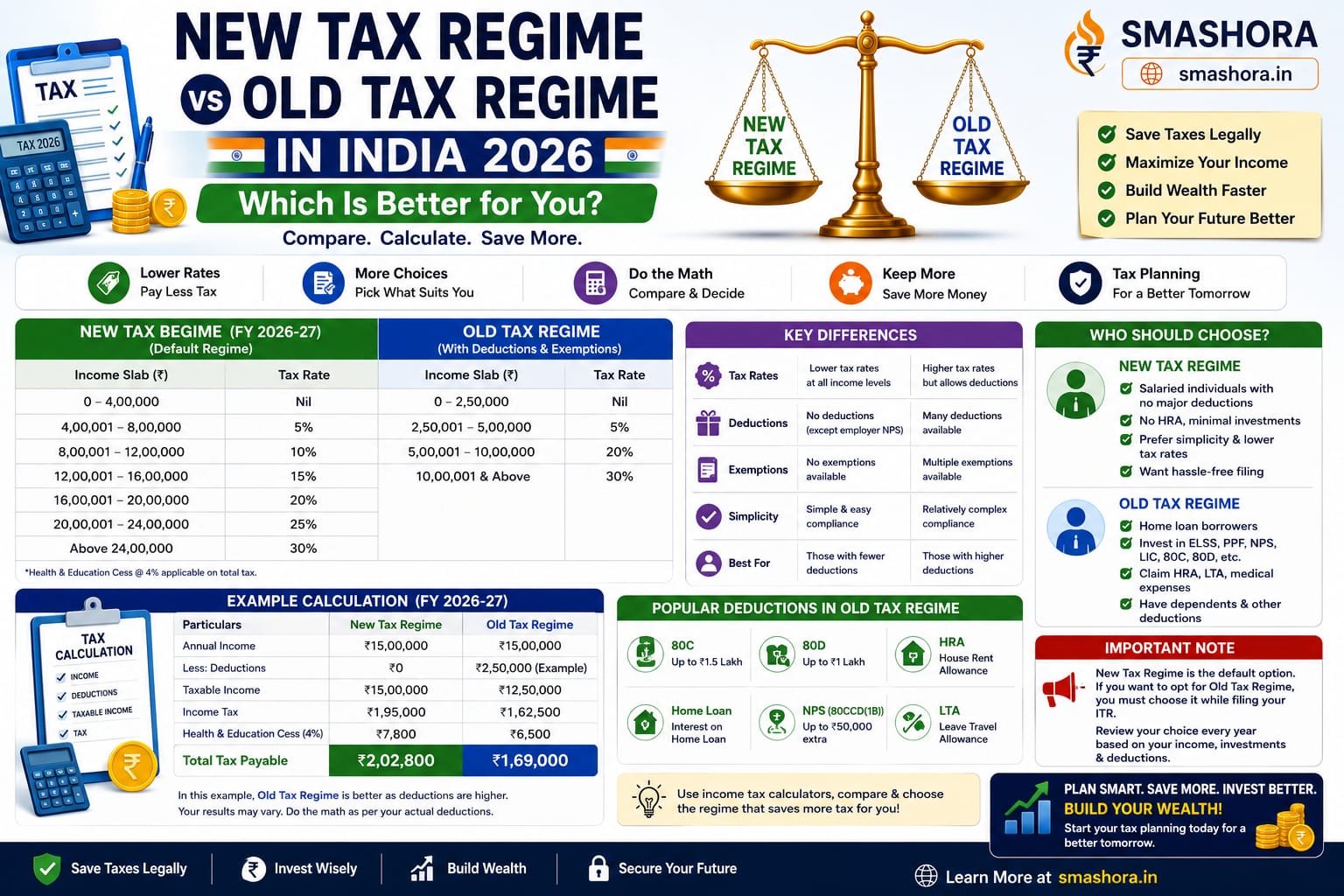
New Tax Regime Tax Slabs for AY 2026-27
| Income Slab | New Regime Tax Rate |
|---|---|
| Up to ₹4 lakh | Nil |
| ₹4 lakh to ₹8 lakh | 5% |
| ₹8 lakh to ₹12 lakh | 10% |
| ₹12 lakh to ₹16 lakh | 15% |
| ₹16 lakh to ₹20 lakh | 20% |
| ₹20 lakh to ₹24 lakh | 25% |
| Above ₹24 lakh | 30% |
Key benefit: Section 87A rebate under the new regime makes income up to ₹12 lakh completely tax-free. Combined with the ₹75,000 standard deduction, a salaried individual with gross income up to ₹12.75 lakh pays zero income tax under the new regime in AY 2026-27.
Old Tax Regime Tax Slabs for AY 2026-27
| Income Slab | Old Regime Tax Rate |
|---|---|
| Up to ₹2.5 lakh | Nil |
| ₹2.5 lakh to ₹5 lakh | 5% |
| ₹5 lakh to ₹10 lakh | 20% |
| Above ₹10 lakh | 30% |
87A rebate under old regime: ₹12,500 rebate for total income up to ₹5 lakh — making income up to ₹5 lakh tax-free under the old regime as well.
New Tax Regime vs Old Tax Regime in India 2026 — Deductions Comparison
The most critical aspect of the new tax regime vs old tax regime in India 2026 comparison is which deductions are available under each:
| Deduction or Exemption | New Tax Regime | Old Tax Regime |
|---|---|---|
| Standard Deduction | ₹75,000 | ₹50,000 |
| Section 80C (PPF, ELSS, EPF, LIC etc.) | Not Available | Up to ₹1,50,000 |
| Section 80D (Health Insurance) | Not Available | Up to ₹25,000 (self and family), ₹50,000 (senior parents) |
| HRA Exemption | Not Available | Available (based on actual rent, salary, city) |
| LTA Exemption | Not Available | Available for domestic travel twice in 4 years |
| Section 24(b) Home Loan Interest | Not Available (self-occupied) | Up to ₹2,00,000 per year |
| Section 80CCD(1B) — NPS extra | Not Available | Up to ₹50,000 additional |
| Section 80CCD(2) — Employer NPS | Available (up to 10% of basic) | Available (up to 10% of basic) |
| Section 80TTA — Savings account interest | Not Available | Up to ₹10,000 |
| Professional Tax | Not Available | Available (actual amount paid) |
| Section 87A Rebate | Up to ₹60,000 (income up to ₹12 lakh) | Up to ₹12,500 (income up to ₹5 lakh) |
New Tax Regime vs Old Tax Regime in India 2026 — Salary-Wise Comparison
Here is a direct income-by-income comparison to help you decide between the new tax regime vs old tax regime in India 2026:
Gross Salary ₹8 Lakh Per Year
| Calculation Step | New Tax Regime | Old Tax Regime |
|---|---|---|
| Gross Salary | ₹8,00,000 | ₹8,00,000 |
| Standard Deduction | ₹75,000 | ₹50,000 |
| 80C Deduction | Nil | ₹1,50,000 |
| 80D (health insurance) | Nil | ₹25,000 |
| Taxable Income | ₹7,25,000 | ₹4,75,000 |
| Tax Before Rebate | ₹32,500 | ₹12,500 |
| 87A Rebate | Nil (income above ₹7L threshold) | ₹12,500 (full rebate as income below ₹5L) |
| Tax After Rebate | ₹32,500 | ₹0 |
| Plus 4% Cess | ₹1,300 | ₹0 |
| Total Tax Payable | ₹33,800 | ₹0 |
Verdict at ₹8 lakh: Old regime wins decisively if you claim 80C and 80D deductions. If you have NO deductions to claim, the new regime applies and tax is ₹33,800. With full deductions claimed, the old regime gives zero tax on ₹8 lakh gross salary.
Gross Salary ₹12 Lakh Per Year
| Calculation Step | New Tax Regime | Old Tax Regime (with full deductions) |
|---|---|---|
| Gross Salary | ₹12,00,000 | ₹12,00,000 |
| Standard Deduction | ₹75,000 | ₹50,000 |
| 80C + 80D + NPS 80CCD(1B) | Nil | ₹2,25,000 |
| Taxable Income | ₹11,25,000 | ₹9,25,000 |
| Tax Before Cess | ₹0 (87A rebate — taxable income below ₹12L) | ₹1,12,500 |
| Plus 4% Cess | ₹0 | ₹4,500 |
| Total Tax Payable | ₹0 | ₹1,17,000 |
Verdict at ₹12 lakh: New regime wins convincingly. The 87A rebate makes income up to ₹12.75 lakh (with ₹75,000 standard deduction) completely tax-free under the new regime. Even with maximum 80C, 80D, and NPS deductions claimed, the old regime results in ₹1.17 lakh in tax. Choose the new regime at ₹12 lakh gross salary.
Gross Salary ₹15 Lakh Per Year
| Calculation Step | New Tax Regime | Old Tax Regime (with full deductions) |
|---|---|---|
| Gross Salary | ₹15,00,000 | ₹15,00,000 |
| Standard Deduction | ₹75,000 | ₹50,000 |
| 80C + 80D + NPS 80CCD(1B) | Nil | ₹2,25,000 |
| HRA Exemption (metro city renter) | Nil | ₹1,20,000 (assumed) |
| Taxable Income | ₹14,25,000 | ₹11,05,000 |
| Tax Before Cess | ₹1,73,750 | ₹1,21,500 |
| Plus 4% Cess | ₹6,950 | ₹4,860 |
| Total Tax Payable | ₹1,80,700 | ₹1,26,360 |
| Tax Saving by Choosing Old Regime | ₹54,340 saved |
Verdict at ₹15 lakh: Old regime saves ₹54,340 per year for a salaried employee with full 80C, 80D, NPS, and HRA deductions. If you claim HRA, have invested fully in 80C, pay health insurance, and contribute to NPS — the old regime is significantly better at ₹15 lakh gross salary.
Gross Salary ₹20 Lakh Per Year
| Calculation Step | New Tax Regime | Old Tax Regime (with full deductions) |
|---|---|---|
| Gross Salary | ₹20,00,000 | ₹20,00,000 |
| Standard Deduction | ₹75,000 | ₹50,000 |
| 80C + 80D + NPS 80CCD(1B) | Nil | ₹2,25,000 |
| HRA + Home Loan Interest | Nil | ₹3,20,000 (assumed combined) |
| Taxable Income | ₹19,25,000 | ₹14,05,000 |
| Tax Before Cess | ₹3,48,750 | ₹2,41,500 |
| Plus 4% Cess | ₹13,950 | ₹9,660 |
| Total Tax Payable | ₹3,62,700 | ₹2,51,160 |
| Tax Saving by Choosing Old Regime | ₹1,11,540 saved |
Verdict at ₹20 lakh: Old regime saves over ₹1.11 lakh per year for someone with full deductions including HRA and home loan interest. The old regime advantage increases with income for people who have significant deductions to claim.
The Break-Even Rule — When Does Old Regime Beat New Regime?
The new tax regime vs old tax regime in India 2026 decision comes down to one simple test: how much in total deductions can you actually claim?
If your total deductions — 80C plus 80D plus HRA plus home loan interest plus NPS plus professional tax — exceed approximately ₹3.75 lakh to ₹5.43 lakh, the old regime is likely to give you a lower total tax bill. Below that threshold, the new regime wins. The exact break-even point varies by income level:
| Gross Annual Salary | Approximate Break-Even Deduction Threshold | Choose New Regime if Deductions Below | Choose Old Regime if Deductions Above |
|---|---|---|---|
| ₹8 lakh | ₹2.00 lakh | Below ₹2 lakh | Above ₹2 lakh |
| ₹10 lakh | ₹2.25 lakh | Below ₹2.25 lakh | Above ₹2.25 lakh |
| ₹12 lakh | New regime almost always better (87A rebate) | Almost always new regime | Rarely old regime at this income |
| ₹15 lakh | ₹3.75 lakh | Below ₹3.75 lakh | Above ₹3.75 lakh |
| ₹20 lakh | ₹4.50 lakh | Below ₹4.50 lakh | Above ₹4.50 lakh |
| ₹30 lakh and above | ₹5.43 lakh | Below ₹5.43 lakh | Above ₹5.43 lakh |
Who Should Choose the New Tax Regime in 2026?
In the new tax regime vs old tax regime in India 2026 decision, the new regime is clearly better for:
- First-time earners and young professionals (age 22 to 28) who are just starting out, have not yet built 80C investments, do not pay HRA, and have no home loan — the new regime’s lower rates and zero tax up to ₹12 lakh is straightforward and beneficial
- Salaried employees with income up to ₹12.75 lakh and limited deductions — the 87A rebate makes this income bracket completely tax-free under the new regime regardless of deductions
- Employees whose employer contributes to NPS under 80CCD(2) — this benefit is available under the new regime too, making NPS even more valuable as the only major deduction that survives the new regime
- Individuals in the new tax regime who also earn rental income or have capital gains — the simpler new regime calculation is often more convenient and the lower rates at the 20% and 25% slabs can save more than old regime deductions
- Self-employed individuals with business income — can opt for the new regime and enjoy simplified compliance without complex deduction tracking
Who Should Choose the Old Tax Regime in 2026?
In the new tax regime vs old tax regime in India 2026 comparison, the old regime remains better for:
- Salaried employees who pay HRA and have significant rent expenses — especially those in metro cities where HRA exemption can be ₹1.5 lakh to ₹3 lakh or more per year
- Home loan borrowers — the ₹2 lakh home loan interest deduction under Section 24(b) is exclusively available in the old regime and is extremely valuable for high-income bracket taxpayers
- Those who have maxed 80C investments (EPF, PPF, ELSS) and also pay health insurance — at ₹1.5 lakh 80C plus ₹50,000 NPS plus ₹25,000 to ₹75,000 health insurance, the combined deductions can easily make the old regime more beneficial at ₹15 lakh and above
- Individuals with dependents who have senior citizen parents requiring health insurance — the extra ₹50,000 Section 80D deduction for senior citizen parents is exclusively old regime and provides significant tax benefit
To maximise the old regime’s benefit, make sure all your 80C investments are optimally utilised. Our complete guide on how to save tax under Section 80C in India 2026 covers every eligible investment and expense in detail. For health insurance premiums that qualify for 80D deduction, our guide on the best health insurance plans in India 2026 helps you choose the right cover to maximise both financial protection and tax benefit.
New vs Old Tax Regime — The NPS Special Case
One deduction survives into the new tax regime that is worth understanding in the new tax regime vs old tax regime in India 2026 context: the employer contribution to NPS under Section 80CCD(2).
If your employer contributes to your NPS account as part of your CTC — up to 10% of basic salary for private sector employees — that employer NPS contribution is tax-deductible under Section 80CCD(2) even under the new tax regime. This means:
- On a basic salary of ₹6 lakh per year, employer NPS contribution of ₹60,000 per year (10%) reduces your new regime taxable income by ₹60,000
- At 15% or 20% tax rate in the new regime, this saves ₹9,000 to ₹12,000 per year — for free, without any additional investment from you
- This benefit applies across both tax regimes but is uniquely valuable under the new regime where most other deductions are unavailable
Ask your HR team whether your company offers NPS as part of your CTC structure — if yes, ensure you are enrolled regardless of which tax regime you choose. For the complete NPS guide covering account opening, fund selection, and all tax benefits, read our article on NPS vs PPF in India 2026.
How to Switch Between Tax Regimes in India in 2026
A key practical aspect of the new tax regime vs old tax regime in India 2026 decision is understanding the switching rules:
- Salaried individuals: Can switch between new and old regime every year at the time of filing their ITR. You are not locked into any regime permanently. If you choose the new regime for AY 2026-27 and find the old regime better next year, you can switch at AY 2027-28.
- Declaration to employer: At the start of each financial year (April), your employer asks you to declare your preferred regime for TDS computation. If you declare new regime, your employer deducts lower TDS. If you switch to old regime later at filing, you can claim the additional deductions and get any excess TDS refunded.
- Self-employed individuals with business income: Can switch out of the new regime only once in their lifetime. Once they opt back into the old regime, they cannot switch to the new regime again (except for certain specific conditions).
Step-by-Step — How to Decide Between New and Old Regime for AY 2026-27
- List all your actual deductions: Add up your actual 80C (EPF contribution + PPF + ELSS + LIC), 80D (health insurance paid), HRA exemption amount, home loan interest paid, NPS 80CCD(1B), and any other eligible deductions
- Calculate your taxable income under the old regime: Gross income minus standard deduction (₹50,000) minus all deductions above
- Calculate your taxable income under the new regime: Gross income minus standard deduction (₹75,000) only
- Apply the respective tax slabs to each taxable income figure
- Check for 87A rebate: If taxable income under new regime is below ₹12 lakh, tax is zero after rebate
- Compare the final tax payable under both regimes and choose the lower one
- Use the official income tax portal calculator at incometax.gov.in for an instant comparison with your exact figures
For a complete step-by-step guide on the ITR filing process including how to select your regime correctly during e-filing, read our article on how to file ITR online in India 2026 before the July 31 deadline.
Conclusion — New Tax Regime vs Old Tax Regime in India 2026: The Simple Answer
The new tax regime vs old tax regime in India 2026 decision has a clear framework. If your total claimable deductions are below ₹3.75 lakh and your income is at or below ₹12.75 lakh, the new regime is almost certainly better — you pay zero tax with the 87A rebate and standard deduction in many cases. If your total claimable deductions exceed ₹4 lakh to ₹5 lakh through a combination of 80C, HRA, home loan interest, health insurance, and NPS, the old regime saves significantly more at income levels above ₹15 lakh.
The most important action you can take right now is to calculate your exact deductions using the steps above and compare both regimes with your specific income and deduction figures. Use the income tax calculator on the official portal, or approach a CA or tax filing service for a personalised calculation. The difference between choosing the right and wrong regime can be ₹50,000 to over ₹1 lakh per year — well worth 30 minutes of calculation before the July 31 ITR deadline.
At Smashora, our mission is to help every Indian make every rupee count — including every rupee saved through smart tax regime selection. If this guide on the new tax regime vs old tax regime in India 2026 helped you decide, leave a comment below and tell us which regime works out better for your income — or share it with a colleague who is still unsure which regime to choose this year.
Frequently Asked Questions
Which is better — new tax regime or old tax regime for salaried employees in India in 2026?
The answer depends on your deductions. For salaried employees with gross income up to ₹12.75 lakh and minimal deductions, the new tax regime is clearly better — the 87A rebate effectively makes this income bracket completely tax-free. For employees with income above ₹15 lakh who claim HRA, full 80C at ₹1.5 lakh, health insurance under 80D, home loan interest under Section 24(b), and NPS under 80CCD(1B), the old tax regime can save ₹50,000 to ₹1 lakh or more per year. Calculate your specific deductions before deciding in the new tax regime vs old tax regime in India 2026 comparison.
What is the income tax slab under the new tax regime for AY 2026-27?
Under the new tax regime for AY 2026-27 (FY 2025-26), the slabs are: nil up to ₹4 lakh, 5% from ₹4 to ₹8 lakh, 10% from ₹8 to ₹12 lakh, 15% from ₹12 to ₹16 lakh, 20% from ₹16 to ₹20 lakh, 25% from ₹20 to ₹24 lakh, and 30% above ₹24 lakh. Plus a standard deduction of ₹75,000 for salaried individuals and a Section 87A rebate that effectively makes income up to ₹12 lakh completely tax-free after the rebate is applied.
Is the new tax regime the default for AY 2026-27?
Yes. The new tax regime is the default for FY 2025-26 (AY 2026-27). If you do not actively inform your employer or declare your regime preference in your ITR, you will be placed in the new tax regime automatically. If you want the old tax regime and its deductions — 80C, HRA, home loan interest, 80D — you must actively opt for it when declaring your regime to your employer at the start of the financial year and when selecting the regime during ITR filing on the income tax portal.
Can I claim HRA under the new tax regime in India in 2026?
No. HRA (House Rent Allowance) exemption is not available under the new tax regime in 2026. This is one of the most significant differences in the new tax regime vs old tax regime in India 2026 comparison for employees paying rent. If you live in a rented home in a metro city and pay significant rent, the HRA exemption under the old regime can be ₹1.5 lakh to ₹3 lakh or more per year — making the old regime substantially more beneficial if you also claim other deductions like 80C and 80D simultaneously.
Can I switch from new to old tax regime after filing ITR?
No, you cannot switch regimes after submitting your ITR for a financial year. You must choose your regime at the time of filing. However, for salaried individuals, you can switch between old and new regime every year when filing your ITR — you are not permanently locked into a regime. If you filed under the new regime for AY 2026-27, you can choose the old regime for AY 2027-28 if it becomes more beneficial. Inform your employer at the start of the new financial year about your preferred regime for TDS deduction purposes.