Contents
- 1 What Defines a Good Investment for Senior Citizens in 2026
- 2 Best Investment Options for Senior Citizens in India 2026 — Senior Citizen Savings Scheme (SCSS)
- 3 Best Investment Options for Senior Citizens in India 2026 — Post Office Monthly Income Scheme (POMIS)
- 4 Best Investment Options for Senior Citizens in India 2026 — Senior Citizen Fixed Deposits
- 5 Best Investment Options for Senior Citizens in India 2026 — PPF for Retirees
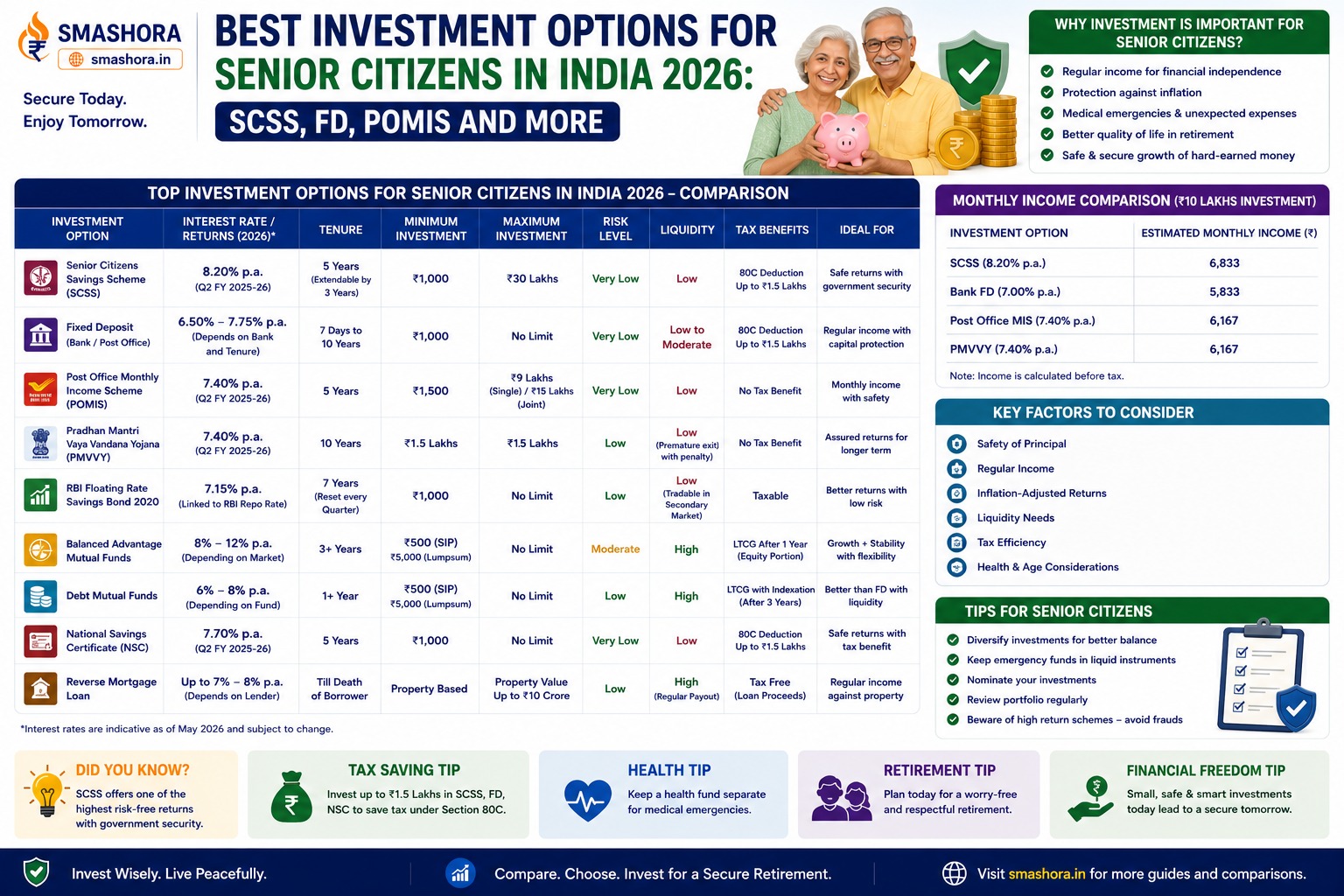
- 6 Best Investment Options for Senior Citizens in India 2026 — Comparison Table
- 7 Building a Monthly Income Strategy With the Best Investment Options for Senior Citizens in India 2026
- 8 Should Senior Citizens Invest in Mutual Funds?
- 9 Tax Planning for Senior Citizens — Key Benefits to Know
- 10 Common Mistakes Senior Citizens Make With Their Retirement Corpus
- 11 Conclusion — Build a Safe, Predictable Income Stream in Retirement
- 12 Frequently Asked Questions
- 12.1 What is the best investment option for senior citizens in India in 2026?
- 12.2 What is the current SCSS interest rate for 2026?
- 12.3 How much monthly income can I get from a ₹30 lakh investment in SCSS?
- 12.4 Is SCSS or senior citizen FD better for retirees?
- 12.5 Can both husband and wife open separate SCSS accounts?
- 12.6 How can senior citizens avoid TDS on FD and SCSS interest?
Choosing the best investment options for senior citizens in India 2026 requires a fundamentally different approach than investing during your working years. After decades of building a corpus, the priority shifts decisively from growth to safety, predictability, and regular income that covers monthly expenses without market-linked anxiety. The good news for retirees in 2026 is that government-backed schemes specifically designed for this life stage — Senior Citizen Savings Scheme at 8.2%, Post Office Monthly Income Scheme at 7.4%, and senior citizen fixed deposits offering 0.50% to 0.75% above standard rates — provide genuinely strong returns with the full safety that a retirement corpus demands.
I have seen many retired families make the same costly mistake — leaving their entire retirement corpus in a regular savings account earning 3% to 4%, simply because the safer, higher-return government schemes felt unfamiliar or complicated. A retired couple with ₹40 lakh sitting largely idle in savings accounts could be earning ₹3.28 lakh per year through SCSS alone at the current 8.2% rate — money that directly funds groceries, medicines, and the comfortable retirement they spent a working lifetime building toward.
This complete guide on the best investment options for senior citizens in India 2026 covers every major scheme — SCSS, POMIS, senior citizen FDs, PPF, and a calibrated mix for different corpus sizes — with current interest rates, tax treatment, and a practical framework for generating reliable monthly income throughout retirement.
What Defines a Good Investment for Senior Citizens in 2026
Before comparing specific schemes, the best investment options for senior citizens in India 2026 should be evaluated against criteria that differ meaningfully from working-age investment priorities:
- Capital safety above all: At this life stage, recovering from a significant capital loss is far harder than during working years. Government-backed and sovereign-guaranteed instruments should form the core of any retirement portfolio.
- Regular income, not just growth: Monthly or quarterly payouts that cover routine expenses matter more than long-term compounding, since the corpus exists to fund current living costs rather than build future wealth.
- Liquidity for emergencies: Healthcare needs can arise suddenly in retirement. A portion of the corpus should remain accessible without heavy penalty.
- Tax efficiency: Since most retirees have lower or no other income, careful planning around TDS thresholds and Section 80C benefits can meaningfully increase net returns.
Best Investment Options for Senior Citizens in India 2026 — Senior Citizen Savings Scheme (SCSS)
The Senior Citizen Savings Scheme remains the single best investment option for senior citizens in India 2026 for anyone prioritising the highest safe, guaranteed return with regular income. Backed entirely by the Government of India, SCSS offers a combination of safety and yield that no other instrument in this category matches.
- Interest Rate: 8.2% per annum, paid quarterly
- Eligibility: Individuals aged 60 and above; those aged 55 to 60 who have retired under VRS or superannuation; defence personnel retirees above 50
- Minimum Investment: ₹1,000
- Maximum Investment: ₹30 lakh per individual
- Tenure: 5 years, extendable by an additional 3 years at maturity
- Where to Open: Any post office or authorised bank branch
- Tax: Investment qualifies for Section 80C deduction up to ₹1.5 lakh; quarterly interest is fully taxable as income, with TDS deducted if annual interest exceeds ₹50,000
Monthly income example: A senior citizen investing the maximum ₹30 lakh in SCSS at 8.2% generates approximately ₹61,500 per quarter, or roughly ₹20,500 per month in regular income — among the highest guaranteed payouts available from any government-backed instrument in India in 2026.
For a complete breakdown of SCSS alongside other government savings schemes including PPF, NSC, and KVP, read our comprehensive guide on the best government savings schemes in India 2026.
Best Investment Options for Senior Citizens in India 2026 — Post Office Monthly Income Scheme (POMIS)
POMIS is one of the best investment options for senior citizens in India 2026 specifically for those who want monthly — rather than quarterly — income, making budgeting for regular expenses like utility bills and groceries more straightforward.
- Interest Rate: 7.4% per annum, paid monthly
- Eligibility: Any individual aged 18 and above can invest, though it is particularly popular among senior citizens for its monthly payout structure
- Minimum Investment: ₹1,500
- Maximum Investment: ₹9 lakh for a single account, ₹15 lakh for a joint account
- Tenure: 5 years
- Tax: No Section 80C benefit; monthly interest is fully taxable as income
Monthly income example: A joint POMIS investment of ₹15 lakh at 7.4% generates approximately ₹9,250 per month — a stable, predictable monthly income stream with zero market-linked risk. Many retirees combine POMIS with SCSS so that the monthly POMIS payout and the quarterly SCSS interest together cover routine expenses like utilities, groceries, and medicines throughout the year.
Best Investment Options for Senior Citizens in India 2026 — Senior Citizen Fixed Deposits
Bank and NBFC fixed deposits remain among the best investment options for senior citizens in India 2026 because they are simple to understand, widely accessible, and offer a meaningful rate premium specifically for this age group.
- Interest Rate: Typically 0.25% to 0.75% higher than standard FD rates for the same tenure — many banks and NBFCs offer 6.5% to 8.75% per annum for senior citizens depending on tenure and institution
- Tenure Options: 7 days to 10 years, allowing flexible laddering across different maturity dates
- Payout Options: Cumulative (interest compounds and is paid at maturity) or non-cumulative (monthly, quarterly, or annual payout) — choose based on whether you need regular income or are building a corpus
- Safety: Bank FDs are protected by DICGC insurance up to ₹5 lakh per depositor per bank, the highest level of deposit protection in India
- Tax: Fully taxable as income; senior citizens benefit from a higher TDS exemption threshold of ₹50,000 in annual interest before deduction begins (compared to ₹40,000 for non-seniors)
For seniors with a larger corpus, laddering FDs across multiple tenures and even multiple small finance banks (while staying within the ₹5 lakh DICGC limit per institution) can capture meaningfully higher rates than sticking to one large bank. Our complete guide on the best FD rates in India 2026 covers current rates across public banks, private banks, and small finance banks in detail, including specific senior citizen rate tables.
Best Investment Options for Senior Citizens in India 2026 — PPF for Retirees
While PPF is typically thought of as a working-years savings instrument, it remains relevant and useful among the best investment options for senior citizens in India 2026 for those who want a completely tax-free, government-guaranteed component in their retirement portfolio.
- Interest Rate: 7.1% per annum, completely tax-free (EEE treatment)
- Eligibility: Senior citizens can open a PPF account in their own name, and can also open one in their spouse’s name
- Tenure: 15 years, extendable in 5-year blocks indefinitely — useful for seniors who want to preserve a portion of their corpus for the next generation while it continues compounding tax-free
- Maximum Investment: ₹1.5 lakh per year
- Tax: Section 80C deduction on investment, completely tax-free interest and maturity
If you already have an existing PPF account from your working years, continuing to operate it into retirement — even with smaller annual contributions — keeps a portion of your wealth compounding completely tax-free, which is particularly valuable for any portion of the corpus not needed for immediate income.
Best Investment Options for Senior Citizens in India 2026 — Comparison Table
| Scheme | Interest Rate | Payout Frequency | Maximum Investment | Tax on Interest |
|---|---|---|---|---|
| SCSS | 8.2% per year | Quarterly | ₹30 lakh | Taxable, TDS above ₹50,000 |
| Senior Citizen FD | 6.5% to 8.75% per year | Monthly, quarterly, or cumulative | No upper limit (DICGC covers up to ₹5 lakh per bank) | Taxable, TDS above ₹50,000 |
| POMIS | 7.4% per year | Monthly | ₹15 lakh (joint account) | Taxable, no specific TDS |
| PPF | 7.1% per year | Compounds annually, accessible at maturity | ₹1.5 lakh per year | Completely tax-free |
Building a Monthly Income Strategy With the Best Investment Options for Senior Citizens in India 2026
A practical, widely used approach among financial advisors is combining SCSS and POMIS so that the quarterly SCSS payout and monthly POMIS payout together create a steady cash flow throughout the year, rather than relying on a single scheme alone.
| Retirement Corpus | Suggested Allocation | Approximate Monthly Income |
|---|---|---|
| ₹20 lakh | SCSS ₹15 lakh, POMIS ₹5 lakh, balance in senior citizen FD | Approximately ₹13,500 to ₹15,000 per month |
| ₹40 lakh | SCSS ₹30 lakh (maximum), POMIS ₹9 lakh, balance in senior citizen FD | Approximately ₹26,000 to ₹28,000 per month |
| ₹60 lakh and above | SCSS ₹30 lakh (maximum, plus spouse’s separate SCSS if eligible), POMIS ₹15 lakh joint, remainder in laddered senior citizen FDs and PPF | Varies, typically ₹35,000 plus per month |
If both spouses are senior citizens, each can independently open their own SCSS account up to ₹30 lakh, effectively doubling the household’s access to this highest-yield government scheme — a significant planning opportunity many couples overlook.
Should Senior Citizens Invest in Mutual Funds?
A limited allocation to conservative hybrid or short-duration debt mutual funds can help a retirement portfolio offset inflation over a 20 to 30 year retirement horizon, but this should only ever form the growth portion of the portfolio — never the essential income-generating core that covers monthly expenses. Equity exposure, even moderate, introduces market-linked volatility that is inappropriate for funds needed to cover routine living costs. For seniors who want some inflation-beating growth alongside their guaranteed income instruments, an allocation of no more than 10% to 15% of the total corpus in conservative hybrid funds is a reasonable approach, with the remaining 85% to 90% firmly in the guaranteed schemes covered above.
Tax Planning for Senior Citizens — Key Benefits to Know
| Benefit | Detail |
|---|---|
| Higher TDS exemption on interest | ₹50,000 per year for senior citizens vs ₹40,000 for others before TDS applies on FD and SCSS interest |
| Section 80D health insurance deduction | Up to ₹50,000 for senior citizens’ own health insurance premium (compared to ₹25,000 for those below 60) |
| Higher basic exemption limit | Senior citizens (60 plus) have a higher basic exemption threshold than general taxpayers under the Old Tax Regime |
| Form 15H for TDS avoidance | Senior citizens whose total income is below the taxable limit can submit Form 15H to avoid TDS deduction altogether on FD and SCSS interest |
Submitting Form 15H at the start of each financial year to every bank or post office where you hold an SCSS or FD account is one of the simplest and most impactful actions a senior citizen can take to maximise net income, since it prevents unnecessary TDS deduction throughout the year. Adequate health insurance is equally critical at this life stage given rising medical costs — our complete guide on the best health insurance plans in India 2026 covers senior-citizen-specific considerations including pre-existing condition waiting periods.
Common Mistakes Senior Citizens Make With Their Retirement Corpus
Keeping Too Much in a Regular Savings Account
A savings account earning 3% to 4% is the least efficient place for a retirement corpus when SCSS at 8.2% and senior citizen FDs at 6.5% to 8.75% are equally safe and significantly more rewarding. Keep only 2 to 3 months of expenses in a savings account for immediate liquidity, and move the rest into the appropriate income-generating schemes covered above.
Not Splitting SCSS Between Spouses
Many couples invest only in one spouse’s name, missing the opportunity to each independently access the ₹30 lakh SCSS limit — effectively doubling the household’s exposure to the highest-yield safe government scheme available.
Forgetting to Submit Form 15H
Many senior citizens whose total income is below the taxable threshold still have TDS deducted simply because they did not submit Form 15H to their bank or post office at the start of the financial year — money that then needs to be claimed back through an ITR refund instead of being received upfront.
Chasing High Returns Through Risky Instruments
Unregulated chit funds, unrealistic fixed-return schemes from unverified entities, or excessive equity allocation can put a retirement corpus at serious risk. Stick to government-backed schemes and DICGC-insured bank deposits for the core of the portfolio, regardless of how attractive an alternative scheme’s advertised returns may appear.
For a broader understanding of how to structure a retirement corpus during the working years leading up to retirement, our comprehensive guide on retirement planning in India 2026 covers the accumulation phase in detail, complementing this guide’s focus on the income-generating phase after retirement.
Conclusion — Build a Safe, Predictable Income Stream in Retirement
The best investment options for senior citizens in India 2026 are not complicated — they are a handful of government-backed schemes that, used together thoughtfully, provide both safety and meaningful regular income. SCSS at 8.2% quarterly should form the core of most retirement portfolios up to the ₹30 lakh limit. POMIS at 7.4% monthly fills the gap for those who want predictable monthly cash flow. Senior citizen FDs offer flexibility and a modest rate premium for the remaining corpus. PPF continues to offer a tax-free compounding option for funds not immediately needed for income.
The most important actions any senior citizen or their family can take today: move idle savings account balances into SCSS and senior citizen FDs, split SCSS investments between both spouses if married, submit Form 15H annually to avoid unnecessary TDS, and maintain adequate health insurance to protect the corpus from being eroded by unexpected medical expenses.
At Smashora, our mission is to help every Indian make every rupee count — at every life stage, including the retirement years that should be the most secure and comfortable. If this guide on the best investment options for senior citizens in India 2026 helped you or a family member plan a more secure retirement income, leave a comment below or share it with a parent or relative who is navigating these decisions right now. More Info at nsiindia.gov.in
Frequently Asked Questions
What is the best investment option for senior citizens in India in 2026?
The Senior Citizen Savings Scheme (SCSS) is widely considered the best investment option for senior citizens in India in 2026, offering 8.2% per annum with quarterly payouts, full government backing, and Section 80C tax benefit on the investment amount. For those who want monthly rather than quarterly income, the Post Office Monthly Income Scheme at 7.4% per annum is an excellent complement. Most financial advisors recommend combining SCSS and POMIS together so that quarterly and monthly payouts create a steady year-round income stream, supplemented by senior citizen fixed deposits for any remaining corpus.
What is the current SCSS interest rate for 2026?
The Senior Citizen Savings Scheme interest rate for the current quarter in 2026 is 8.2% per annum, paid quarterly. This rate is reviewed by the Finance Ministry every quarter and has remained stable at 8.2% for several consecutive quarters, making it one of the highest guaranteed returns available from any government-backed scheme in India. The maximum investment limit is ₹30 lakh per individual, meaning a married couple where both partners are eligible can collectively invest up to ₹60 lakh across two separate SCSS accounts.
How much monthly income can I get from a ₹30 lakh investment in SCSS?
A ₹30 lakh investment in SCSS at the current 8.2% interest rate generates approximately ₹61,500 in interest per quarter, which translates to an average of approximately ₹20,500 per month when spread across the year, though the actual payout is credited quarterly rather than monthly. For those who specifically need monthly payouts, combining a smaller SCSS investment with a Post Office Monthly Income Scheme investment, or choosing a senior citizen FD with monthly interest payout, can provide a true monthly cash flow structure.
Is SCSS or senior citizen FD better for retirees?
SCSS is generally the better first choice for most retirees due to its higher guaranteed interest rate of 8.2% (compared to typical senior citizen FD rates of 6.5% to 8.75% depending on the bank and tenure), the additional Section 80C tax benefit on investment, and the full sovereign government guarantee. However, SCSS has a maximum investment limit of ₹30 lakh per individual. Senior citizen FDs become relevant for any corpus beyond this limit, or for retirees who want more flexibility in choosing tenure and payout frequency. Most financial advisors recommend maximising SCSS first, then using senior citizen FDs for any remaining corpus.
Can both husband and wife open separate SCSS accounts?
Yes, if both spouses individually meet the eligibility criteria (age 60 and above, or 55 to 60 if retired under VRS, or defence personnel above 50), each can open their own separate SCSS account with the full ₹30 lakh investment limit applying independently to each. This means a couple where both partners are eligible can collectively invest up to ₹60 lakh across two SCSS accounts, significantly increasing their household’s access to this high-yield, government-guaranteed income source. This is a commonly overlooked planning opportunity for retired couples.
How can senior citizens avoid TDS on FD and SCSS interest?
Senior citizens whose total annual income, including interest from FDs and SCSS, falls below the taxable threshold can submit Form 15H to their bank or post office at the beginning of each financial year. This declaration informs the institution that no TDS should be deducted on the interest paid, since the senior citizen’s total tax liability for the year is expected to be nil. Without submitting Form 15H, banks and post offices automatically deduct 10% TDS once annual interest crosses ₹50,000 for senior citizens, which then needs to be claimed back as a refund when filing an ITR — a less efficient process than avoiding the deduction upfront.