Contents
- 1 Third-Party vs Comprehensive Car Insurance — The Core Decision
- 2 Best Car Insurance in India 2026 — Top Insurers Ranked by Claim Settlement Ratio
- 3 Best Car Insurance in India 2026 — Detailed Insurer Reviews
- 4 Choosing the Best Car Insurance in India 2026 by Budget
- 5 Key Terms You Must Understand — IDV, NCB, and Zero Depreciation
- 6 Essential Add-Ons for the Best Car Insurance in India 2026
- 7 Car Insurance for Electric Vehicles — Special Considerations in 2026
- 8 How to Lower Your Car Insurance Premium in India 2026
- 9 Common Mistakes When Buying Car Insurance in India
- 10 Conclusion — Compare the Best Car Insurance in India 2026 Before Every Renewal
- 11 Frequently Asked Questions
- 11.1 Which insurer has the best claim settlement ratio for car insurance in India in 2026?
- 11.2 Is comprehensive car insurance worth it in India 2026?
- 11.3 What is zero depreciation cover and should I buy it?
- 11.4 Can I buy third-party and comprehensive insurance from different companies?
- 11.5 How does No Claim Bonus (NCB) work and can I lose it?
- 11.6 Is car insurance more expensive for electric vehicles in India?
Choosing the best car insurance in India 2026 is a decision most car owners make in five minutes while renewing online, yet it determines whether a single accident leaves you facing ₹2 lakh to ₹8 lakh in out-of-pocket repair costs or walking away with a smooth, fully covered claim. Third-party insurance is legally mandatory under the Motor Vehicles Act and covers only damage you cause to others. Comprehensive insurance covers that plus your own car’s damage, theft, fire, and natural disasters — and the gap between a bare-minimum policy and a well-structured comprehensive plan with the right add-ons is the single biggest factor in how a car insurance claim actually plays out.
The honest reality is that most car owners in India either buy the cheapest policy their dealer pushes at the time of purchase, or simply auto-renew the same policy year after year without checking whether a better claim settlement ratio, a more relevant add-on, or a more competitive premium exists elsewhere. With over 15 insurers actively competing in the Indian motor insurance market in 2026, comparison genuinely pays off — IRDAI data shows claim settlement ratios ranging from the high 80s to 96% across major insurers, a gap that matters enormously the one time you actually need to file a claim.
This complete guide on the best car insurance in India 2026 covers the difference between third-party and comprehensive cover, the top insurers ranked by actual claim settlement performance, every add-on worth knowing, premium expectations by budget, and exactly how to choose the right policy for your specific car and situation.
Third-Party vs Comprehensive Car Insurance — The Core Decision
Before comparing the best car insurance in India 2026 across insurers, understanding the fundamental coverage difference is essential:
| Feature | Third-Party Insurance | Comprehensive Insurance |
|---|---|---|
| Legal Requirement | Mandatory under Motor Vehicles Act | Not mandatory, but required by banks for financed cars |
| Covers Third-Party Damage | Yes | Yes |
| Covers Your Own Car’s Damage | No | Yes |
| Covers Theft | No | Yes |
| Covers Fire and Natural Disasters | No | Yes |
| Premium | Fixed by IRDAI, approximately ₹2,094 per year for cars up to 1000cc | ₹1,850 to ₹15,000 plus per year depending on car value and add-ons |
| Best For | Older, fully depreciated cars with low market value, no loan | New, financed, or high-value cars |
The practical rule used by most insurance advisors: if your car’s market value is under ₹1.5 lakh to ₹2 lakh and there is no outstanding loan against it, third-party-only insurance can be a reasonable cost-saving choice. For any car under 5 years old, financed, or worth more than ₹2 lakh, comprehensive insurance is strongly recommended — a single major accident without own-damage cover can mean ₹2 lakh to ₹8 lakh in out-of-pocket repair costs.
Importantly, you do not have to buy both covers from the same insurer. You can purchase a long-term third-party policy from one insurer and a standalone own-damage (OD) policy from another at renewal time — a flexibility many car owners are unaware of that allows you to chase the best OD pricing or garage network each year while keeping a stable third-party plan.
Best Car Insurance in India 2026 — Top Insurers Ranked by Claim Settlement Ratio
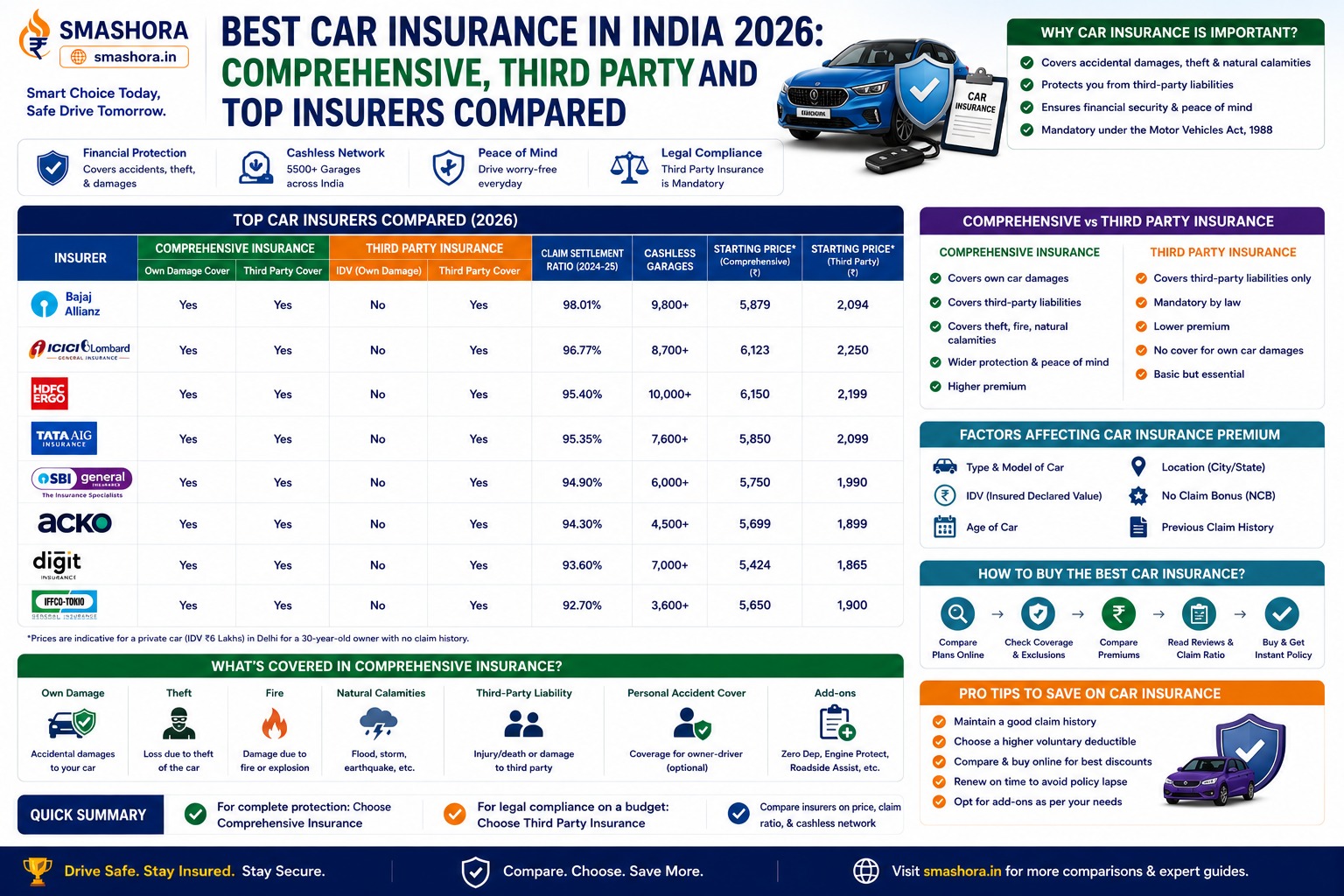
The Claim Settlement Ratio (CSR) is the single most important metric when evaluating the best car insurance in India 2026 — it tells you what percentage of claims an insurer actually settles versus the total claims received. A CSR above 85% is considered reliable; anything above 90% is excellent.
| Insurer | Claim Settlement Ratio | Cashless Garage Network | Starting Comprehensive Premium |
|---|---|---|---|
| Digit Insurance | 96% | Wide digital-first network | Approximately ₹1,850 to ₹1,980 per year |
| HDFC ERGO | 92.5% to 96% | 8,000 plus garages | Approximately ₹3,000 to ₹3,500 per year |
| ICICI Lombard | 94% | 7,500 plus garages | Approximately ₹3,200 per year |
| Bajaj Allianz | 91.3% | Strong pan-India network | Approximately ₹3,000 to ₹3,800 per year |
| Tata AIG | Above 90% | Strong network | Approximately ₹3,200 to ₹4,000 per year |
| InsuranceDekho (aggregator) | Varies by underlying insurer | Varies | Approximately ₹1,850 per year (basic comprehensive) |
For official and updated claim settlement ratio data published annually, refer to the IRDAI Annual Report, which is the authoritative source for these figures.
Best Car Insurance in India 2026 — Detailed Insurer Reviews
Digit Insurance — Best for Highest Claim Settlement Ratio and Lowest Premium
Digit Insurance has emerged as one of the best car insurance in India 2026 options for cost-conscious buyers who still want strong claim reliability. With a 96% claim settlement ratio — the highest among major insurers — and some of the most competitive comprehensive premiums starting around ₹1,850 to ₹1,980 per year, Digit combines affordability with genuine claim performance.
- Claim Settlement Ratio: 96%
- Premium: Among the most competitive in the market for standard mid-segment cars
- Claims Process: Fully digital, app-based claim filing and tracking
- Best for: Budget-conscious buyers who want digital-first convenience without compromising on claim reliability
HDFC ERGO — Best for Garage Network and Zero Depreciation Cover
HDFC ERGO is consistently ranked among the best car insurance in India 2026 for its extensive cashless garage network of over 8,000 locations and strong zero depreciation add-on offering, making it a reliable choice for owners who want minimal hassle during repairs.
- Claim Settlement Ratio: 92.5% to 96% depending on the reporting period
- Cashless Garages: 8,000 plus — one of the widest networks in India
- Key Feature: Strong zero depreciation cover bundled into higher-tier comprehensive plans
- Best for: Owners who prioritise easy access to a cashless repair garage near their location, especially in tier-2 and tier-3 cities
ICICI Lombard — Best for Instant Claim Assessment
ICICI Lombard’s Drive Smart Protect plan is one of the best car insurance in India 2026 options for owners who want fast, technology-driven claim processing. With a 94% claim settlement ratio and over 7,500 cashless garages, ICICI Lombard combines reliability with a smooth digital claims experience.
- Claim Settlement Ratio: 94%
- Cashless Garages: 7,500 plus
- Key Feature: Instant claim assessment through app-based photo submission for minor damage claims
- Starting Premium: Approximately ₹3,200 per year for comprehensive cover
- Best for: Owners who want a fast, modern claims experience with strong garage coverage
Bajaj Allianz — Best Established Pan-India Network
Bajaj Allianz remains a strong contender among the best car insurance in India 2026 due to its long-established presence and extensive pan-India network, particularly valuable for owners who travel frequently across states and need consistent cashless support wherever they are.
- Claim Settlement Ratio: 91.3%
- Network: Strong nationwide presence including smaller towns
- Best for: Frequent inter-state travellers who want consistent garage support across India
Choosing the Best Car Insurance in India 2026 by Budget
A practical way to navigate the best car insurance in India 2026 is by budget tier, since coverage depth scales directly with premium:
| Annual Budget | Recommended Coverage | Suggested Insurers |
|---|---|---|
| Under ₹3,000 | Third-party only | InsuranceDekho or Digit |
| ₹3,000 to ₹7,000 | Basic comprehensive | Digit or Acko |
| ₹7,000 to ₹12,000 | Comprehensive plus zero depreciation | HDFC ERGO or Bajaj Allianz |
| ₹12,000 plus | Full coverage with all add-ons | ICICI Lombard or HDFC ERGO |
Key Terms You Must Understand — IDV, NCB, and Zero Depreciation
Insured Declared Value (IDV)
IDV is the maximum amount your insurer will pay if your car is stolen or completely destroyed beyond repair. It is calculated as your car’s current market value after applying fixed, age-based depreciation rates set by IRDAI. A higher IDV means a higher payout in case of total loss, but it also raises your premium proportionally. When renewing, always check that your insurer is offering a realistic IDV — not artificially deflated to reduce their potential payout, nor artificially inflated to charge you unnecessary premium. Use an IDV calculator to verify the proposed figure aligns with your car’s genuine current market value before accepting any quote.
No Claim Bonus (NCB)
NCB is a discount on your own-damage premium for every consecutive year you do not file a claim — typically starting at 20% after the first claim-free year and rising to a maximum of 50% after 5 consecutive claim-free years. This bonus is tied to you as the policyholder, not the car, and can be transferred to a new insurer at renewal or even to a new vehicle you purchase. Many car owners are unaware that filing a small claim for minor damage can cost them more in lost NCB over subsequent years than the repair would have cost out of pocket — always calculate this trade-off before filing a claim for minor damage.
Zero Depreciation Cover
Also called bumper-to-bumper cover, zero depreciation is an add-on that waives the depreciation deduction normally applied to car parts during a claim settlement. Without this add-on, an insurer pays you the depreciated value of a damaged part — meaning you bear the difference between the part’s original cost and its depreciated value. With zero depreciation, you receive the full replacement value. This add-on typically allows 2 claims per year and is usually available only for cars under 5 years old. For new and financed cars, skipping zero depreciation is one of the most common and costly mistakes car owners make.
Essential Add-Ons for the Best Car Insurance in India 2026
| Add-On | What It Covers | Most Useful For |
|---|---|---|
| Zero Depreciation | Full replacement value without depreciation deduction | Cars under 5 years old, financed cars |
| Engine Protection | Covers engine damage from water ingression or oil leakage | Owners in flood-prone or waterlogging-prone cities |
| Return to Invoice (RTI) | Pays the original invoice price (not depreciated IDV) in case of total loss or theft | New cars in their first 2 to 3 years |
| Roadside Assistance | Towing, battery jumpstart, fuel delivery, flat tyre support | Frequent long-distance drivers |
| NCB Protector | Preserves your No Claim Bonus despite filing 1 to 2 claims | Owners worried about losing NCB after a minor claim |
| Consumables Cover | Covers cost of nuts, bolts, engine oil, and other consumables used during repair | All comprehensive policy holders, low additional cost |
For a brand-new car, the ideal combination is comprehensive cover bundled with zero depreciation, return to invoice, and engine protection — together providing full financial protection during the first few years of ownership when the car’s value and your loan exposure are both at their highest. If you took a car loan to purchase your vehicle, your lender typically mandates comprehensive insurance for the loan tenure regardless of your own preference — for the complete picture on financing, read our guide on best car loan interest rates in India 2026.
Car Insurance for Electric Vehicles — Special Considerations in 2026
With EV adoption accelerating in India in 2026, electric vehicle owners face a distinct insurance landscape when evaluating the best car insurance in India 2026 for their vehicle:
- Higher premiums: EV own-damage insurance premiums run 20% to 40% higher than equivalent petrol or diesel models, reflecting the higher cost of specialist technical labour and proprietary components
- Battery protection cover: A specific add-on protecting against hydrostatic lock or electrical surge damage during charging cycles — critical for EV owners and often overlooked
- Charging equipment risk: Home wall-box chargers and proprietary charging cables are vulnerable to theft, vandalism, and power surges — check whether your policy or a specific add-on covers this equipment separately from the vehicle itself
- Zero depreciation is essential: Standard depreciation tables age advanced EV electronic components quickly, leaving owners exposed to significant out-of-pocket costs for plastic and electronic part replacement without this add-on
How to Lower Your Car Insurance Premium in India 2026
- Maintain your NCB: Avoid filing claims for minor damage that costs less to repair out of pocket than the NCB you would lose over subsequent renewal years
- Choose a higher voluntary deductible: Opting for a higher voluntary excess (the amount you agree to pay out of pocket per claim) reduces your premium, suitable for confident drivers with a clean record
- Install anti-theft devices: ARAI-approved anti-theft devices can earn you a premium discount at most insurers
- Compare before every renewal: Premiums and add-on pricing change year to year across insurers — never auto-renew without comparing at least 2 to 3 quotes
- Buy online directly: Purchasing directly from the insurer’s website or app rather than through a dealer typically saves 10% to 20%, since dealer commissions are eliminated
- Consider commercial use deduction: If your vehicle is officially registered for business use, the insurance premium can be claimed as a legitimate business expense to reduce taxable income
Common Mistakes When Buying Car Insurance in India
Choosing the Cheapest Premium Without Checking CSR
The lowest premium quote is meaningless if the insurer has a poor claim settlement track record. Always weigh premium against claim settlement ratio — a slightly higher premium from a 95%-plus CSR insurer is far better value than a marginally cheaper policy from an insurer with a CSR below 85%.
Skipping Zero Depreciation on a New or Financed Car
For cars under 5 years old, especially financed ones, skipping the zero depreciation add-on to save a few thousand rupees in premium can result in tens of thousands in unrecovered costs during a single significant claim. This add-on is consistently worth its cost for newer vehicles.
Letting the IDV Drift Without Review
Insurers automatically depreciate your IDV at renewal based on standard age tables, but always verify this matches your car’s genuine current market value. An artificially low IDV reduces your potential payout in a total loss scenario without you realising it until the claim is filed.
Filing Claims for Every Minor Scratch
Filing a claim for a minor bumper scratch that costs ₹3,000 to repair, when it would cost you 20% to 30% of your NCB (worth significantly more than ₹3,000 over future renewals), is a common and costly mistake. Calculate the NCB impact before filing any small claim.
Car insurance is one piece of a broader financial protection strategy. For comprehensive health coverage that complements your overall insurance planning, read our guide on the best health insurance plans in India 2026. And ensure you have a financial buffer for any out-of-pocket costs not covered by insurance — our guide on how to build an emergency fund in India covers exactly how much to keep aside. Insurance premiums are also a meaningful annual expense worth budgeting for — our article on how to save money every month in India 2026 covers how to plan for annual costs like this within your monthly budget.
Conclusion — Compare the Best Car Insurance in India 2026 Before Every Renewal
The best car insurance in India 2026 is not a single universal answer — it depends on your car’s age, value, financing status, and your budget. For new or financed cars, comprehensive insurance with zero depreciation, engine protection, and return to invoice is essential, with Digit offering the best combination of low premium and high claim settlement ratio, and HDFC ERGO or ICICI Lombard offering the strongest garage networks for hassle-free repairs. For older, fully owned, lower-value cars, third-party-only coverage from Digit or InsuranceDekho can be a reasonable cost-saving choice.
Whatever you choose, never auto-renew without comparing at least 2 to 3 quotes, always verify your IDV reflects genuine market value, protect your NCB by avoiding claims for minor damage, and prioritise claim settlement ratio over premium savings of a few hundred rupees. The right car insurance policy is the one that performs when you actually need it — not just the one that looks cheapest on the renewal page.
At Smashora, our mission is to help every Indian make every rupee count. If this guide on the best car insurance in India 2026 helped you choose the right cover for your vehicle, leave a comment below or share it with a friend or family member whose car insurance renewal is coming up.
Frequently Asked Questions
Which insurer has the best claim settlement ratio for car insurance in India in 2026?
Based on the latest available data, Digit Insurance has the highest claim settlement ratio among major car insurers in India at 96%, followed closely by HDFC ERGO at 92.5% to 96% and ICICI Lombard at 94%. Bajaj Allianz follows at 91.3%. All four insurers are considered reliable choices since a CSR above 90% indicates the insurer settles the vast majority of claims it receives, though always verify the most current figures from the latest IRDAI Annual Report before purchasing.
Is comprehensive car insurance worth it in India 2026?
Yes, for most car owners, particularly those with cars under 5 years old, financed vehicles, or cars valued above ₹2 lakh. A single major accident without own-damage cover can result in ₹2 lakh to ₹8 lakh in out-of-pocket repair costs, far exceeding the additional premium comprehensive insurance costs over third-party-only coverage. For older, fully depreciated cars under ₹1.5 lakh to ₹2 lakh in market value with no outstanding loan, third-party-only coverage can be a reasonable cost-saving alternative since the potential own-damage payout is limited by the car’s low value anyway.
What is zero depreciation cover and should I buy it?
Zero depreciation cover, also called bumper-to-bumper insurance, is an add-on that ensures you receive the full replacement cost of damaged car parts during a claim, without the standard age-based depreciation deduction applied. Without this add-on, you bear the difference between a part’s original price and its depreciated value out of pocket. For cars under 5 years old, particularly financed or high-value vehicles, zero depreciation is highly recommended since it typically costs a modest premium addition but can save tens of thousands of rupees during a significant claim. Most insurers limit zero depreciation claims to 2 per policy year and restrict eligibility to vehicles under 5 years old.
Can I buy third-party and comprehensive insurance from different companies?
Yes. You can purchase a long-term third-party liability policy from one insurer and a standalone own-damage (OD) policy from a different insurer, then combine them for full coverage. This flexibility allows you to lock in a stable, long-term third-party plan while shopping around for the best own-damage premium, garage network, or add-ons at each annual renewal. Many car owners are unaware of this option and simply renew a single combined comprehensive policy with the same insurer year after year without checking whether splitting the cover would save money or improve service.
How does No Claim Bonus (NCB) work and can I lose it?
No Claim Bonus is a discount on your own-damage premium that increases for each consecutive year you do not file a claim — typically starting at 20% after the first claim-free year and reaching a maximum of 50% after 5 consecutive claim-free years. NCB belongs to you as the policyholder, not the vehicle, and is transferable to a new insurer at renewal or to a newly purchased car. Filing even one claim resets your NCB accumulation, which is why many advisors recommend paying for minor repairs (like a small dent or scratch) out of pocket rather than filing a claim, since the NCB loss over subsequent years often exceeds the repair cost itself.
Is car insurance more expensive for electric vehicles in India?
Yes. Electric vehicle own-damage insurance premiums in India in 2026 typically run 20% to 40% higher than equivalent petrol or diesel models, reflecting the higher cost of specialist EV technical labour and proprietary electronic components. EV owners should prioritise zero depreciation cover, since standard depreciation tables can rapidly age the value of EV-specific electronic and plastic components, leaving owners exposed to significant costs without this add-on. Battery protection cover, which protects against hydrostatic lock or electrical surge damage during charging, is another EV-specific add-on worth considering, along with separate coverage for home charging equipment which is vulnerable to theft and power surges.