Contents
- 1 Best Business Loan Interest Rates in India 2026 — Bank Comparison
- 2 SBI Business Loan 2026 — The Most Comprehensive Public Sector Option
- 3 Other Major Banks — Best Business Loan Interest Rates in India 2026
- 4 Government-Backed Business Loan Schemes — The Best Business Loan Interest Rates in India 2026 for First-Time Entrepreneurs
- 5 MSME Eligibility Criteria — Understanding Udyam Registration Categories
- 6 Secured vs Unsecured Business Loans — Which Should You Choose?
- 7 What Determines Your Business Loan Interest Rate in India 2026
- 8 Documents Required for Business Loans in India 2026
- 9 How to Get the Best Business Loan Interest Rate in India 2026 — Step by Step
- 10 Business Loan vs Personal Loan for Business Needs — Which Is Better?
- 11 Tax Benefits Related to Business Loans
- 12 Conclusion — Compare the Best Business Loan Interest Rates in India 2026 Before Borrowing
- 13 Frequently Asked Questions
- 13.1 Which bank offers the best business loan interest rate in India in 2026?
- 13.2 Can I get a business loan without collateral in India in 2026?
- 13.3 What is the Mudra loan scheme and who is eligible?
- 13.4 What CIBIL score do I need for a business loan in India in 2026?
- 13.5 How long does it take to get a business loan approved in India?
- 13.6 What is Udyam Registration and why is it required for business loans?
Finding the best business loan interest rates in India 2026 can be the single most important financial decision for an entrepreneur scaling beyond personal savings. Business loan rates in India in 2026 range from as low as 8% at public sector banks for well-qualified MSMEs to 14% to 36% at NBFCs and fintech lenders for businesses without collateral or a strong credit history. On a ₹20 lakh business loan over 5 years, that gap can mean the difference between ₹4.5 lakh and ₹14 lakh in total interest — money that could otherwise fund inventory, hiring, or expansion.
What makes the Indian business lending landscape genuinely favourable for small business owners in 2026 is the depth of government-backed schemes specifically designed to reduce or eliminate the collateral requirement that has historically locked many entrepreneurs out of formal credit. Mudra loans under the Pradhan Mantri Mudra Yojana, CGTMSE-backed collateral-free lending, and PMEGP subsidies together mean that a first-time entrepreneur with no property to pledge has more real funding options today than at almost any point in India’s banking history.
This complete guide on the best business loan interest rates in India 2026 covers public sector and private bank rates, NBFC and fintech options for faster approval, every major government scheme worth knowing, eligibility criteria, and a practical framework for choosing the right funding source based on your business stage and need.
Best Business Loan Interest Rates in India 2026 — Bank Comparison
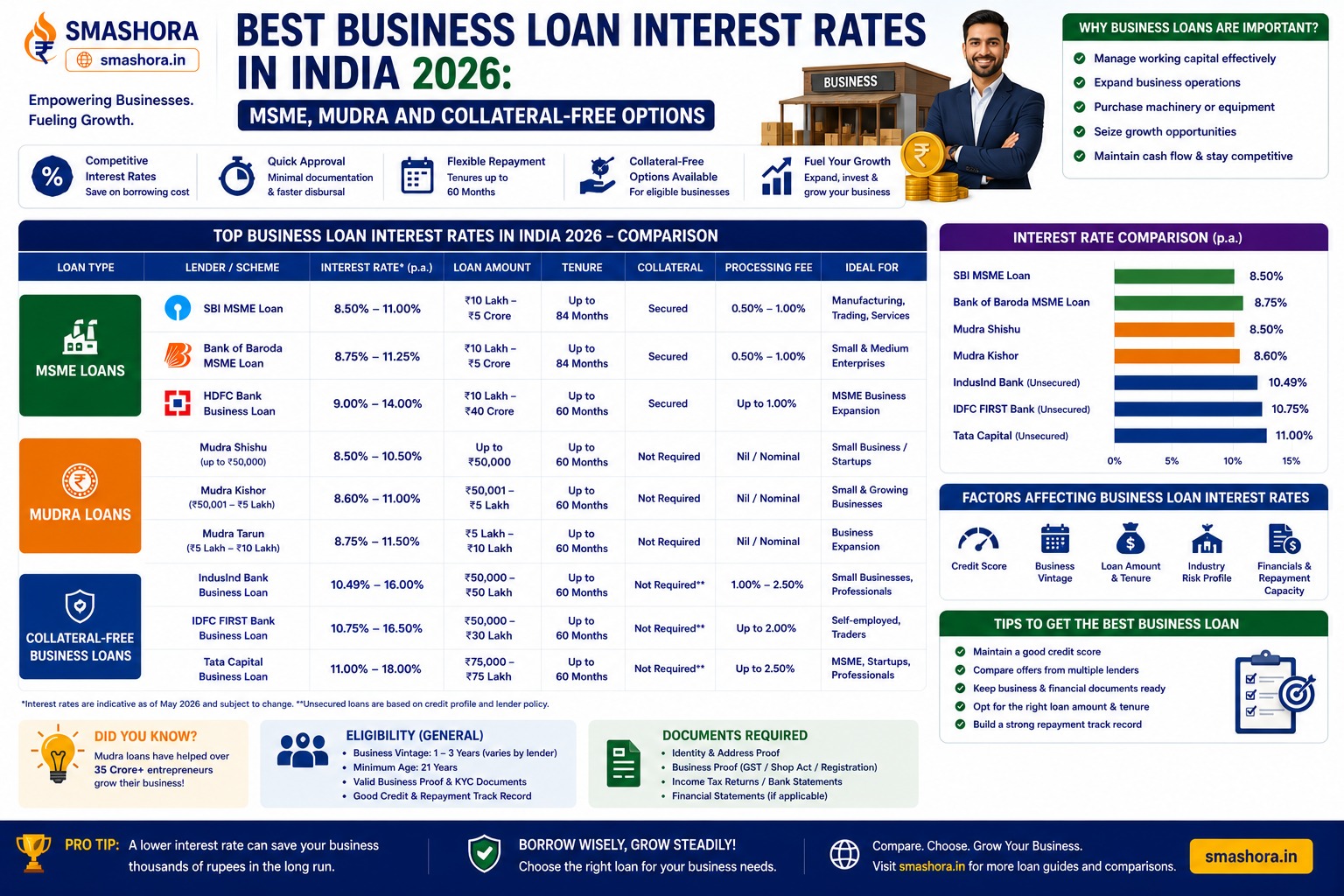
Here are the current best business loan interest rates in India 2026 from major lenders:
| Lender | Interest Rate Range | Loan Amount | Approval Time |
|---|---|---|---|
| State Bank of India | 8.00% to 12% per year | Up to ₹500 lakh (MSME), up to ₹200 lakh collateral-free | Within 7 days for SME Smart Score loans |
| Punjab National Bank | 8.00% to 8.25% per year | Varies by scheme | 7 to 15 working days |
| Bank of Baroda | 8.10% to 12% per year (additional 0.10% discount for women entrepreneurs) | Varies by scheme | 7 to 15 working days, digital loan options faster |
| HDFC Bank | 10% to 18% per year | Up to ₹50 lakh (fintech-scored, same-day approval) | Same day for pre-approved profiles |
| ICICI Bank | 10% to 18% per year | Up to ₹50 lakh (fintech-scored) | Same day for pre-approved profiles |
| Bajaj Finserv (NBFC) | 14% to 30% per year | Up to ₹75 lakh unsecured | 24 to 72 hours |
| SIDBI | 8% to 11% per year | Project-based, large ticket sizes | Varies — best for manufacturing and machinery loans |
All rates above are indicative as of June 2026 for businesses with a CIBIL score of 700 and above and reasonable financial documentation. For official lending guidelines and RBI’s priority sector lending framework that underpins many MSME schemes, refer to the Reserve Bank of India website.
SBI Business Loan 2026 — The Most Comprehensive Public Sector Option
State Bank of India offers among the best business loan interest rates in India 2026 due to its combination of competitive pricing, the widest branch and relationship-manager network, and deep integration with government guarantee schemes that reduce or eliminate collateral requirements.
- Interest Rate: 8.00% to 12% per year depending on scheme and risk profile
- Collateral-Free Limit: Up to ₹200 lakh through CGTMSE and Mudra integration
- Eligibility: Business vintage of 1 to 3 years for working capital loans, or 0 years for startups with equity infusion; annual turnover ranging from ₹10 lakh to ₹250 crore; minimum CIBIL score of 650 for unsecured loans, 600 for secured loans
- Loan Range: ₹1 lakh to ₹500 lakh under the MSME loan scheme, covering working capital limits, term finance, and performance guarantees
- Key Feature: SME Smart Score digital assessment enables sanction within 7 days for qualifying collateral-free applications
Best for: Established MSMEs with at least 1 year of operating history who want the lowest possible rate and value the credibility and relationship-based support that comes with India’s largest public sector bank.
Other Major Banks — Best Business Loan Interest Rates in India 2026
Punjab National Bank and Bank of Baroda — Lowest Public Sector Rates
PNB offers some of the most competitive starting rates at 8.00% to 8.25% per year for qualified MSMEs, particularly attractive for businesses with strong GST compliance and turnover history. Bank of Baroda matches this competitive pricing and has introduced a notable 0.10% rate discount specifically for women entrepreneurs through its MSME Digital Loan scheme, sanctioned within 7 days for collateral-free applications.
HDFC Bank and ICICI Bank — Best for Speed Through Fintech Scoring
HDFC Bank and ICICI Bank leverage fintech-based credit scoring models that analyse GST filings, bank statement cash flow, and digital transaction history to enable same-day approval for loans up to ₹50 lakh — significantly faster than traditional document-heavy underwriting, though at a meaningfully higher interest rate of 10% to 18% compared to public sector bank rates.
Bajaj Finserv and Other NBFCs — Best for Businesses Without Collateral
Bajaj Finserv offers unsecured business loans up to ₹75 lakh with repayment tenures of 36 to 60 months, specifically designed for businesses lacking property collateral. The trade-off is a significantly higher rate range of 14% to 30% per year. NBFCs are particularly useful for businesses that need funds urgently (24 to 72 hour disbursal) or do not meet bank documentation thresholds, but the higher cost makes them best suited as a bridge or growth-stage option rather than a long-term primary funding source.
Government-Backed Business Loan Schemes — The Best Business Loan Interest Rates in India 2026 for First-Time Entrepreneurs
India’s government runs several flagship schemes specifically designed to minimise interest burden and eliminate collateral barriers for small businesses and first-time entrepreneurs. These schemes consistently offer the best business loan interest rates in India 2026 for those who qualify.
Pradhan Mantri Mudra Yojana (PMMY) — Best for Micro Enterprises
Mudra loans are linked to the bank’s MCLR, making them genuinely affordable and accessible without collateral for first-time entrepreneurs and micro businesses. The scheme is divided into three categories based on loan size:
| Mudra Category | Loan Amount | Typical Interest Rate | Best For |
|---|---|---|---|
| Shishu | Up to ₹50,000 | 8% to 9% per year | Very small micro-enterprises, first-time entrepreneurs |
| Kishor | ₹50,000 to ₹5 lakh | 9% to 12% per year | Established micro businesses needing growth capital |
| Tarun | ₹5 lakh to ₹10 lakh | 10% to 13% per year | Growing small businesses ready to scale |
Mudra loans are collateral-free across all three categories, available at nearly all public sector banks, and require no security or guarantor for the loan amount — making this one of the most accessible entry points into formal business credit in India.
CGTMSE — Credit Guarantee for Collateral-Free Bank Loans
The Credit Guarantee Fund Trust for Micro and Small Enterprises (CGTMSE) is not itself a lender — it is a government guarantee mechanism that allows banks to extend loans without requiring collateral, since the government guarantee covers the bank’s risk. Under CGTMSE, eligible MSMEs can access collateral-free loans up to significant amounts through participating banks including SBI, with the credit guarantee reducing the lender’s risk and therefore the interest rate charged.
PMEGP — Best for New Business Subsidy Support
The Prime Minister’s Employment Generation Programme (PMEGP) is specifically designed for new businesses and focuses on creating self-employment opportunities. It offers a substantial MSME loan subsidy of up to 35% — meaning a portion of the project cost is effectively grant-funded rather than loaned, significantly reducing the entrepreneur’s repayment burden compared to a standard business loan.
SIDBI — Best for Manufacturing and Machinery Loans
The Small Industries Development Bank of India (SIDBI) specialises in larger-ticket project finance, particularly for manufacturing units and machinery purchases. SIDBI’s SMILE (SIDBI Make in India Soft Loan Fund for MSMEs) scheme offers competitive rates of 8% to 11% per year specifically structured to support India’s manufacturing sector growth.
MSME Eligibility Criteria — Understanding Udyam Registration Categories
To access most of the best business loan interest rates in India 2026 through government-backed schemes, your business must first be registered under Udyam Registration, which classifies MSMEs based on annual turnover:
| Category | Annual Turnover | Typical Scheme Access |
|---|---|---|
| Micro Enterprises | Less than ₹5 crore | Mudra (all categories), CGTMSE, PMEGP |
| Small Enterprises | ₹5 crore to ₹50 crore | CGTMSE, bank MSME schemes, SIDBI |
| Medium Enterprises | ₹50 crore to ₹250 crore | Bank MSME schemes, SIDBI project finance |
Registration under Udyam is free, entirely online, and based on Aadhaar and PAN verification. Sole proprietorships, partnership firms, private limited companies, and LLPs are all eligible to register, and most lenders now require Udyam Registration as a prerequisite for accessing MSME-specific interest rates and government scheme benefits.
Secured vs Unsecured Business Loans — Which Should You Choose?
| Feature | Secured Business Loan | Unsecured Business Loan |
|---|---|---|
| Collateral Required | Yes — property, machinery, or other assets | No |
| Interest Rate | Lower (8% to 12% typically) | Higher (10% to 30% depending on lender) |
| Maximum Loan Amount | Higher, tied to collateral value | Up to ₹2 crore at select lenders, more commonly ₹50 lakh to ₹75 lakh |
| Best For | Established businesses with assets to pledge, larger funding needs | First-time entrepreneurs, service businesses without physical assets, urgent funding needs |
Pledging collateral or security significantly reduces credit risk for the lender, which directly translates to lower interest rates being offered to you. If you have business or personal assets you are comfortable pledging and need a larger loan amount, a secured loan from a public sector bank will almost always deliver the best business loan interest rates in India 2026. If you lack collateral or need funds quickly, government-backed unsecured schemes like Mudra or CGTMSE-supported bank loans should be your first stop before considering higher-cost NBFC options.
What Determines Your Business Loan Interest Rate in India 2026
- Type of loan scheme: Interest rates vary significantly between Mudra loans, standard MSME term loans, and working capital facilities like bill discounting — each priced differently based on risk and tenure
- Nature and value of collateral: Higher-value collateral reduces lender risk and consequently the interest rate offered
- Occupation profile: Self-employed professionals (doctors, chartered accountants, architects) typically receive lower rates than self-employed non-professionals, who in turn often receive better rates than newly registered MSMEs without an established track record
- Business vintage and turnover: Established businesses with consistent GST filings and 2 to 3 years of stable turnover history qualify for significantly better rates than businesses in their first year
- CIBIL score: A score of 750 and above qualifies for the lowest advertised rates across most banks; below 700, expect either rejection at banks or significantly higher rates at NBFCs (14% to 18%) and fintech lenders
If your personal or business CIBIL score needs improvement before applying, read our detailed guide on how to improve your CIBIL score, since most business loan underwriting for proprietorships and partnerships heavily weighs the promoter’s personal credit history alongside business financials.
Documents Required for Business Loans in India 2026
- Udyam Registration certificate
- PAN card and Aadhaar card of all partners or directors
- Business registration proof (partnership deed, certificate of incorporation, or proprietorship registration)
- Last 2 to 3 years of ITR and audited financial statements (for established businesses)
- Last 6 to 12 months of bank statements showing business cash flow
- GST registration certificate and recent GST filing returns
- Project report or business plan, particularly for new business loans under PMEGP or Mudra
- Collateral documents (property papers, machinery valuation) if applying for a secured loan
How to Get the Best Business Loan Interest Rate in India 2026 — Step by Step
- Complete Udyam Registration first: This free, online registration is a prerequisite for accessing most government-backed schemes and preferential MSME interest rates
- Check your personal and business CIBIL score: A score of 750 and above significantly widens your access to the lowest rates across public sector banks
- Start with public sector banks for the lowest rates: SBI, PNB, and Bank of Baroda consistently offer the best business loan interest rates in India 2026 starting from 8.00%, especially for loans backed by CGTMSE or Mudra
- Maintain clean GST filing and bank statement history: Fintech-scored loans at HDFC and ICICI rely heavily on consistent GST filings and healthy bank cash flow for fast approval at reasonable rates
- Explore subsidy schemes for new businesses: If you are launching a new venture, check PMEGP eligibility for the substantial subsidy component before defaulting to a standard term loan
- Consider NBFCs only as a speed-driven last resort: If you need funds within 24 to 72 hours and do not qualify for bank financing, NBFCs like Bajaj Finserv provide genuine speed but at a meaningfully higher cost — use this route only when urgency outweighs the rate difference
- Ask about women entrepreneur concessions: Banks like Bank of Baroda offer specific rate discounts for women-led businesses — always ask explicitly since these are not always advertised prominently
Business Loan vs Personal Loan for Business Needs — Which Is Better?
| Feature | Business Loan (MSME/Mudra) | Personal Loan |
|---|---|---|
| Interest Rate | 8% to 18% (banks), 14% to 30% (NBFCs) | 9.99% to 36% per year |
| Government Scheme Access | Yes — Mudra, CGTMSE, PMEGP subsidies available | No government schemes apply |
| Loan Amount | Up to ₹500 lakh at banks for established MSMEs | Typically up to ₹40 to ₹50 lakh |
| Documentation | More extensive — GST, ITR, business proof | Simpler — income proof and bank statements |
| Best For | Genuine business funding needs with formal documentation | Quick smaller amounts when business documentation is incomplete |
For genuine business funding needs, a properly structured MSME or Mudra loan almost always delivers better rates and larger amounts than routing the need through a personal loan. However, for very small, urgent needs where formal business documentation is not yet in place, our guide on the best personal loan in India 2026 covers the unsecured personal loan landscape that some early-stage entrepreneurs use as a bridge before formal business credit is established.
Tax Benefits Related to Business Loans
Interest paid on a business loan is treated as a legitimate business expense and is fully deductible from your business income before calculating tax — unlike personal loan interest, which generally offers no such deduction unless the personal loan was specifically used for business purposes and can be documented as such. This makes formally structured business loans not just cheaper on the interest rate itself, but also more tax-efficient than informally routing business funding needs through personal credit. For a complete understanding of how various deductions interact with your overall tax planning as a business owner or self-employed professional, read our guide on how to save tax under Section 80C in India 2026, which covers personal-side deductions that apply alongside your business income tax planning.
Conclusion — Compare the Best Business Loan Interest Rates in India 2026 Before Borrowing
The best business loan interest rates in India 2026 start at 8.00% at SBI, PNB, and SIDBI for well-qualified MSMEs with established turnover and clean credit history. For first-time entrepreneurs and micro businesses without collateral, Mudra loans starting at 8% to 9% for the Shishu category provide genuinely accessible, government-backed funding with no security required. For businesses needing fast approval at the cost of a higher rate, HDFC, ICICI, and Bajaj Finserv offer same-day to 72-hour disbursal through fintech-based credit scoring.
The most important actions for any entrepreneur: complete Udyam Registration before applying anywhere, check whether CGTMSE or Mudra can eliminate your collateral requirement, maintain consistent GST filing and bank statement history to access fintech-scored fast approvals, and always start your search with public sector banks before turning to NBFCs for the genuinely best business loan interest rates in India 2026 available to your specific business profile.
At Smashora, our mission is to help every Indian make every rupee count — including the entrepreneurs building businesses that create jobs and opportunity. If this guide on the best business loan interest rates in India 2026 helped you plan your funding strategy, leave a comment below or share it with a fellow entrepreneur currently comparing business loan options.
Frequently Asked Questions
Which bank offers the best business loan interest rate in India in 2026?
State Bank of India and Punjab National Bank offer among the best business loan interest rates in India 2026, starting from 8.00% to 8.25% per year for well-qualified MSMEs, particularly those accessing loans through CGTMSE or Mudra integration. For manufacturing and machinery-focused project loans, SIDBI offers competitive rates of 8% to 11%. For first-time micro entrepreneurs without collateral, Mudra loans under the Shishu category offer rates as low as 8% to 9% specifically designed for very small businesses.
Can I get a business loan without collateral in India in 2026?
Yes. Several government-backed schemes specifically enable collateral-free business loans in India in 2026. Mudra loans (up to ₹10 lakh across Shishu, Kishor, and Tarun categories) require no collateral at all. CGTMSE provides a government credit guarantee that allows banks to extend collateral-free loans up to significant amounts, with SBI offering collateral-free loans up to ₹200 lakh through this mechanism. NBFCs like Bajaj Finserv also offer unsecured business loans up to ₹75 lakh, though at meaningfully higher interest rates of 14% to 30% per year compared to bank-backed collateral-free schemes.
What is the Mudra loan scheme and who is eligible?
The Pradhan Mantri Mudra Yojana (PMMY) is a government scheme providing collateral-free loans to micro and small businesses across three categories: Shishu (up to ₹50,000) at 8% to 9% interest, Kishor (₹50,000 to ₹5 lakh) at 9% to 12%, and Tarun (₹5 lakh to ₹10 lakh) at 10% to 13%. Eligibility includes sole proprietorships, partnership firms, and small companies engaged in manufacturing, trading, or services, registered under Udyam Registration. Mudra loans are available at nearly all public sector banks and many private banks and NBFCs, making them one of the most accessible entry points into formal business credit for first-time entrepreneurs in India.
What CIBIL score do I need for a business loan in India in 2026?
Most banks require a minimum CIBIL score of 650 for unsecured business loans and 600 for secured loans backed by collateral, though scores of 750 and above qualify for the best business loan interest rates in India 2026 starting from 8.00%. Businesses or proprietors with scores between 650 and 750 can still access funding but typically at moderately higher rates. Below 650, bank approval becomes difficult, and NBFCs or fintech lenders charging 14% to 18% or higher become the more realistic option. Both the business entity’s credit history and the promoter’s personal CIBIL score are typically evaluated together for proprietorships and partnerships.
How long does it take to get a business loan approved in India?
Approval timelines vary significantly by lender and loan type. SBI’s SME Smart Score digital assessment can sanction collateral-free loans within 7 days for qualifying applicants. Bank of Baroda’s MSME Digital Loan follows a similar 7-day timeline. HDFC Bank and ICICI Bank can offer same-day approval for pre-qualified profiles using fintech-based credit scoring on loans up to ₹50 lakh. NBFCs like Bajaj Finserv typically disburse within 24 to 72 hours for unsecured loans. Traditional secured business loans involving collateral valuation and more extensive documentation generally take 7 to 30 working days, with delays usually arising from incomplete documentation or unclear financial projections.
What is Udyam Registration and why is it required for business loans?
Udyam Registration is the official government classification system for Micro, Small, and Medium Enterprises (MSMEs) in India, based on annual turnover thresholds — micro enterprises under ₹5 crore, small enterprises ₹5 crore to ₹50 crore, and medium enterprises ₹50 crore to ₹250 crore. Registration is free, fully online, and based on Aadhaar and PAN verification. Most banks and government schemes including Mudra, CGTMSE, and PMEGP now require Udyam Registration as a prerequisite to access MSME-specific interest rates, collateral-free lending limits, and subsidy benefits, making it an essential first step before applying for any business loan in India in 2026.