Contents
- 1 Best Two Wheeler Loan Interest Rates in India 2026 — Bank and NBFC Comparison
- 2 Bank of India and IDFC First — The Lowest Starting Rates
- 3 SBI Two-Wheeler Loan — Best for Women Borrowers and Superbikes
- 4 ICICI Bank and HDFC Bank — Convenience at a Higher Cost
- 5 How to Read NBFC “Starting From” Rates Like 0.99%
- 6 Two Wheeler Loan EMI Calculator — Reference Table
- 7 What Determines Your Two-Wheeler Loan Interest Rate
- 8 New vs Used Two-Wheeler Loans
- 9 Electric Two-Wheeler Loans in India 2026
- 10 How to Get the Best Two Wheeler Loan Interest Rate in India 2026 — Step by Step
- 11 Two-Wheeler Loan vs Personal Loan — Which Is Better?
- 12 Conclusion — Compare the Best Two Wheeler Loan Interest Rates in India 2026 Before You Sign
- 13 Frequently Asked Questions
- 13.1 Which bank offers the best two wheeler loan interest rate in India in 2026?
- 13.2 What CIBIL score do I need for a two wheeler loan in India?
- 13.3 Is it better to take a two wheeler loan from a bank or an NBFC?
- 13.4 How much can I finance for a two wheeler purchase in India in 2026?
- 13.5 Are interest rates different for new and used two wheeler loans?
- 13.6 Can I get a loan for an electric two wheeler in India in 2026?
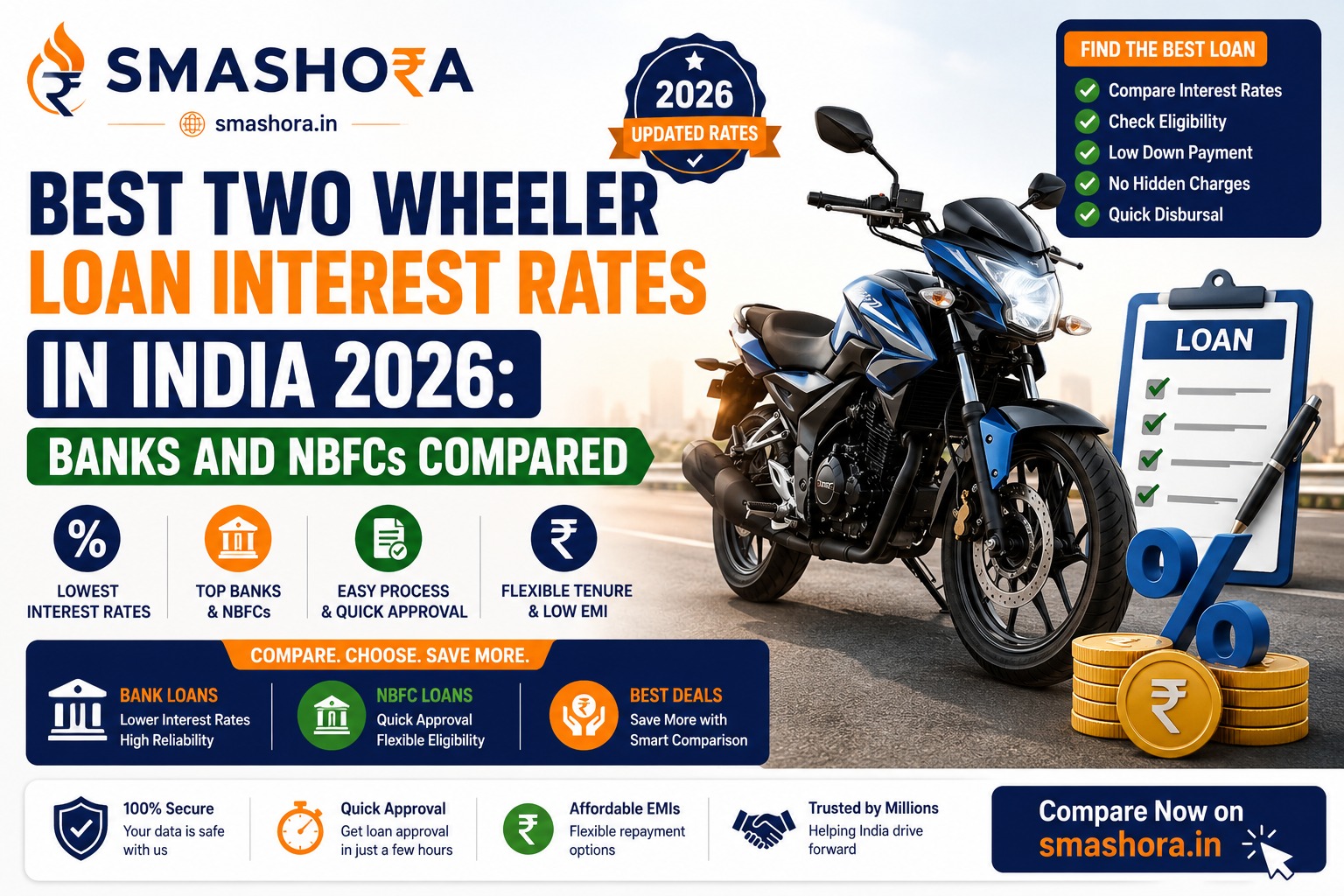
With over 21 million two-wheelers sold in India every year, finding the best two wheeler loan interest rates in India 2026 matters to a genuinely massive share of Indian households. Two-wheeler loan rates in India in 2026 range from as low as 7.60% per year at Bank of India to over 26% at some private banks and NBFCs for the same vehicle — a gap that, on a typical ₹80,000 to ₹1.2 lakh bike loan, can mean paying ₹8,000 to ₹25,000 more in total interest simply by choosing the wrong lender or skipping comparison altogether.
The two-wheeler financing market in India is unusual in how wide its rate spread is compared to other vehicle loans. Unlike home loans where most major banks cluster within a narrow 1% to 2% band, two-wheeler loan rates can differ by 15 to 20 percentage points between the cheapest public sector option and the costliest dealer-pushed NBFC scheme. Most buyers never see this gap because dealership finance counters present only one or two options at the point of sale, and the convenience of signing immediately often outweighs the impulse to compare.
This complete guide on the best two wheeler loan interest rates in India 2026 covers current rates from major banks and NBFCs, what determines the rate you are actually offered, EMI expectations for common loan amounts, new versus used bike loan differences, and the specific steps that can save you thousands of rupees before you sign at the showroom.
Best Two Wheeler Loan Interest Rates in India 2026 — Bank and NBFC Comparison
| Lender | Interest Rate Range | Max Tenure | Max Financing (On-Road Price) |
|---|---|---|---|
| Bank of India | 7.60% per year onwards | 5 years | Up to 100%, no guarantee needed up to ₹50 lakh |
| IDFC First Bank | 9% per year onwards | 6 to 60 months | Up to 95% |
| ICICI Bank | 10.25% to 26.10% per year | Varies by tenure | Up to 90% to 95% |
| SBI (Standard Two-Wheeler) | 11.70% to 15.70% per year | 5 years | 0.50% discount for women borrowers |
| SBI (Super Bike Scheme) | 12.55% to 14.05% per year | 5 years | Minimum loan ₹1.5 lakh |
| HDFC Bank | 14.5% per year onwards (fixed rate only) | 12 to 48 months | Point of purchase financing available |
| Bajaj Markets (NBFC aggregator) | 0.99% per year onwards (promotional, subvented schemes) | Varies | Up to 100% of on-road price |
The overall market range for two-wheeler loans in India spans 7.60% to 36% per year as of 2026, making this one of the widest rate bands of any common retail loan product. For official lending norms and RBI’s guidelines on consumer vehicle financing, refer to the Reserve Bank of India website.
Bank of India and IDFC First — The Lowest Starting Rates
Bank of India currently offers the most competitive starting rate in the market at 7.60% per year, with no guarantee required for loans up to ₹50 lakh and a repayment tenure of up to 5 years — making it one of the best two wheeler loan interest rates in India 2026 for borrowers with a strong credit profile who can complete the slightly more document-intensive public sector bank process.
IDFC First Bank follows closely with rates starting from 9% per year, financing up to 95% of the on-road price with flexible tenures ranging from 6 to 60 months. IDFC First has built a strong digital-first application process, making it a practical middle ground between the lowest public sector rates and the convenience of private bank processing speed.
SBI Two-Wheeler Loan — Best for Women Borrowers and Superbikes
State Bank of India’s standard two-wheeler loan ranges from 11.70% to 15.70% per year, with a notable 0.50% interest rate concession for women borrowers — a meaningful saving over a 5-year tenure. For premium and superbike purchases, SBI runs a dedicated Super Bike Loan Scheme with rates from 12.55% to 14.05% per year and a minimum loan amount of ₹1.5 lakh, reflecting the higher ticket size and different risk profile of premium motorcycle financing compared to standard commuter bikes and scooters.
ICICI Bank and HDFC Bank — Convenience at a Higher Cost
ICICI Bank’s two-wheeler loan rates span a wide 10.25% to 26.10% per year range, with the actual rate depending heavily on your existing banking relationship, asset segment, and loan tenure. HDFC Bank offers fixed-rate-only two-wheeler loans starting from 14.5% per year, available conveniently at the point of purchase with quick disbursal — a popular choice among dealers specifically because of how fast and frictionless the in-showroom approval process is, though this convenience comes at a meaningfully higher rate than the public sector options above.
How to Read NBFC “Starting From” Rates Like 0.99%
Advertisements for two-wheeler loans “starting from 0.99% per year” are almost always referring to manufacturer-subvented schemes, where the two-wheeler brand or dealer subsidises a portion of the interest cost to drive sales during a specific promotional period. These ultra-low headline rates typically apply only to specific models, specific tenures (often very short, like 12 months), and specific creditworthiness tiers. Always ask for the exact rate applicable to your chosen model, tenure, and credit profile rather than assuming the advertised minimum applies to your purchase.
Two Wheeler Loan EMI Calculator — Reference Table
Understanding your monthly EMI before signing helps you evaluate whether a quoted rate genuinely fits your budget. Here is a quick reference for common two-wheeler loan amounts:
| Loan Amount | 9% — 3 Years | 12% — 3 Years | 15% — 3 Years | 20% — 3 Years |
|---|---|---|---|---|
| ₹60,000 | ₹1,908 | ₹1,993 | ₹2,080 | ₹2,229 |
| ₹80,000 | ₹2,544 | ₹2,657 | ₹2,773 | ₹2,972 |
| ₹1,00,000 | ₹3,180 | ₹3,322 | ₹3,467 | ₹3,716 |
| ₹1,50,000 (superbike entry) | ₹4,771 | ₹4,982 | ₹5,200 | ₹5,573 |
On a ₹1 lakh two-wheeler loan over 3 years, the difference between 9% and 20% is approximately ₹536 per month — or roughly ₹19,300 in total extra interest over the loan period. This single comparison is precisely why checking the best two wheeler loan interest rates in India 2026 across at least 2 to 3 lenders before signing at the showroom is worth the extra 20 to 30 minutes.
What Determines Your Two-Wheeler Loan Interest Rate
- Credit score: A higher CIBIL score significantly improves your chances of approval and secures a lower interest rate; lower scores can result in higher rates or outright rejection at banks, pushing borrowers toward costlier NBFC options
- Employment type: Salaried individuals with stable income generally receive more favourable rates than self-employed applicants, whose variable income patterns are perceived as higher risk by most lenders
- New vs used bike: New and premium two-wheelers attract lower interest rates, while used or entry-level commuter bikes carry higher rates reflecting the higher risk and lower collateral value associated with financing a used vehicle
- Loan amount and tenure: Higher loan amounts combined with shorter repayment periods often attract better rates, since the lender’s exposure period and risk window are both reduced
- RBI policy and market conditions: Prevailing repo rate trends and RBI’s broader monetary policy stance influence the base cost of funds for all lenders, which feeds through to consumer-facing two-wheeler loan rates over time
If your CIBIL score needs improvement before applying for the best two wheeler loan interest rates in India 2026, read our detailed guide on how to improve your CIBIL score for practical steps that typically show results within 3 to 6 months.
New vs Used Two-Wheeler Loans
| Feature | New Two-Wheeler Loan | Used Two-Wheeler Loan |
|---|---|---|
| Interest Rate | Lower — starting from 7.60% to 9% at top lenders | Higher — typically several percentage points above new bike rates |
| Maximum Financing | Up to 95% to 100% of on-road price | Usually capped lower, based on assessed resale value |
| Available At | Most banks and NBFCs, point of purchase | Select lenders including Bank of India, specialised used-vehicle financiers |
| Documentation | Standard income and identity proof | Additional vehicle valuation and ownership transfer documents |
Electric Two-Wheeler Loans in India 2026
Electric two-wheeler loans follow broadly the same procedure and rate structure as regular petrol two-wheeler loans at most banks and NBFCs, with both available across the same lender network. Several states continue to offer purchase subsidies specifically for electric two-wheelers, which can be combined with standard bank or NBFC financing to reduce the effective loan amount needed. When shopping for an EV two-wheeler loan, check whether your chosen lender has any EV-specific rate concession, since a small but growing number of banks now offer marginal discounts to support green vehicle adoption.
How to Get the Best Two Wheeler Loan Interest Rate in India 2026 — Step by Step
- Check your CIBIL score before visiting the showroom: Knowing your score in advance helps you anticipate which lenders are likely to offer you the best rates
- Compare at least 2 to 3 lenders, including a public sector bank: Bank of India and IDFC First’s lower starting rates are frequently overlooked because showroom finance counters default to one or two tied-up NBFC partners
- Ask for the exact rate for your specific model and tenure: Headline rates like “starting from 0.99%” almost always apply to narrow promotional conditions — confirm what genuinely applies to you
- Consider a shorter tenure if your budget allows: A 3-year tenure instead of 5 years meaningfully reduces total interest paid, even though the monthly EMI is somewhat higher
- Check prepayment and foreclosure charges before signing: Some two-wheeler loans, particularly at NBFCs, carry charges for early repayment — verify this if you expect to close the loan ahead of schedule
- Negotiate processing fees and documentation charges: These add-on costs vary across lenders and are often negotiable, especially during festive purchase periods
Once your two-wheeler is financed, do not overlook adequate insurance — a comprehensive policy with appropriate add-ons protects both the vehicle and your loan investment. Our detailed guide on best car insurance in India 2026 covers many of the same principles — claim settlement ratio, IDV, zero depreciation — that apply equally to choosing a strong two-wheeler insurance policy.
Two-Wheeler Loan vs Personal Loan — Which Is Better?
| Feature | Two-Wheeler Loan | Personal Loan |
|---|---|---|
| Interest Rate | 7.60% to 36% per year (secured against the vehicle) | 9.99% to 36% per year (unsecured) |
| Collateral | The two-wheeler itself, hypothecated to the lender | None required |
| Approval Speed | Often instant at point of purchase | Minutes to a few days depending on pre-approval status |
| Best For | Financing the vehicle purchase itself with the lowest possible secured rate | Borrowers who want to own the vehicle outright (no hypothecation) or need funds for purposes beyond just the vehicle |
For most buyers, a dedicated two-wheeler loan from a public sector bank like Bank of India offers a meaningfully lower rate than a general personal loan for the same purpose, since the vehicle itself serves as effective security for the lender. If you are weighing a personal loan as an alternative — for example, to avoid hypothecation on the vehicle’s registration certificate — our comprehensive guide on the best personal loan in India 2026 covers the complete unsecured lending landscape for comparison. And for larger four-wheeler purchases, our article on the best car loan interest rates in India 2026 follows a very similar comparison framework.
Conclusion — Compare the Best Two Wheeler Loan Interest Rates in India 2026 Before You Sign
The best two wheeler loan interest rates in India 2026 start at 7.60% per year at Bank of India and 9% at IDFC First Bank — both significantly below the 14.5% to 26% range that private banks and dealership-tied NBFCs commonly offer for the same purchase. The market’s unusually wide rate spread, sometimes spanning 7.60% to 36% for what is fundamentally the same type of vehicle financing, makes comparison shopping genuinely worthwhile even on relatively modest loan amounts of ₹60,000 to ₹1.5 lakh.
Before signing any two-wheeler loan agreement at the showroom, check your CIBIL score, get a quote from at least one public sector bank, confirm the exact rate applicable to your specific model and tenure rather than trusting headline promotional rates, and verify prepayment terms. These few minutes of comparison can easily save several thousand rupees in total interest over the life of the loan.
At Smashora, our mission is to help every Indian make every rupee count. If this guide on the best two wheeler loan interest rates in India 2026 helped you plan your next bike or scooter purchase, leave a comment below or share it with a friend or family member who is currently comparing financing options at the showroom.
Frequently Asked Questions
Which bank offers the best two wheeler loan interest rate in India in 2026?
Bank of India offers the most competitive starting rate among major lenders at 7.60% per year, with no guarantee required for loans up to ₹50 lakh. IDFC First Bank follows with rates starting from 9% per year and financing up to 95% of the on-road price. SBI’s standard two-wheeler loan ranges from 11.70% to 15.70%, with a 0.50% concession specifically for women borrowers. Always confirm the exact rate applicable to your specific credit profile, vehicle model, and tenure before finalising, since advertised starting rates often apply only to the most qualified borrowers.
What CIBIL score do I need for a two wheeler loan in India?
While specific minimum thresholds vary by lender, a higher CIBIL score significantly improves both your approval chances and the interest rate offered on a two-wheeler loan. Borrowers with strong credit scores (generally 750 and above) are best positioned to access the lowest rates from public sector banks like Bank of India. Lower scores can still result in approval, particularly at NBFCs and dealership-tied finance partners, but typically at meaningfully higher interest rates, sometimes reaching into the 20% to 36% range.
Is it better to take a two wheeler loan from a bank or an NBFC?
Banks, particularly public sector banks like Bank of India, generally offer significantly lower interest rates than NBFCs for two-wheeler financing, often by a margin of 5 to 15 percentage points or more for comparable loan profiles. NBFCs and dealership finance partners offer the convenience of instant point-of-purchase approval and sometimes promotional subvented rates for specific models, but the headline low rates frequently apply only to narrow, specific conditions. For the lowest genuine cost, comparing at least one bank option alongside any NBFC offer presented at the showroom is strongly recommended before signing.
How much can I finance for a two wheeler purchase in India in 2026?
Most lenders finance up to 90% to 100% of the on-road price of a new two-wheeler. Bank of India and similar public sector lenders offer up to 100% financing with no guarantee required for loans up to ₹50 lakh under certain schemes, while IDFC First Bank finances up to 95% of the on-road price. The exact financing percentage available to you depends on your credit profile, income stability, and the specific lender’s policy for the vehicle category you are purchasing.
Are interest rates different for new and used two wheeler loans?
Yes. New and premium two-wheelers generally attract lower interest rates due to their higher resale value and lower perceived lending risk. Used or entry-level commuter bikes typically carry higher interest rates, reflecting the additional risk associated with financing a vehicle that has already depreciated and may have less predictable resale value. Some lenders, including Bank of India, specifically offer used two-wheeler loan products with their own distinct rate structure and documentation requirements, including vehicle valuation and ownership transfer verification.
Can I get a loan for an electric two wheeler in India in 2026?
Yes. Electric two-wheeler loans follow broadly the same procedure and interest rate structure as standard petrol two-wheeler loans, and are available from the same range of banks and NBFCs active in the conventional two-wheeler financing market. Several state governments continue to offer additional purchase subsidies specifically for electric two-wheelers, which can be combined with standard loan financing to reduce your overall borrowing requirement. It is worth checking with your chosen lender whether any EV-specific rate concession is currently available, as a growing number of lenders offer marginal discounts to support green vehicle adoption.